
Why Designers Say You Should Never Order Kitchen Cabinets Without Samples
Cabinet samples help homeowners compare color, wood tone, finish, construction, and hardware before ordering kitchen cabinets for a renovation.
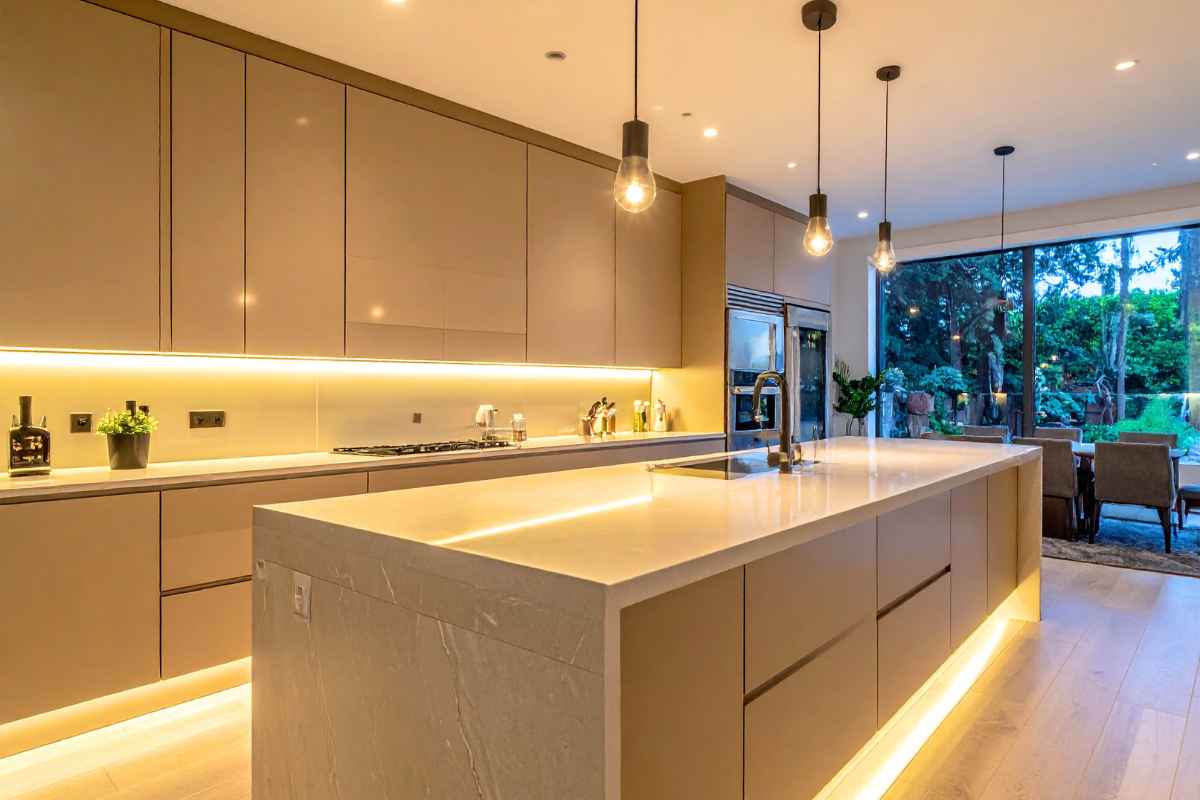
Kitchen cabinets are one of the most expensive and visually dominant choices in a remodel. They shape the room before the counters, backsplash, hardware, lighting, or appliances are even installed.
They also cover a large amount of surface area, which means a small decision made from a screen can look very different once it is repeated across an entire kitchen.
That is why designers rarely recommend ordering cabinets without samples.
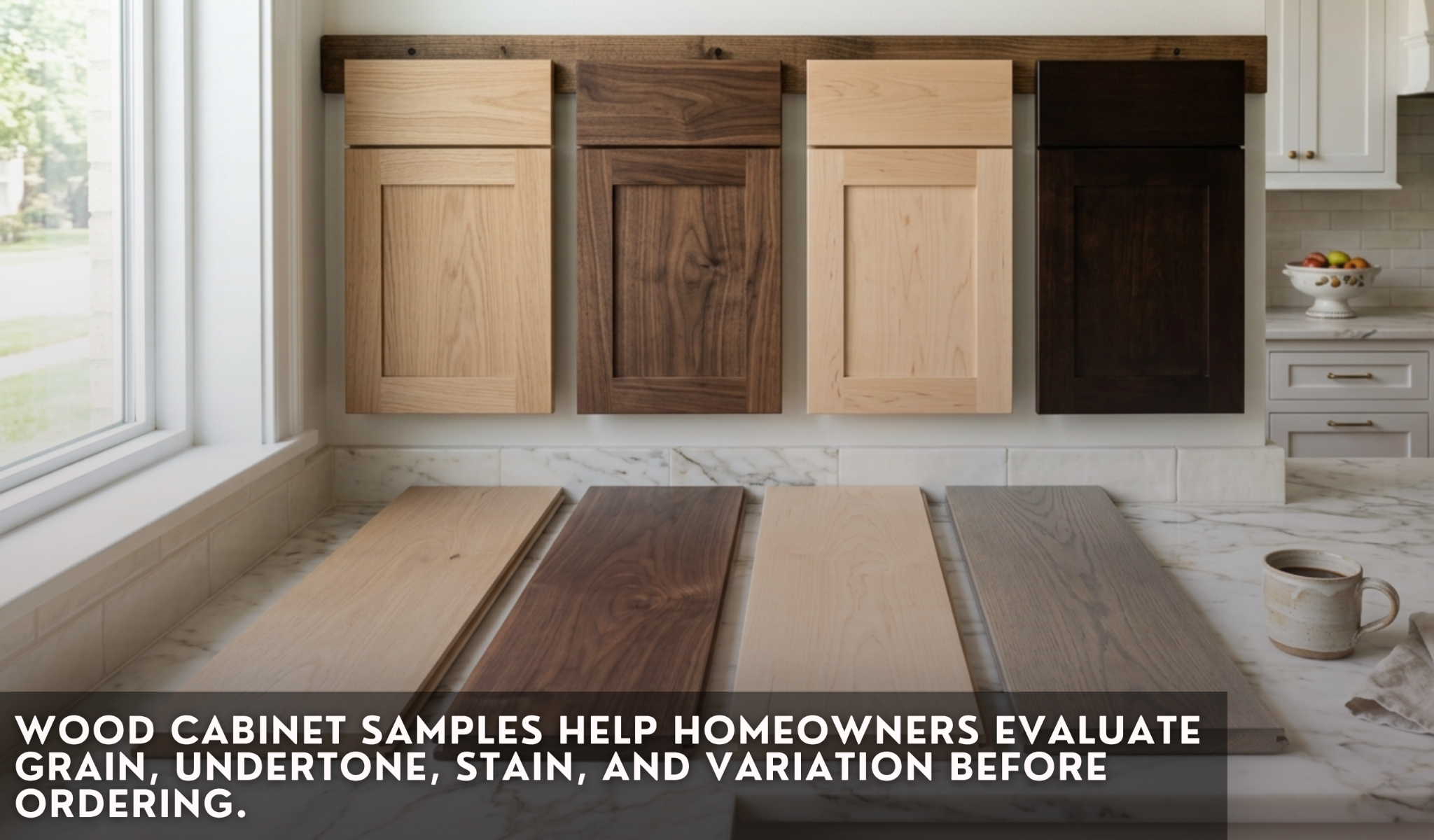
A cabinet sample may seem like a small step, but it can prevent some of the most common renovation regrets: a white finish that looks too cold, a wood tone that clashes with the floor, a painted door that feels flatter than expected, or a cabinet style that looks less refined in person than it did online.
A sample is not just a color swatch. It is a reality check for finish, grain, sheen, construction quality, and how the material behaves in the actual light of the home.
Samples help you answer practical questions before committing:
Does the cabinet color work with the floor?
Does the finish look good in natural and artificial light?
Does the wood tone clash with the countertop?
Does the door style feel too modern, too traditional, or just right?
Does the cabinet look and feel sturdy enough for daily use?
These are hard to judge from product photos alone.
Shows how color behaves in real light
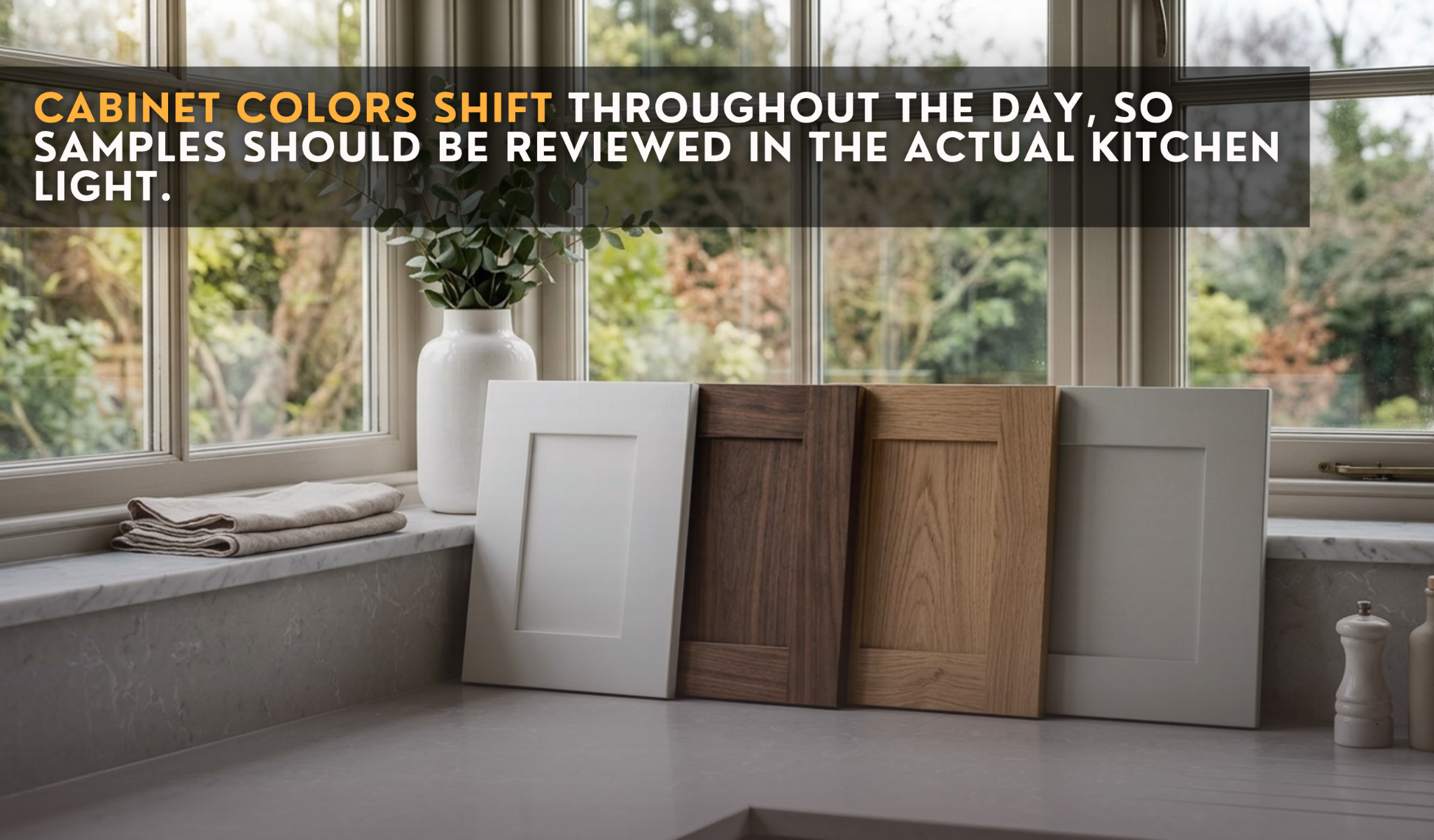
Cabinet colors do not exist in isolation. They change depending on natural light, artificial light, wall color, flooring, countertop material, and even the direction the room faces.
A warm white cabinet can look creamy in morning light and yellow under warm bulbs at night. A cool white can look crisp in a showroom and slightly gray or blue at home.
A soft greige may look balanced online, then appear muddy beside an existing floor. Dark green, navy, black, and charcoal cabinets can also shift dramatically depending on sheen and light exposure.
This matters because cabinetry is not a small accent. Once installed, the color is repeated across doors, drawers, panels, toe kicks, end panels, and trim. What feels subtle on a website can become overwhelming across an entire wall.
Designers use samples to test color at different times of day. You should do the same. Place the sample vertically, not flat on a table, because cabinet doors are viewed upright. Look at it in morning light, afternoon light, and evening light. Then compare it beside the floor, countertop, backsplash tile, wall paint, and hardware.
Wood cabinet samples reveal grain and undertone
Cabinet samples are especially valuable when the order starts online.
RTA Wood Cabinets, a long-standing name in the ready-to-assemble cabinetry space, gives homeowners a way to make those decisions with more confidence: compare finishes, review cabinet styles, and understand the kind of construction details that will shape daily use.
For renovation projects built around affordable wooden kitchen cabinets for renovations, that sample-first step can be the difference between a cabinet that looks right on a screen and one that actually works with the kitchen’s light, flooring, counters, and backsplash.
Natural wood cabinets are especially difficult to judge without a sample. Screens flatten grain, distort undertones, and hide variation. A white oak cabinet may look pale and neutral online, but in person it may read golden, beige, gray, or even slightly pink depending on the stain and finish. Walnut can range from warm chocolate to cooler brown. Maple can look clean and quiet or unexpectedly yellow.
Wood also has movement. Grain direction, cathedral patterns, rift-cut lines, knots, and variation between pieces can all influence the final kitchen. A small photograph may show one attractive cabinet front, but a full kitchen will include many doors and drawers with natural differences.
Samples help you understand whether they want a uniform look or a more organic one. This is especially important in modern kitchens where flat-panel doors, long drawer fronts, and full-height pantry walls put the wood grain on display.
A sample also helps avoid one of the most common mistakes in wood kitchens: matching the cabinets too closely to the floors. Exact matches are hard to achieve and often look slightly off. A controlled contrast usually feels more intentional.
Finish and sheen change the whole mood
Two cabinet doors in the same color can feel completely different if the finish is different. Matte finishes tend to look softer and more contemporary. Satin finishes offer a balanced middle ground. Glossy finishes reflect more light, which can be useful in small or dark kitchens, but they may also show fingerprints, dust, and surface imperfections more clearly.
A sample lets you judge the finish in real conditions. Does it feel smooth or plasticky? Does it pick up fingerprints easily? Does it reflect the under-cabinet lighting in a distracting way? Does it look too flat beside a honed stone counter or too shiny beside handmade tile?
These details are difficult to judge from renderings. They become obvious when the sample is placed in the room.
Designers also pay attention to how cabinet sheen works with other surfaces. A matte cabinet beside a matte countertop and matte backsplash can look calm, but it may also feel too quiet without contrast. A satin cabinet beside glossy tile can create a more layered kitchen. The sample makes those relationships easier to see before anything is ordered.
Samples reveal construction quality
Cabinet samples are not only about appearance. They can also reveal how the cabinet is made.
A door sample may show the thickness of the material, the smoothness of the finish, the sharpness of the edges, the quality of the joinery, and whether the color is consistent across profiles and corners. Some brands also offer sample doors that show the actual finish process more accurately than a small color chip.
For cabinet lines where construction options vary, you should also ask about the cabinet box, drawer material, hinge hardware, drawer glides, face frame, door style, and soft-close mechanisms. These details influence how the kitchen feels in daily use. A cabinet can look good in a photo but feel lightweight, noisy, or poorly finished once installed.
This type of material and construction awareness is especially important in design/build decision-making where it emphasizes on moving beyond generic appearance-based advice and explaining the technical details that affect longevity, performance, and homeowner trust.
Samples prevent countertop and backsplash clashes
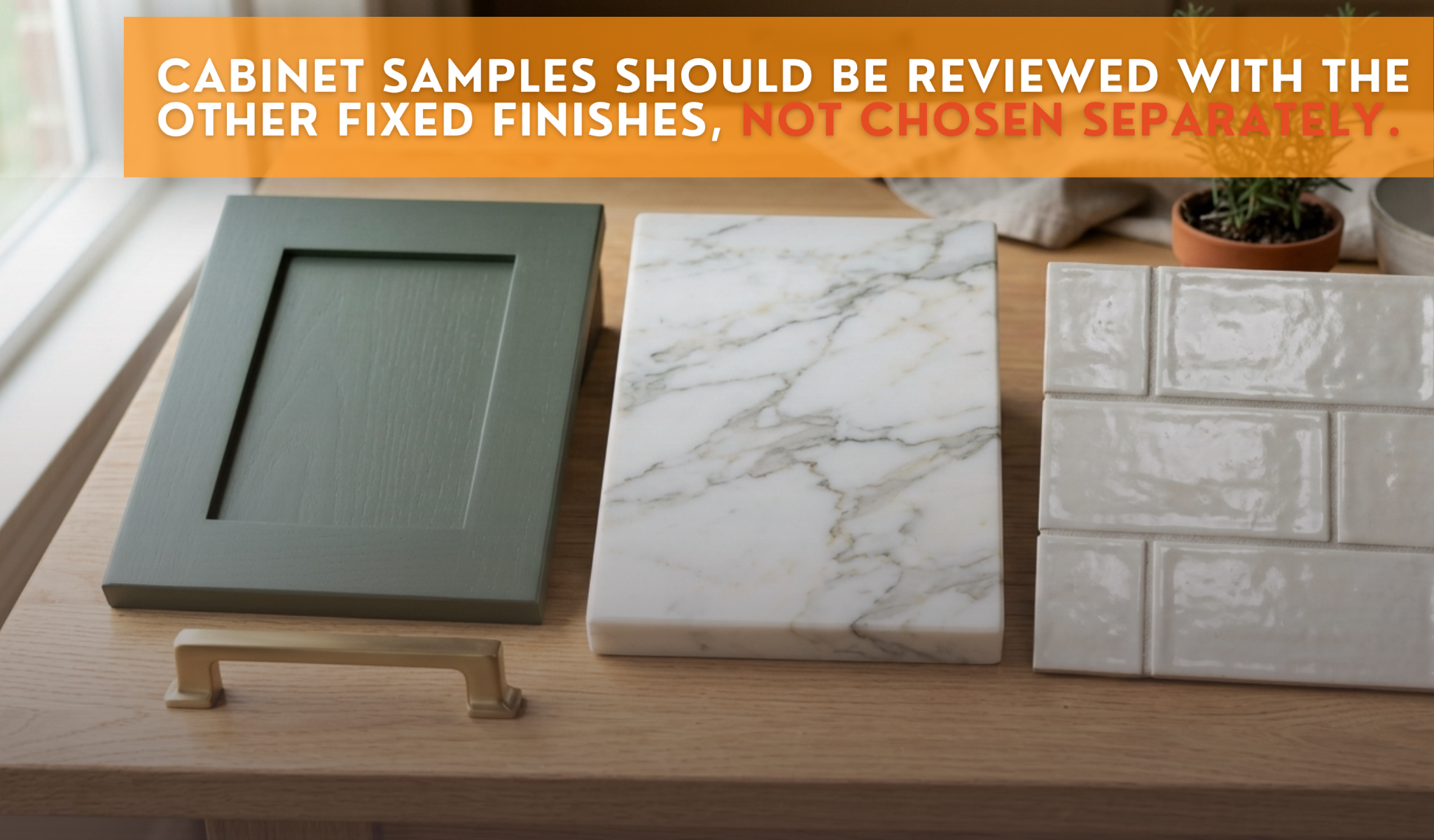
Cabinetry is usually selected before or alongside countertops and backsplash tile, but all three need to work together. A cabinet sample helps you see whether the palette is harmonious before materials are ordered.
For example, a cool white cabinet may clash with a creamy quartz. A warm oak cabinet may compete with a yellow-toned floor. A dark painted cabinet may make a heavily veined stone feel too dramatic. A glossy cabinet may fight with a glossy backsplash if both surfaces are trying to be the focal point.
Samples make these conflicts visible early.
The best approach is to build a physical palette. Place the cabinet sample with the countertop sample, backsplash tile, flooring, wall paint, and hardware finish. View them together under the kitchen’s actual lighting. If one material feels off, it is easier to adjust before the full order is placed.
This is also where scale matters. A small backsplash tile may look quiet as a single piece but busy across a wall. A cabinet finish may look subtle as a sample but strong across a full pantry run. Seeing the materials together helps the homeowner understand the balance.
Samples help confirm the door style
A cabinet color may be right, but the door style may still be wrong for the home. Samples help you see the profile, depth, edge detail, and proportions of the cabinet front.
A shaker door can feel classic, but the width of the rail matters. A very wide frame may feel traditional or heavy. A narrow shaker can feel more modern. A slab door can look sleek, but it may show fingerprints or surface imperfections more depending on finish. Raised-panel doors can suit some homes beautifully, but they may feel too formal in a compact modern kitchen.
The door sample also helps you understand shadow lines. A cabinet profile that looks minimal online may have more depth in person. Another that looked detailed in a rendering may feel too plain once viewed at full scale.
Designers often use door samples to confirm whether the cabinet style suits the architecture of the home. A kitchen does not have to match the house perfectly, but it should feel related to it.
Samples reduce ordering anxiety
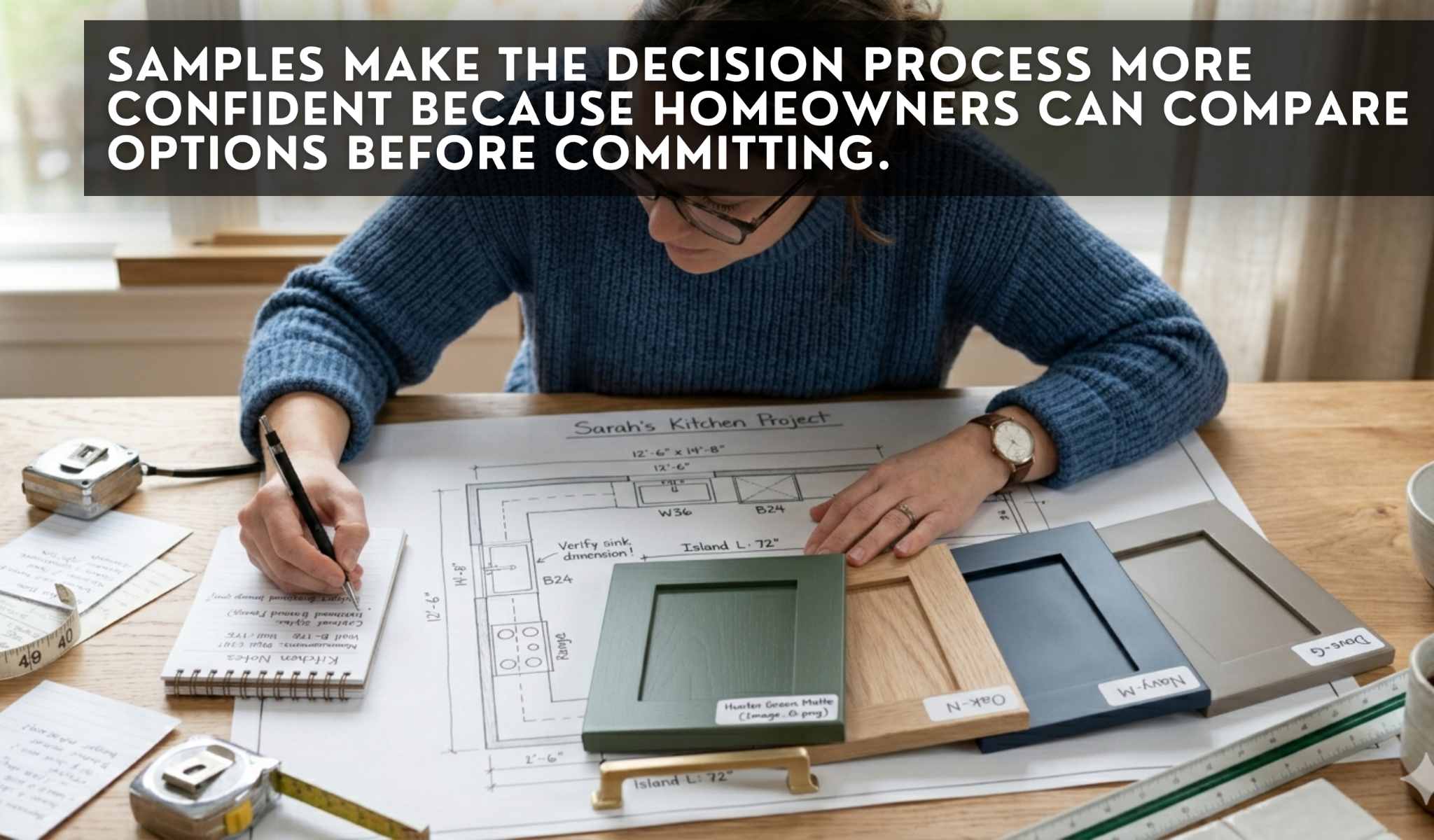
Kitchen remodels involve many expensive decisions made close together. Cabinets are one of the hardest to reverse because they affect layout, storage, appliance placement, and the entire visual direction of the room.
Samples reduce uncertainty. Instead of relying on product photos, you can compare finishes in person. They can eliminate options that look promising online but feel wrong at home. They can show samples to a designer, contractor, installer, or family member and have a more grounded conversation.
This is particularly helpful for homeowners ordering cabinets online or from a ready-to-assemble line. Without a showroom visit, samples become the physical proof point. They help bridge the gap between digital browsing and a real kitchen installation.
When cabinet samples are most important
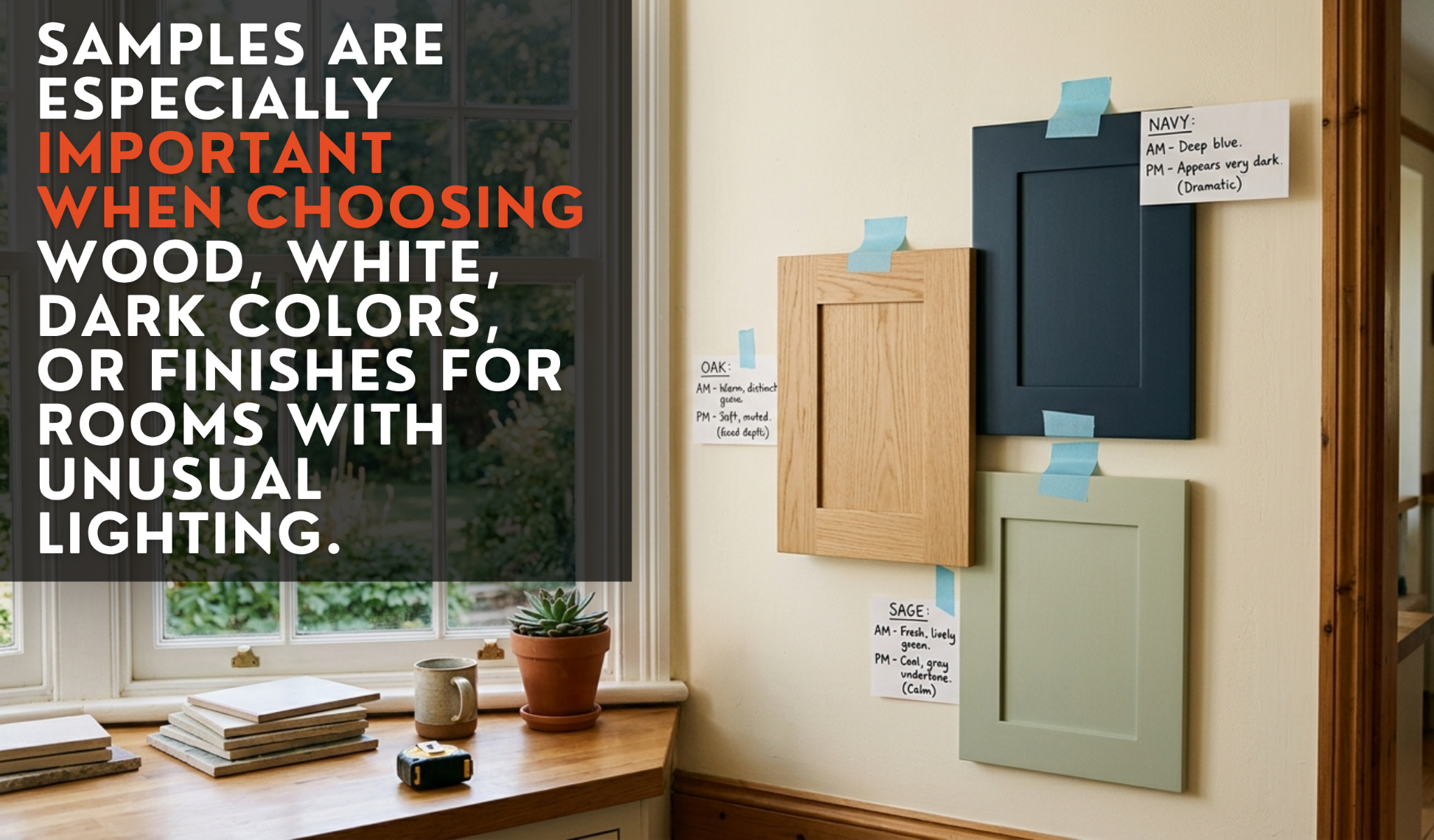
Samples are useful for every cabinet order, but they are especially important in a few situations.
They are essential for white and off-white kitchens because undertones can be hard to see online. They are important for natural wood kitchens because grain and stain variation are central to the final look. They matter in dark kitchens because sheen, dust, and fingerprints can change how the finish performs. They are also important in small kitchens, where every surface is more visible and a wrong undertone can make the room feel cramped or mismatched.
Samples are also valuable when the kitchen connects visually to other rooms. In open-plan homes, the cabinet color may need to work with living room flooring, dining furniture, wall paint, and natural light from several directions.
How to evaluate kitchen cabinet samples
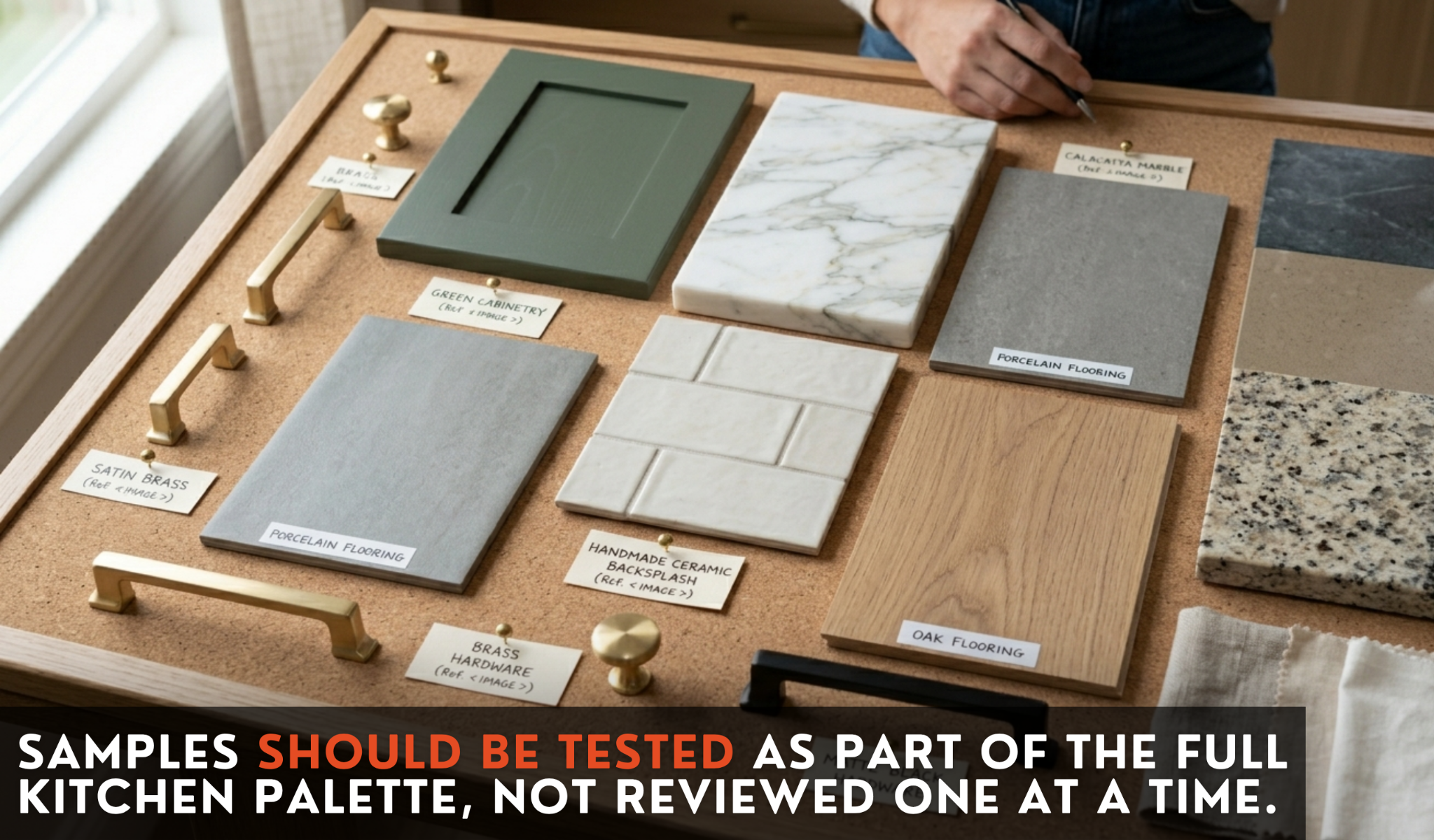
The best way to evaluate cabinet samples is to treat them like a design tool, not a formality.
Start by ordering more than one option. Even if you feel confident about a finish, a close alternative can clarify the decision. Compare a warm white with a cooler white, a pale oak with a medium oak, or a matte finish with a satin finish.
Next, move the samples around the kitchen. Place them near windows, under overhead lighting, beside the existing floor, and against the wall where the cabinets will be installed. Review them at different times of day.
Then compare them with all fixed finishes. Cabinetry should be viewed with counters, tile, flooring, hardware, appliances, and paint. A finish that looks beautiful alone may not be the right finish for the room.
Finally, pay attention to feel. Open and close the sample door if hardware is included. Look at the edge detail. Check whether the finish feels durable. Notice whether fingerprints show quickly. These small observations can prevent larger disappointments later.
Final takeaway
Designers recommend cabinet samples because kitchens are too permanent, too expensive, and too visually dominant to be planned from photos alone.
A sample shows what a screen cannot: undertone, grain, sheen, texture, edge detail, construction quality, and how the cabinet works with the rest of the room. It also gives you a chance to slow down before committing to one of the biggest purchases in a kitchen remodel.
The right cabinet sample confirms a direction. It helps the kitchen feel intentional, durable, and suited to the home rather than assembled from guesses.
For homeowners planning a kitchen renovation, remodelling, ordering samples is not an extra step. It is one of the simplest ways to protect the entire design.

Comments ()