
Bed Bug Treatment in India: Cost, Why It Takes Two Visits & What Actually Works
Bed bug treatment cost in India 2026 by home size, why two visits are standard (not a failure), heat vs chemical, prep steps, and how to stop them coming back.
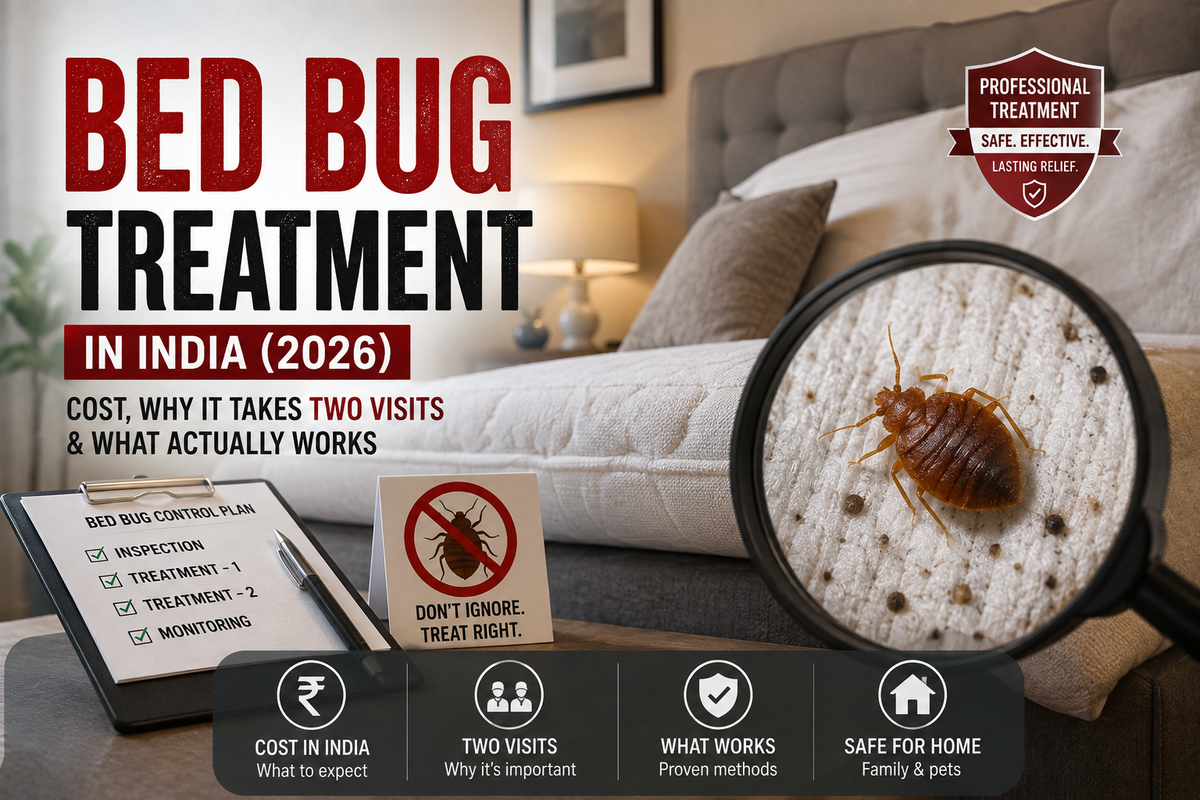
Bed bug treatment in India costs ₹1,000–₹1,500 per room or roughly ₹1,500–₹4,000 for a typical home in 2026, with branded providers starting around ₹3,690. Almost every treatment needs two visits spaced about 15 days apart — not because the first failed, but because bed bug eggs hatch 6–10 days after being laid and most chemicals don't kill eggs. The second visit clears the newly hatched bugs and breaks the breeding cycle. DIY rarely works because bed bugs hide deep in seams and cracks and can survive up to a year without feeding.
Bed bug treatment cost in India (2026) runs about ₹1,000–₹1,500 per room, ₹1,500–₹4,000 for a typical home, with branded/licensed providers starting near ₹3,690. The defining feature is that treatment almost always needs two visits about 15 days apart: bed bug eggs hatch 6–10 days after laying and most chemical treatments don't penetrate eggs, so a follow-up timed to the hatch cycle is standard protocol, not a sign of failure. Bed bugs are hard to eliminate because they hide deep in mattress seams, furniture and cracks, adults can survive up to a year without feeding, and pyrethroid resistance is documented. Heat treatment kills all life stages including eggs in one session but is costlier; chemical treatment is cheaper per visit but needs the follow-up. DIY on high-heat (clothes dryer, steam) helps for clothing and small items but rarely clears a room infestation. Mattress encasements after treatment prevent reinfestation.
Why Bed Bugs Are The Worst Pest To DIY
Most pests are a nuisance you can chip away at. Bed bugs are different, and worse — because they bite you in your sleep, hide where you can't see them, and are genuinely hard to kill.
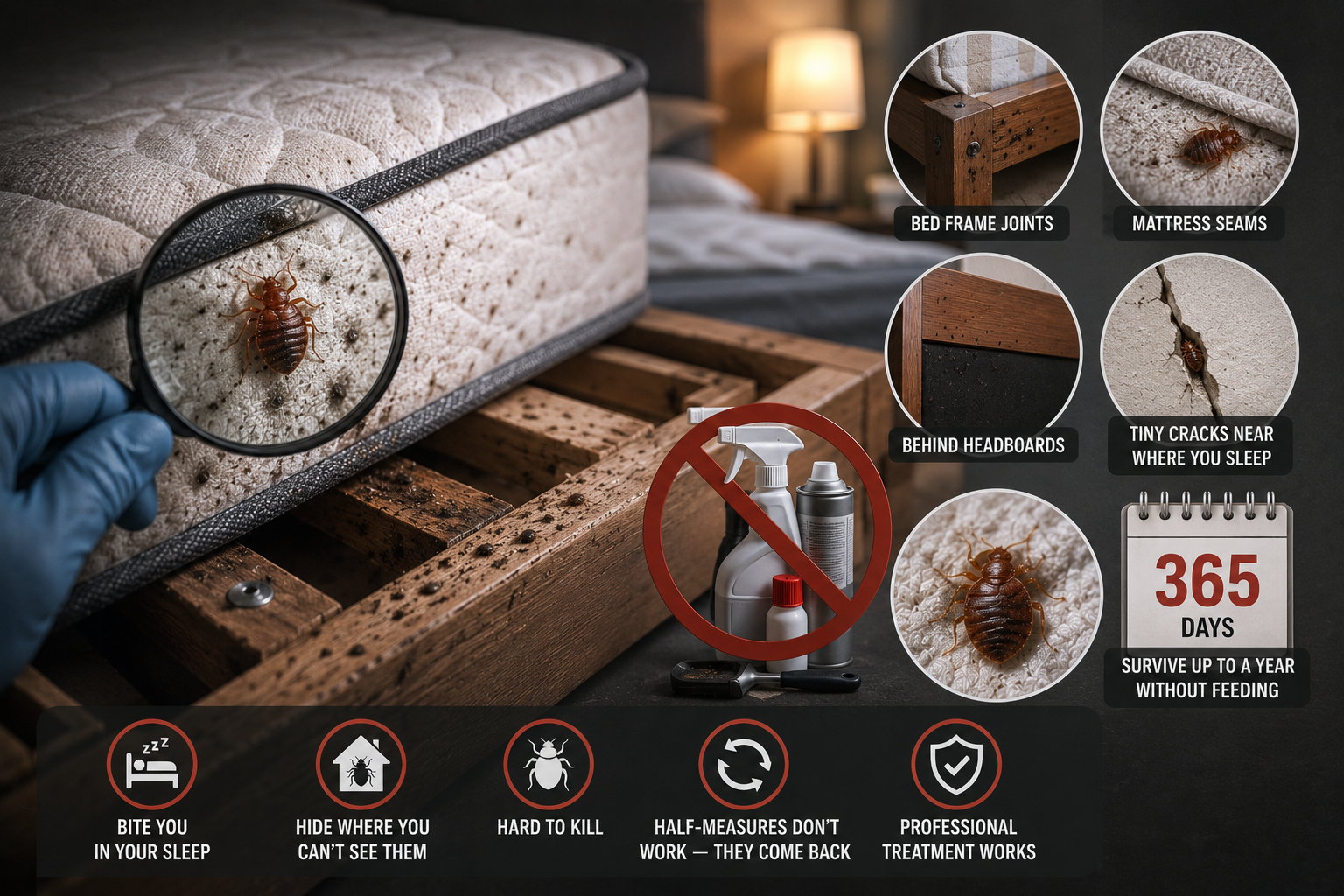
They're small, flat, and expert at hiding in the seams of your mattress, the joints of your bed frame, behind headboards, and in tiny cracks near where you sleep. Worse, adults can survive up to a year without feeding — so a half-measure doesn't starve them out; it just buys time for the infestation to come back. That combination is why DIY is largely "thrown out of the window" for a real infestation, and why understanding the process matters more here than with any other household pest.
Signs You Have Bed Bugs
- Bites in a line or cluster, often on arms, shoulders or legs, appearing overnight — red, itchy, sometimes swollen.
- Tiny dark spots (droppings) on sheets, mattress seams or the bed frame.
- Small blood smears on bedding.
- Live bugs — reddish-brown, apple-seed-sized — in mattress seams, box springs, headboard joints and nearby cracks.
- A sweetish, musty smell in heavy infestations.
- Shed skins or tiny pale eggs in seams and crevices.
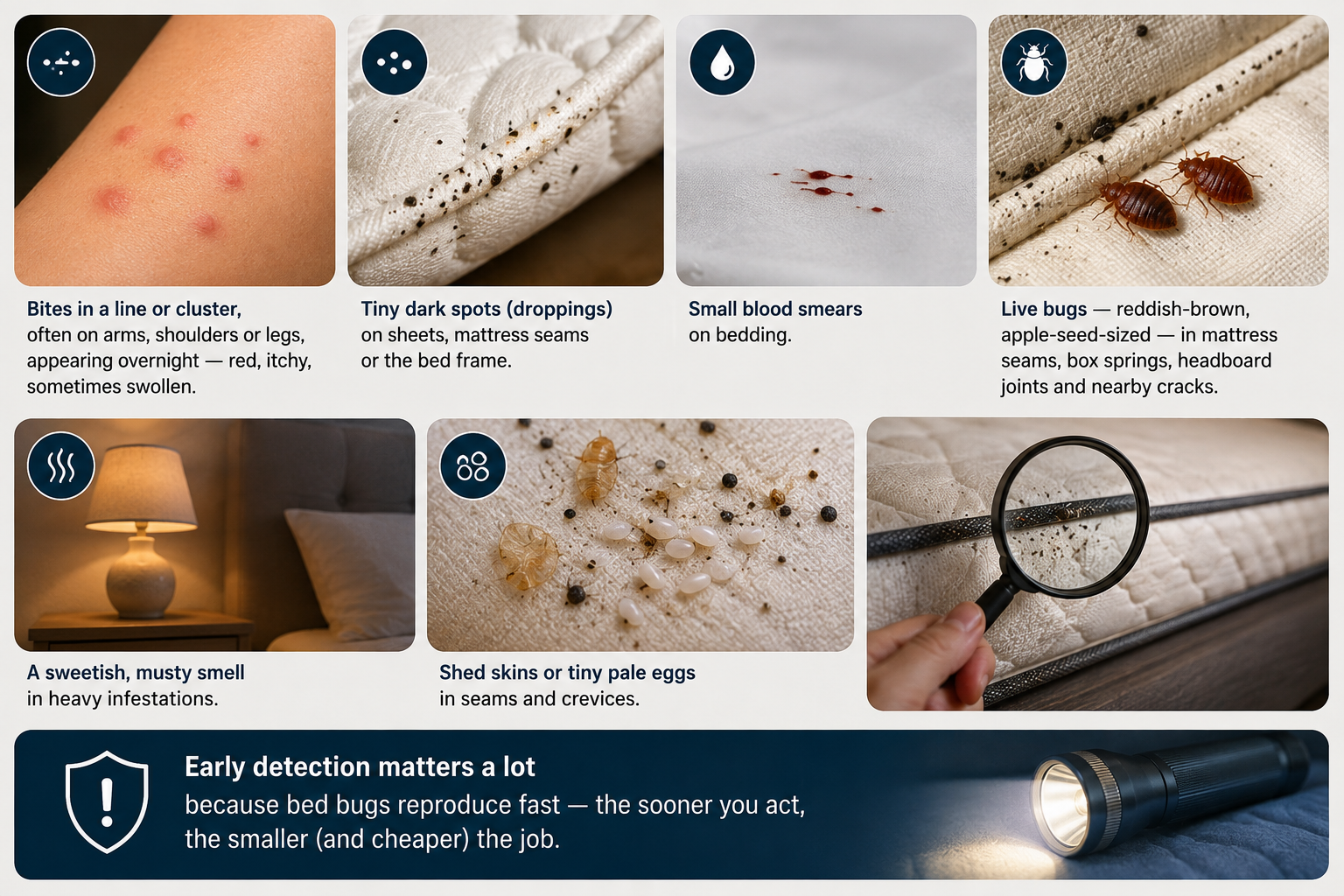
Early detection matters a lot because bed bugs reproduce fast — the sooner you act, the smaller (and cheaper) the job.
What It Costs In 2026
| Scope | Typical 2026 cost |
|---|---|
| Per room / per mattress | ₹1,000–₹1,500 |
| 1 BHK | ₹1,350–₹2,250 |
| 2 BHK | ₹1,750–₹2,900 |
| 3 BHK (furnished) | ₹2,250–₹3,750 |
| Typical home range | ₹1,500–₹4,000 |
| Branded / licensed providers | from ~₹3,690 |
What moves the price: the number of rooms and mattresses, how furnished the home is (more furniture = more hiding places = more work), infestation severity, and the provider's chemicals and licensing. Branded providers using reputed chemicals and full government licensing price higher — sometimes worth it for a stubborn infestation, since a failed cheap treatment just lets the problem rebuild.
Most quotes are calculated per room or per mattress, so the cost scales with how much of the home is affected. Catching it in one room is dramatically cheaper than letting it spread.
Why It Always Takes Two Visits
This is the single most important thing to understand — and the thing that stops people wrongly thinking their treatment failed.
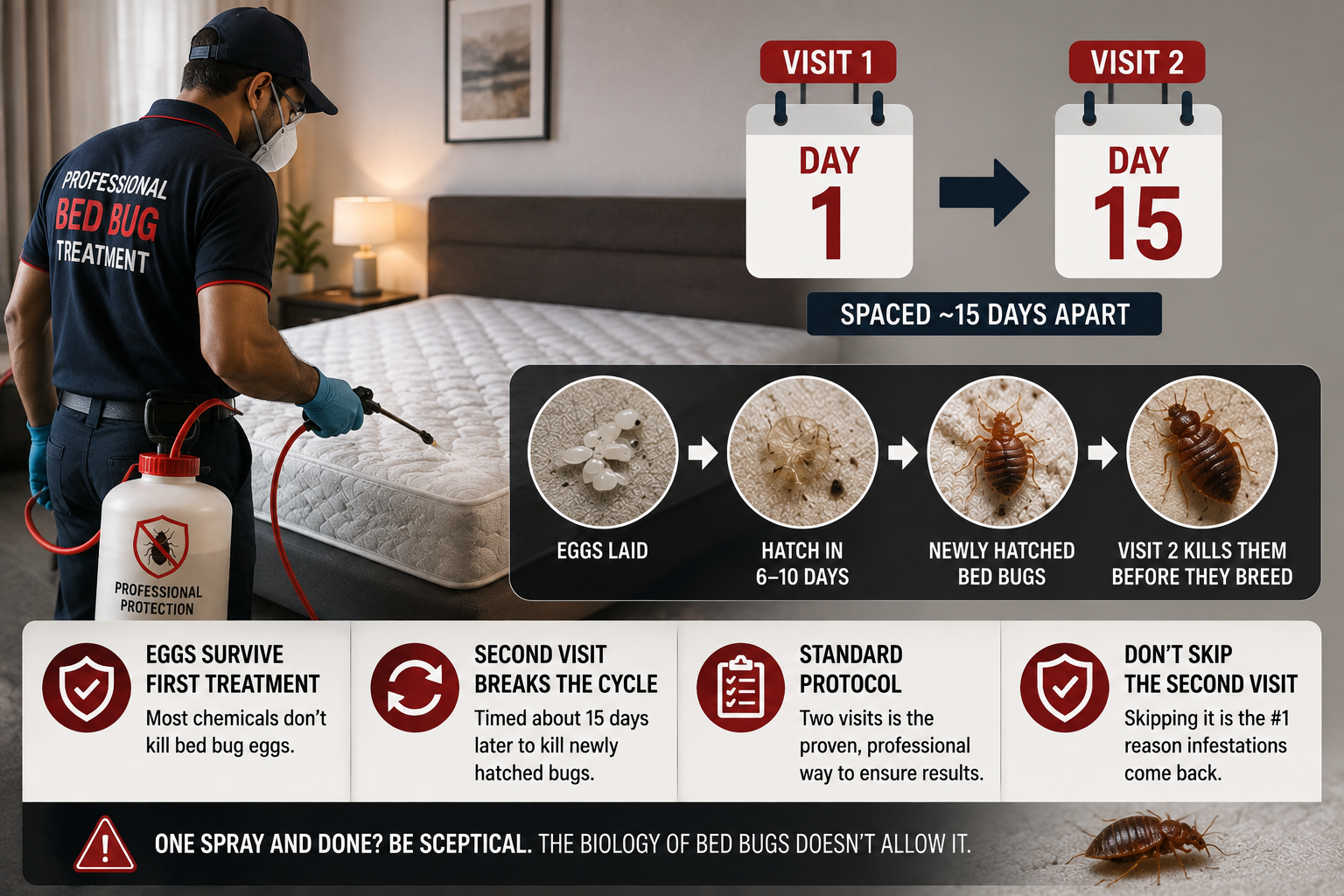
Bed bug eggs hatch 6–10 days after being laid, and most chemical treatments don't kill the eggs. So a second visit, timed about 15 days after the first, is needed to kill the newly hatched bugs before they can breed. This follow-up is standard protocol, not a sign the first treatment failed.
A professional bed bug treatment in India therefore mandates a minimum of two visits spaced about 15 days apart to break the breeding cycle. If a provider promises "one spray and done" for anything beyond the mildest case, be sceptical — the biology doesn't allow it. And critically: don't skip the second visit because things look better after the first. The survivors from unhatched eggs are exactly what causes a "cured" infestation to roar back a month later.
Heat Vs Chemical
There are two main professional approaches:
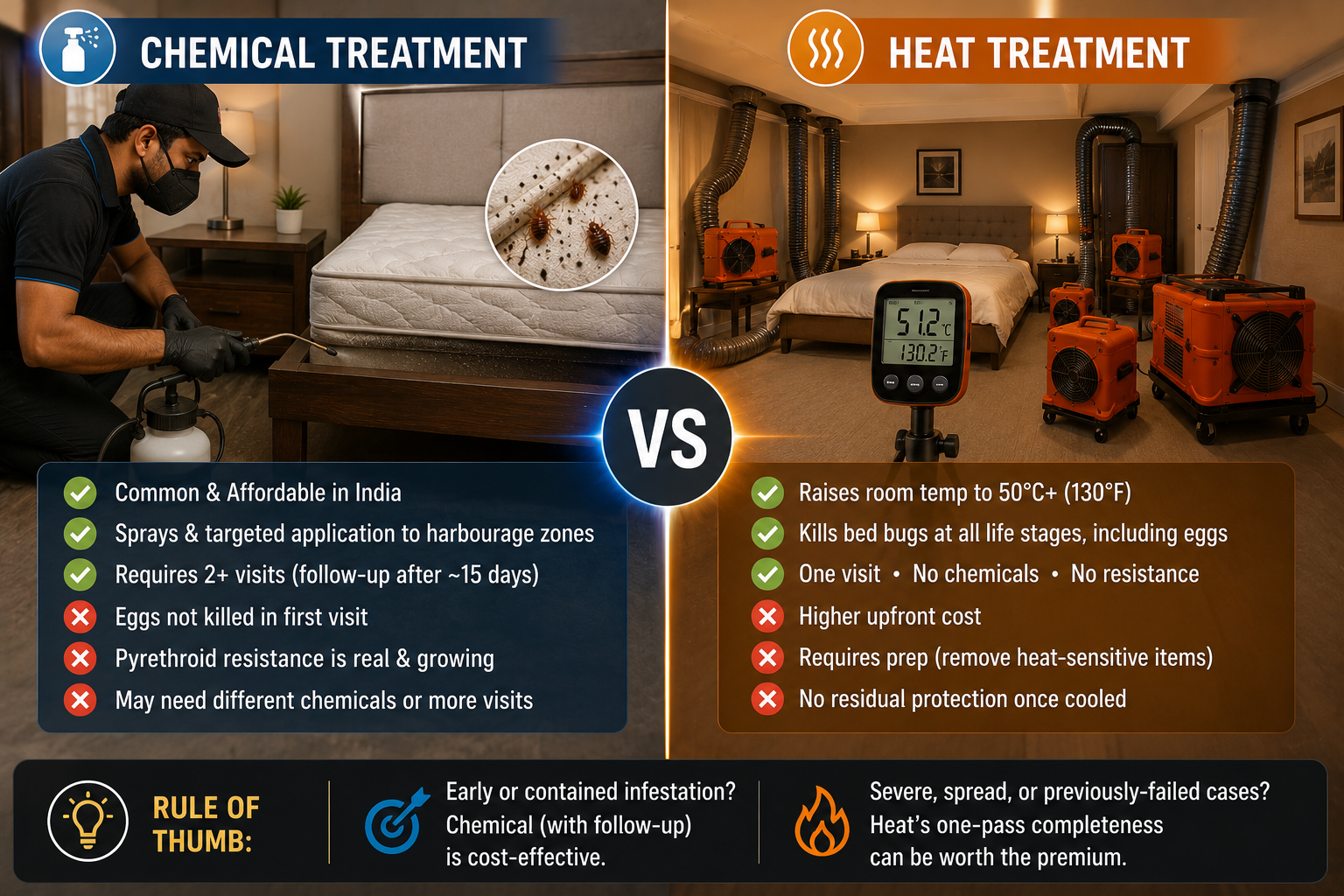
Chemical treatment — the common, affordable method in India. Sprays and targeted application to harbourage zones, plus the mandatory follow-up. Cheaper per visit, but needs 2+ visits, and there's a real-world catch: pyrethroid resistance is documented and growing, so some infestations shrug off standard chemicals and need a different chemical class or more visits.
Heat treatment — industrial heaters raise the room to a lethal temperature (around 50°C+/130°F) that kills bed bugs at every life stage, including eggs, in a single session. Its advantages: one visit, no chemicals, and bed bugs cannot develop resistance to lethal heat — it's physics, not chemistry. The trade-offs: higher upfront cost, more prep (heat-sensitive items like aerosols, candles, some electronics and certain plastics must be removed), and no residual protection once the room cools. Heat is less common in Indian residential settings but worth asking about for severe or resistant infestations.
Rule of thumb: for a contained early infestation, chemical (with the follow-up) is cost-effective. For severe, spread, or previously-failed cases, heat's one-pass completeness can be worth the premium.
What You Can Do Yourself (And What You Can't)
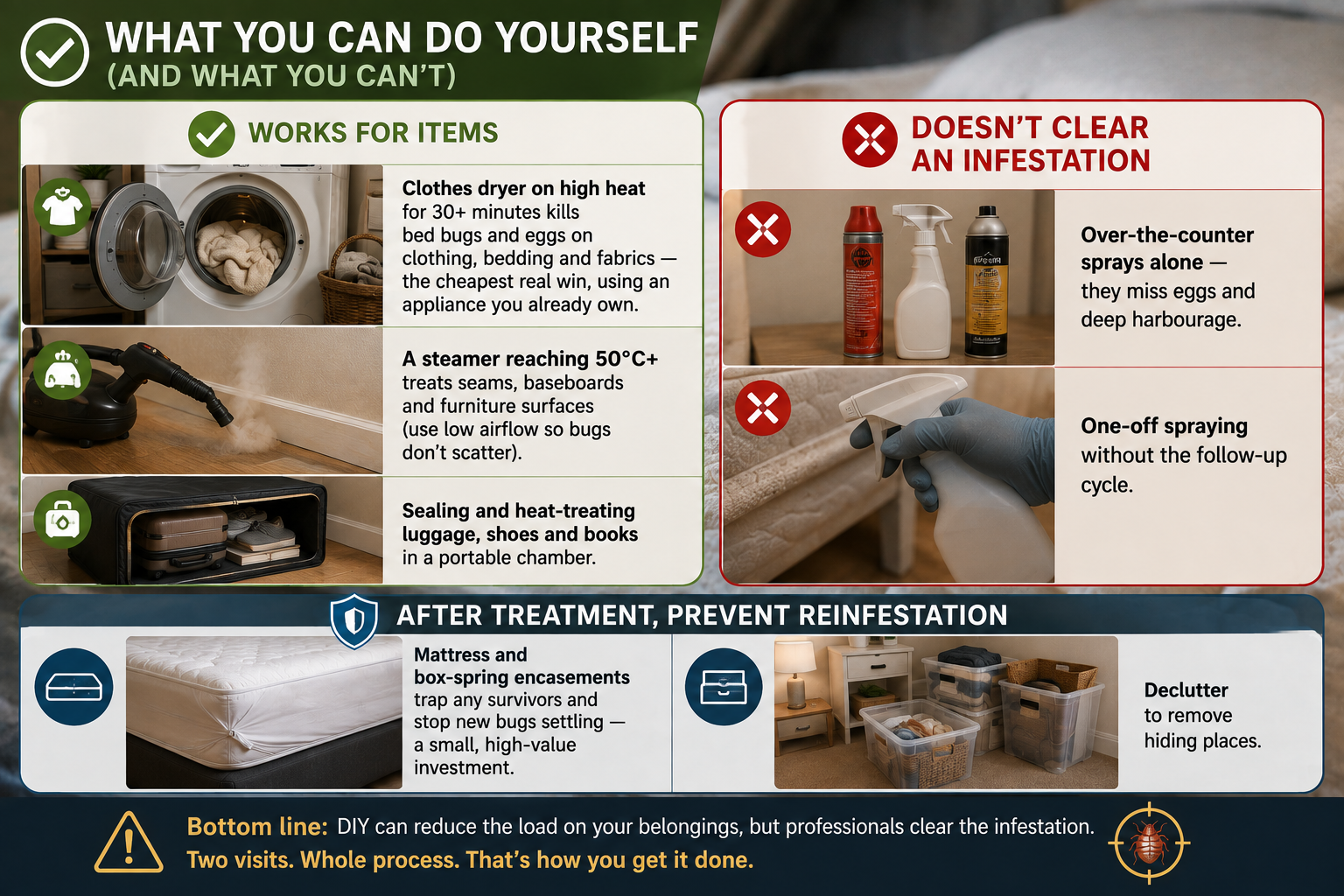
DIY won't clear a room infestation, but some high-heat methods genuinely help for belongings and reduce the load before a pro arrives:
Works for items:
- Clothes dryer on high heat for 30+ minutes kills bed bugs and eggs on clothing, bedding and fabrics — the cheapest real win, using an appliance you already own.
- A steamer reaching 50°C+ treats seams, baseboards and furniture surfaces (use low airflow so bugs don't scatter).
- Sealing and heat-treating luggage, shoes and books in a portable chamber.
Doesn't clear an infestation:
- Over-the-counter sprays alone — they miss eggs and deep harbourage.
- One-off spraying without the follow-up cycle.
After treatment, prevent reinfestation:
- Mattress and box-spring encasements trap any survivors and stop new bugs settling — a small, high-value investment.
- Declutter to remove hiding places.
How To Prepare For Treatment
Doing prep yourself makes treatment more effective (and can lower cost):
- Launder all bedding, clothing and fabrics on high heat and dry hot; bag them sealed afterward.
- Declutter the room — fewer hiding spots means better results.
- Vacuum mattress seams, frame and surrounding floor, then dispose of the bag sealed.
- Pull furniture slightly from walls for access.
- Keep children and pets out during and after chemical application per the technician's re-entry guidance (see the parent Pest Control Guide for safety detail).
- Don't move items to another room — that just spreads the infestation.
Key Takeaways
- Bed bug treatment: ₹1,000–₹1,500/room, ₹1,500–₹4,000/home; branded from ~₹3,690.
- Two visits ~15 days apart is standard — eggs hatch 6–10 days later and chemicals miss them.
- Don't skip the second visit — survivors from unhatched eggs cause the comeback.
- Heat kills all stages in one pass with no resistance; chemical is cheaper but needs the follow-up.
- Pyrethroid resistance is real — stubborn cases may need a different approach.
- DIY high-heat (dryer/steam) helps for items but won't clear a room.
- Mattress encasements after treatment prevent reinfestation.
Myth Vs Fact
| Myth | Fact |
|---|---|
| "One spray will clear bed bugs." | Eggs survive most sprays; two visits ~15 days apart are standard to break the cycle. |
| "A second visit means the first failed." | It's protocol — timed to the egg hatch, not a failure. |
| "I can DIY a bed bug infestation." | DIY helps for items via heat, but rarely clears a room; they hide too deep. |
| "If bites stop, they're gone." | Survivors from unhatched eggs rebuild; complete the full treatment cycle. |
| "Bed bugs die off if I just leave the room empty." | Adults survive up to a year without feeding — waiting doesn't work. |
| "Any chemical will kill them." | Pyrethroid resistance is documented; some cases need heat or a different class. |
Common Mistakes
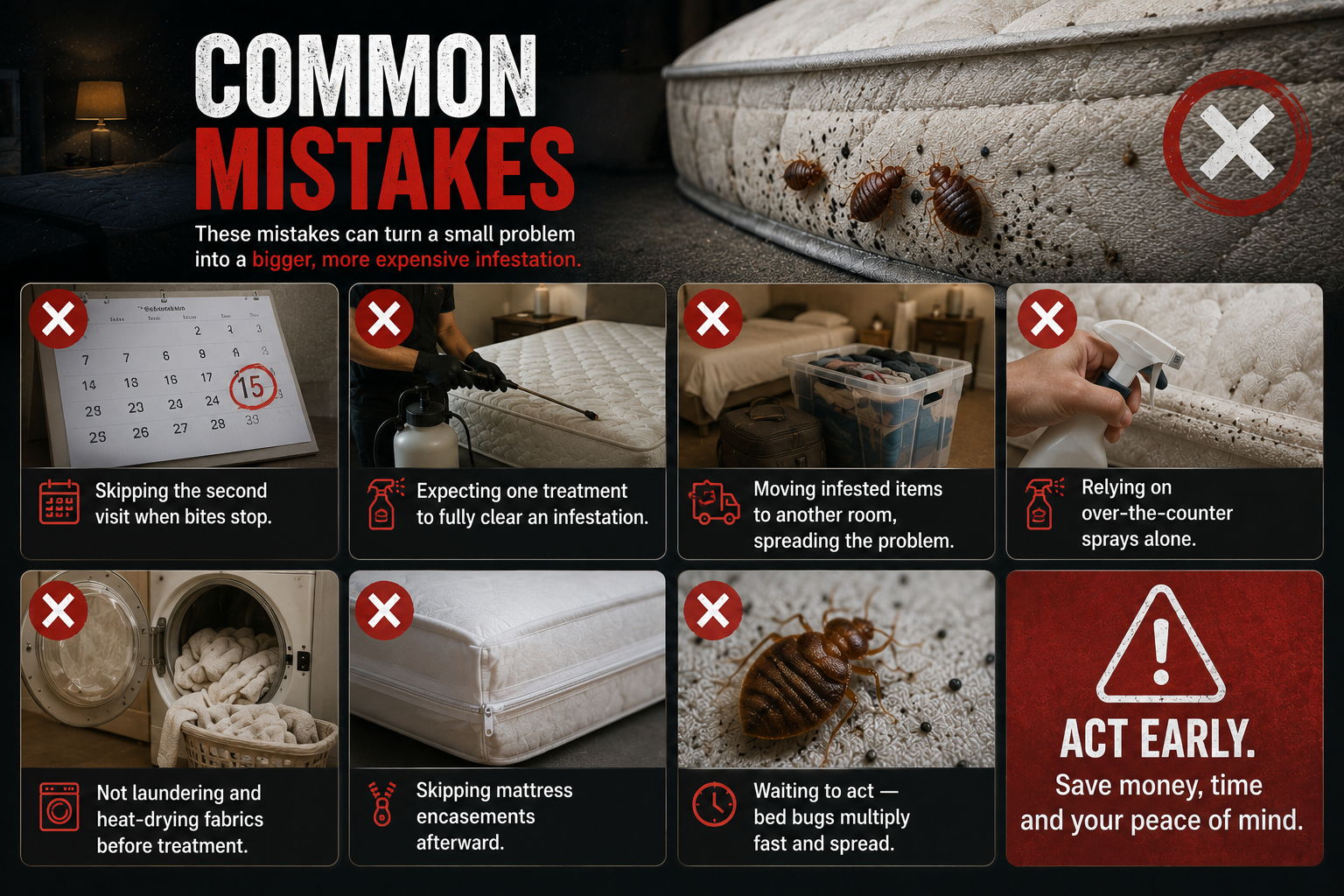
- Skipping the second visit when bites stop.
- Expecting one treatment to fully clear an infestation.
- Moving infested items to another room, spreading the problem.
- Relying on over-the-counter sprays alone.
- Not laundering and heat-drying fabrics before treatment.
- Skipping mattress encasements afterward.
- Waiting to act — bed bugs multiply fast and spread.
Comments ()