
Grout & Tile Cleaning in India (2026): Clean, Seal, Recolour or Regrout — What Yours Actually Needs
Dingy grout making clean tiles look dirty? The 2026 guide to cleaning, sealing, recolouring and regrouting — what your grout needs, cost, and why sealing matters.
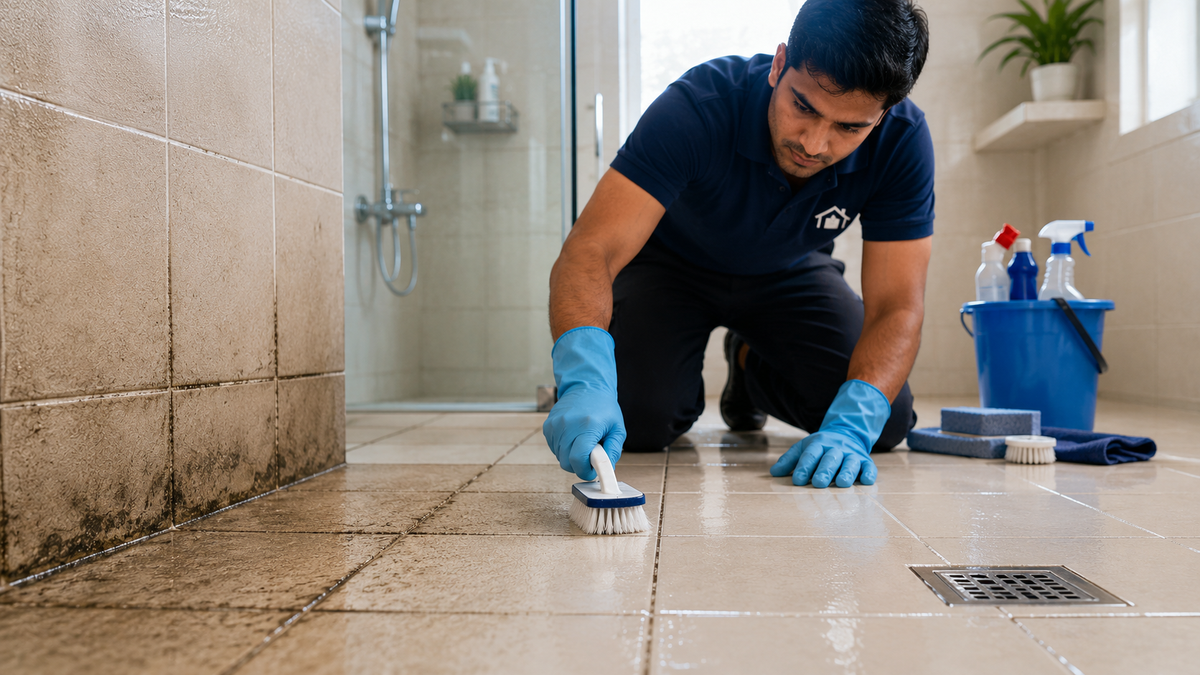
Dingy grout is what makes clean tiles look dirty, and there are four escalating fixes depending on its condition: clean (removes surface dirt and mild stains), seal (protects porous grout from re-absorbing dirt — do this after every deep clean), recolour (a colourant that covers permanent stains and acts as a sealer), and regrout (replace grout that's cracked or crumbling). Professional cleaning and sealing is far cheaper than regrouting or replacing tiles. Grout should be cleaned every 6–12 months and sealed after each deep clean, sooner in high-traffic kitchens and bathrooms.
Grout and tile cleaning in India (2026) follows an escalation ladder based on grout condition: (1) clean — steam or hand-scrub with pre-treatment to lift surface dirt and mild stains; (2) seal — apply a penetrating sealer, essential after every deep clean because bare grout is porous and re-absorbs dirt, moisture and mould immediately; (3) recolour — a grout colourant that covers permanent staining and also acts as a sealer, for grout that won't come clean; (4) regrout — remove and replace grout that's cracked, crumbling or beyond restoration. Cleaning and sealing is far cheaper than recolouring or regrouting, which is cheaper than replacing tiles, so the goal is to catch grout early. Steam cleaning suits most ceramic and vitrified tile but can damage unsealed natural stone and some grout adhesives, so confirm compatibility first. Grout darkens fastest in high-traffic, moist areas (kitchen, bathroom), so clean every 6–12 months and seal after each deep clean. Professional cleaning and sealing is often bundled and takes one to three hours per room.
WHY DINGY GROUT RUINS A CLEAN ROOM
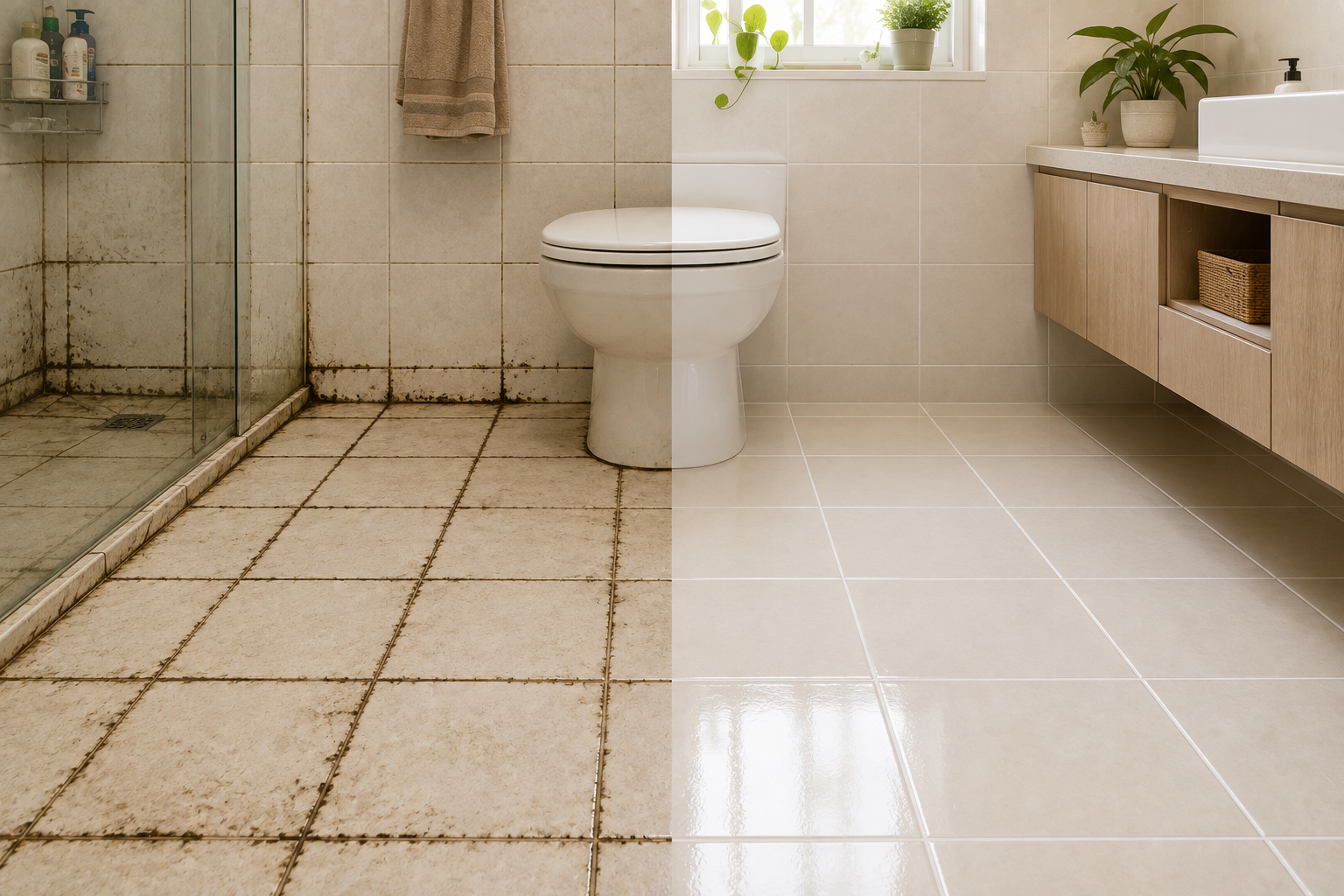
You mop the floor, wipe the tiles, and the room still looks dirty. The culprit is almost always the grout — those lines between the tiles. Grout is the unsung hero of every tiled surface and also the part that gets dirty, stained and worn fastest. It's porous, so it soaks up dirt, spills, mildew and grime, darkening over time until even spotless tiles look dingy.
The good news: you rarely need to replace anything. Restoring grout is far cheaper than re-tiling — and this guide shows you the four escalating fixes (clean → seal → recolour → regrout), how to tell which one your grout needs, and why the sealing step is the one everyone skips and shouldn't.
THE ESCALATION LADDER: WHAT DOES YOUR GROUT NEED?
Think of grout care as four rungs. Start at the bottom; go up only as far as the condition demands.
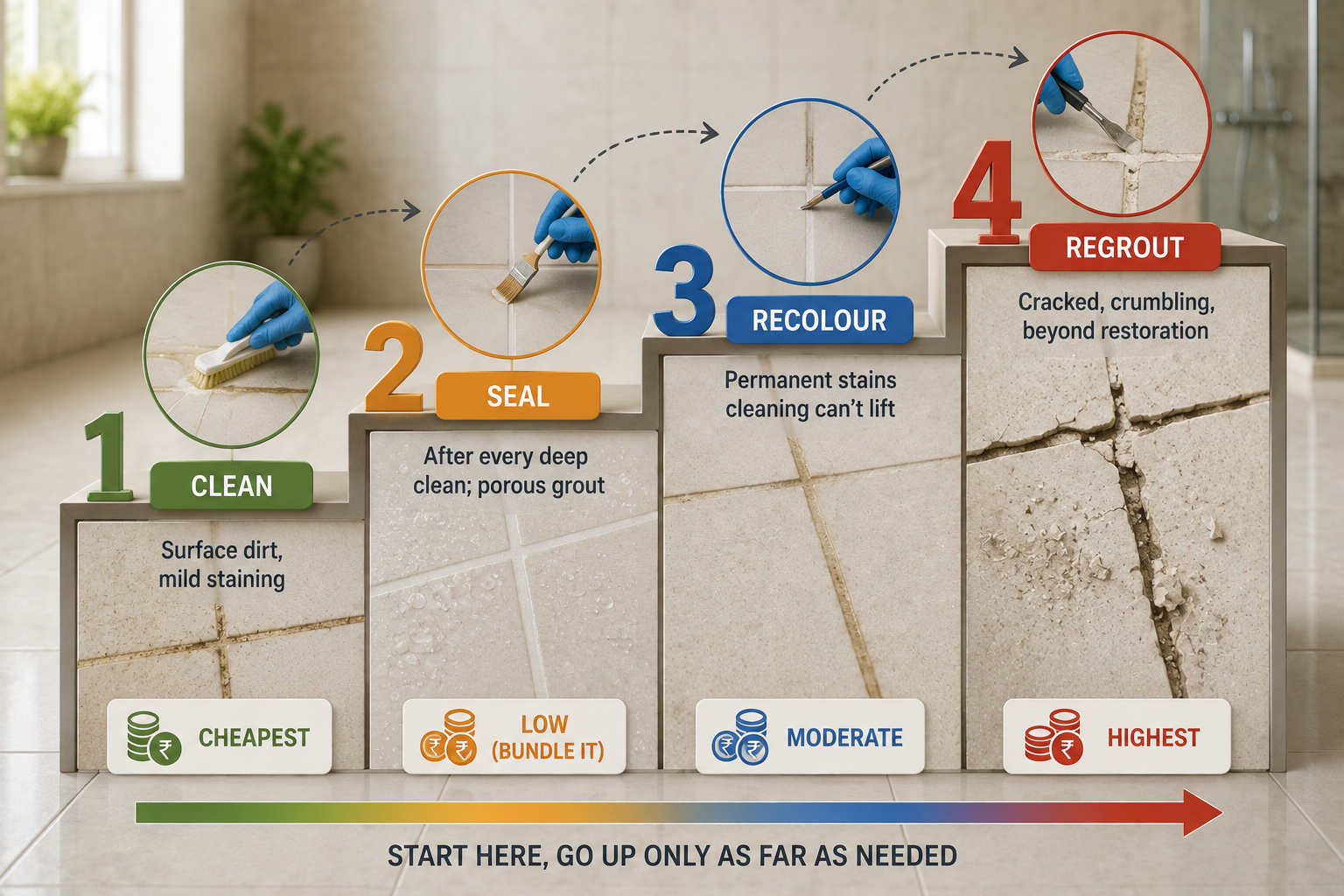
| Rung | Fix | When you need it | Relative cost |
|---|---|---|---|
| 1 | Clean | Surface dirt, mild staining | Cheapest |
| 2 | Seal | After every deep clean; porous grout | Low (bundle it) |
| 3 | Recolour | Permanent stains cleaning can't lift | Moderate |
| 4 | Regrout | Cracked, crumbling, beyond restoration | Highest |
The principle: most homes only need rungs 1 and 2 (clean + seal). Recolouring and regrouting are for grout that's genuinely damaged or permanently stained. Diagnosing correctly saves you from over-paying for a regrout when a clean-and-seal would have done — or from repeatedly cleaning grout that actually needs recolouring.
RUNG 1: CLEANING
The first and most common fix. Professional tile-and-grout cleaning follows a clear process:
- Inspection — the technician identifies problem areas and tile/grout type.
- Pre-treatment — cleaners applied to break down dirt and stains.
- Deep cleaning — brushes or steam scrub the tiles and grout lines.
- Extraction — dirty water and residue removed.
- Sealing — a protective sealer applied to the grout (rung 2 — see below).
- Final inspection — missed spots addressed.
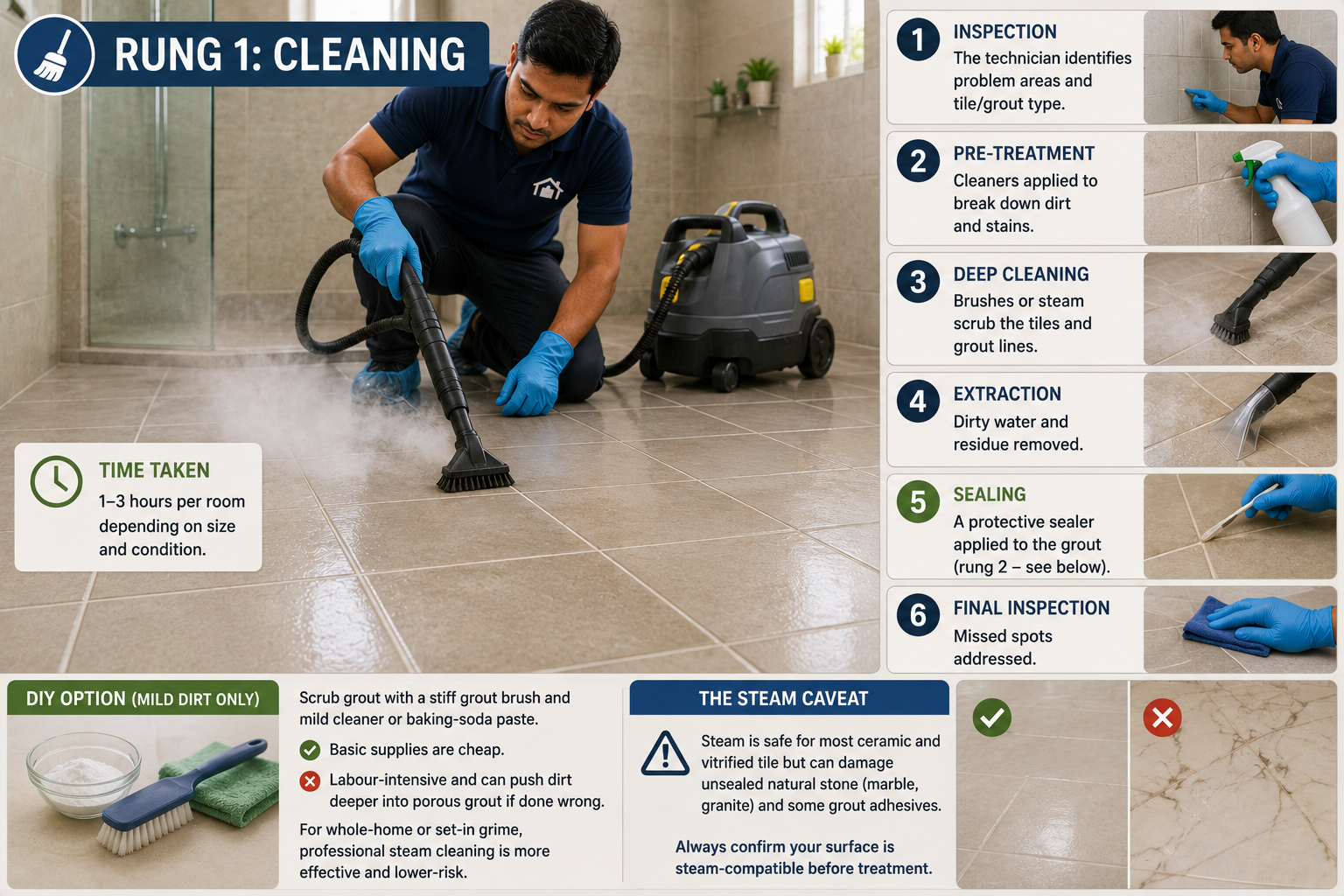
It takes about 1–3 hours per room depending on size and condition. Steam cleaning is highly effective — high-temperature steam breaks down grime without heavy chemicals — but with one important caveat (below).
DIY option: for mild dirt you can scrub grout yourself with a stiff grout brush and a mild cleaner or a baking-soda paste. Basic supplies are cheap. But hand-scrubbing is labour-intensive and, done wrong, can push dirt deeper into porous grout — so for whole-home or set-in grime, professional steam cleaning is more effective and lower-risk. (See the bathroom deep cleaning guide for the descaling that pairs with grout cleaning in wet areas.)
The steam caveat
Steam is safe for most ceramic and vitrified tile but can damage unsealed natural stone (marble, granite) and some grout adhesives. Always confirm your surface is steam-compatible before treatment — or use hand cleaning on natural stone.
RUNG 2: SEALING (THE STEP EVERYONE SKIPS)
Here's the most important, most overlooked fact about grout: you should seal it after every deep clean.
Why? Because grout is porous. The moment you've cleaned it back to fresh, bare grout immediately starts re-absorbing dirt, moisture, soap scum and mould again. A penetrating sealer forms an invisible barrier that:
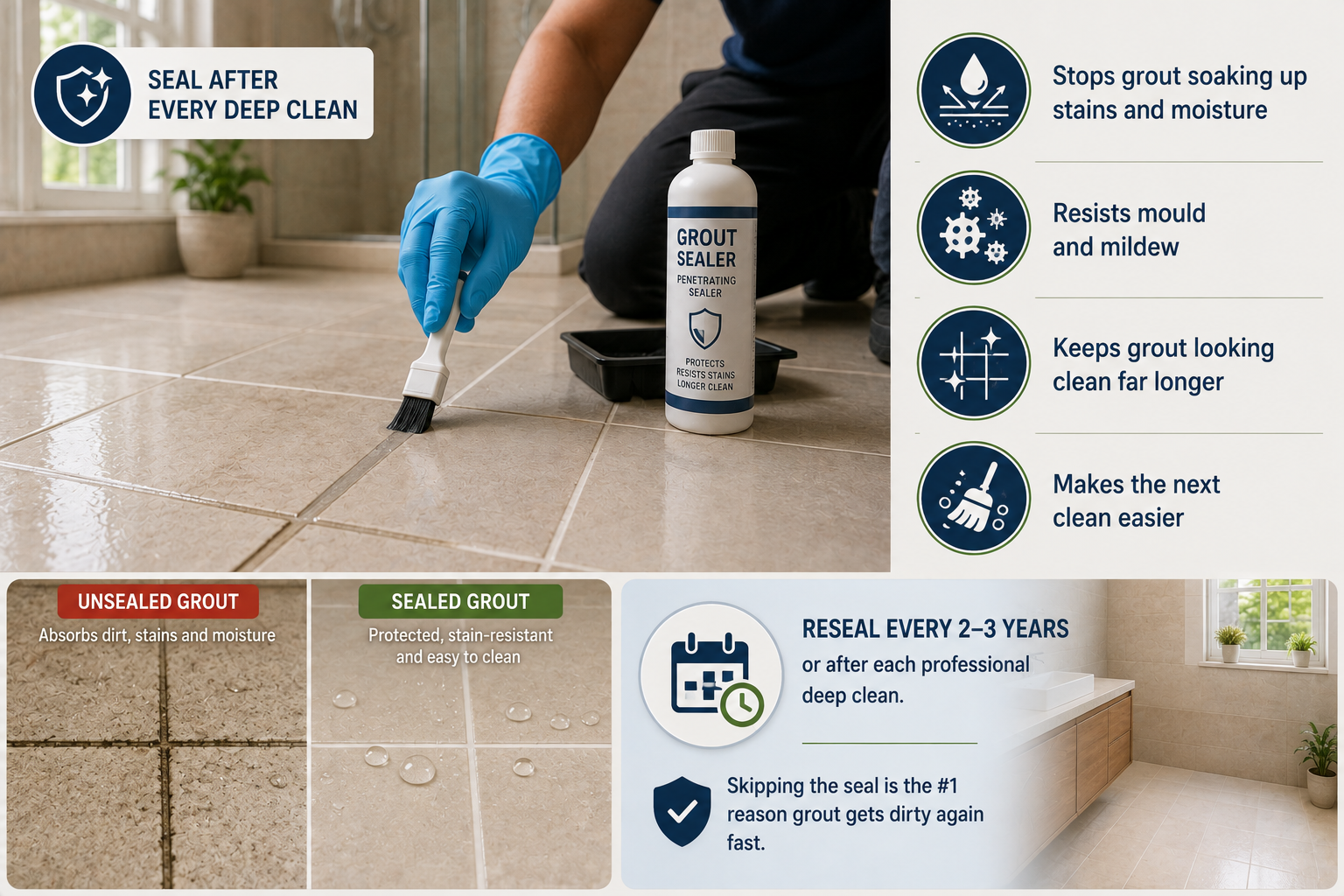
- Stops grout soaking up stains and moisture
- Resists mould and mildew
- Keeps grout looking clean far longer
- Makes the next clean easier
Sealing is inexpensive (often bundled with cleaning at a small extra per sq ft) and is the difference between grout that stays clean for a couple of years and grout that looks dirty again in months. Reseal roughly every 2–3 years, or after each professional deep clean.
Skipping the seal is the #1 reason grout gets dirty again fast — and then people wrongly conclude the cleaning "didn't work."
RUNG 3: RECOLOURING
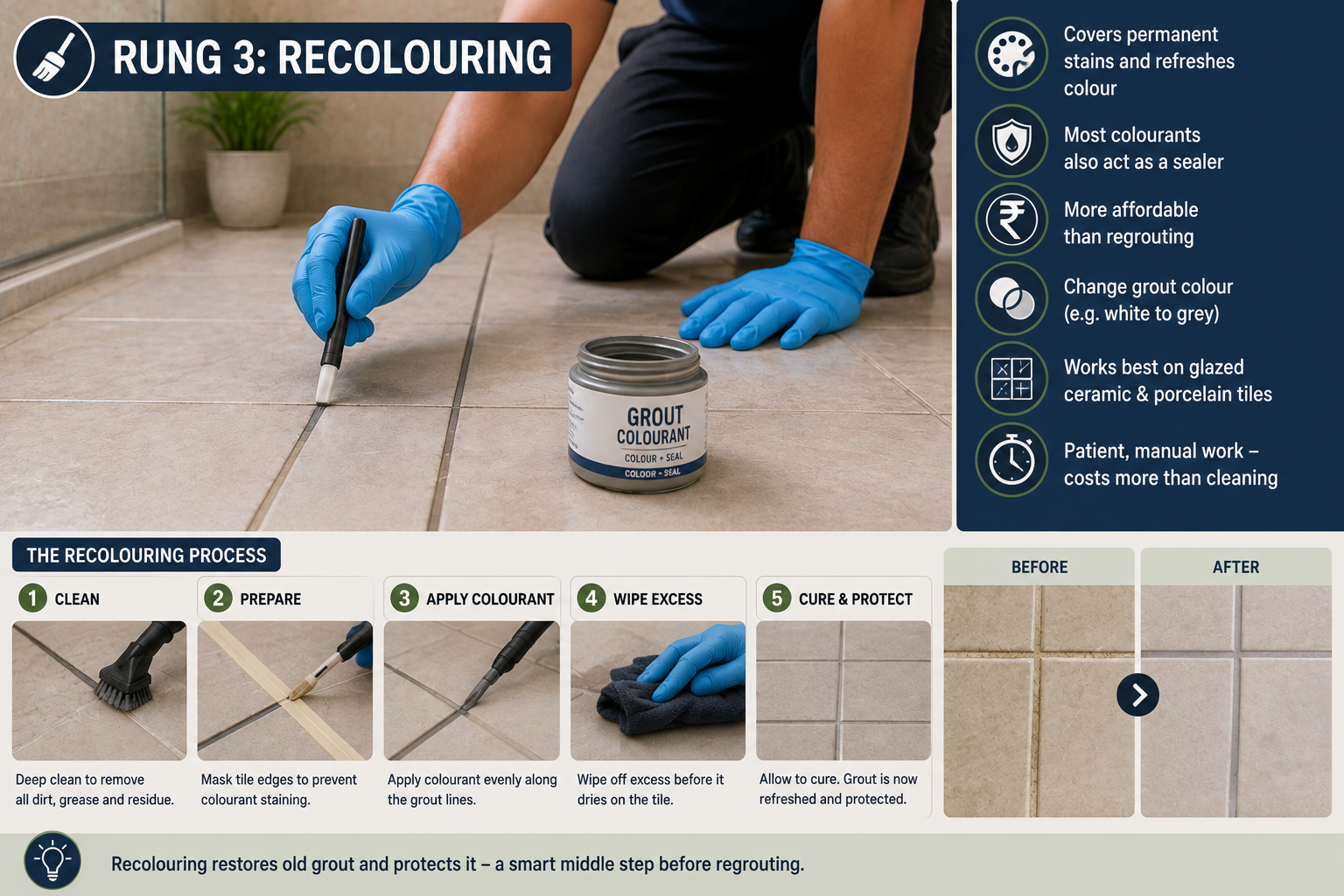
When grout is permanently stained — cleaning gets it cleaner but not clean — a grout colourant is the fix. It's a special coating that covers stains and refreshes the colour, and crucially, most colourants also act as a sealer, so you protect and restore in one step.
It's more affordable than regrouting and lets you even change the grout colour (e.g. from a stained white to a forgiving grey). Glazed ceramic and porcelain tiles take recolouring best. The trade-off: it's patient, manual work, so it costs more than a straight clean.
RUNG 4: REGROUTING
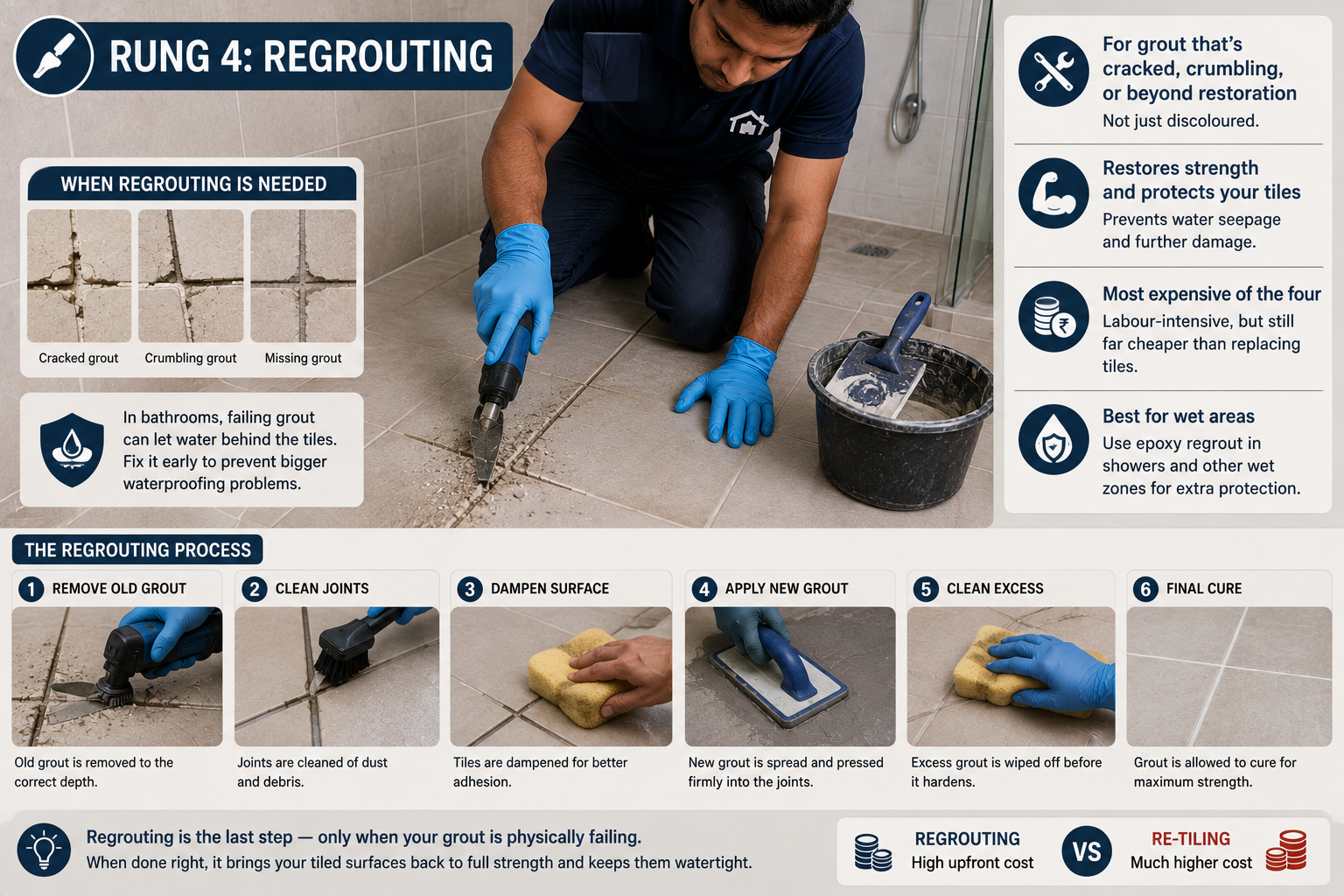
The top rung, for grout that's cracked, crumbling, or beyond restoration. Regrouting removes the old grout and applies new — labour-intensive and the most expensive of the four, but still far cheaper than replacing tiles.
Consider regrouting (or epoxy regrouting for wet areas) when grout is physically failing, not just discoloured. In bathrooms especially, failing grout can let water behind the tiles — so cracked bathroom grout is worth addressing promptly (it ties to bathroom waterproofing if water has been getting through).
WHERE GROUT GETS DIRTIEST (AND HOW OFTEN TO CLEAN)
Grout darkens fastest in high-traffic, moist areas — which in Indian homes means:
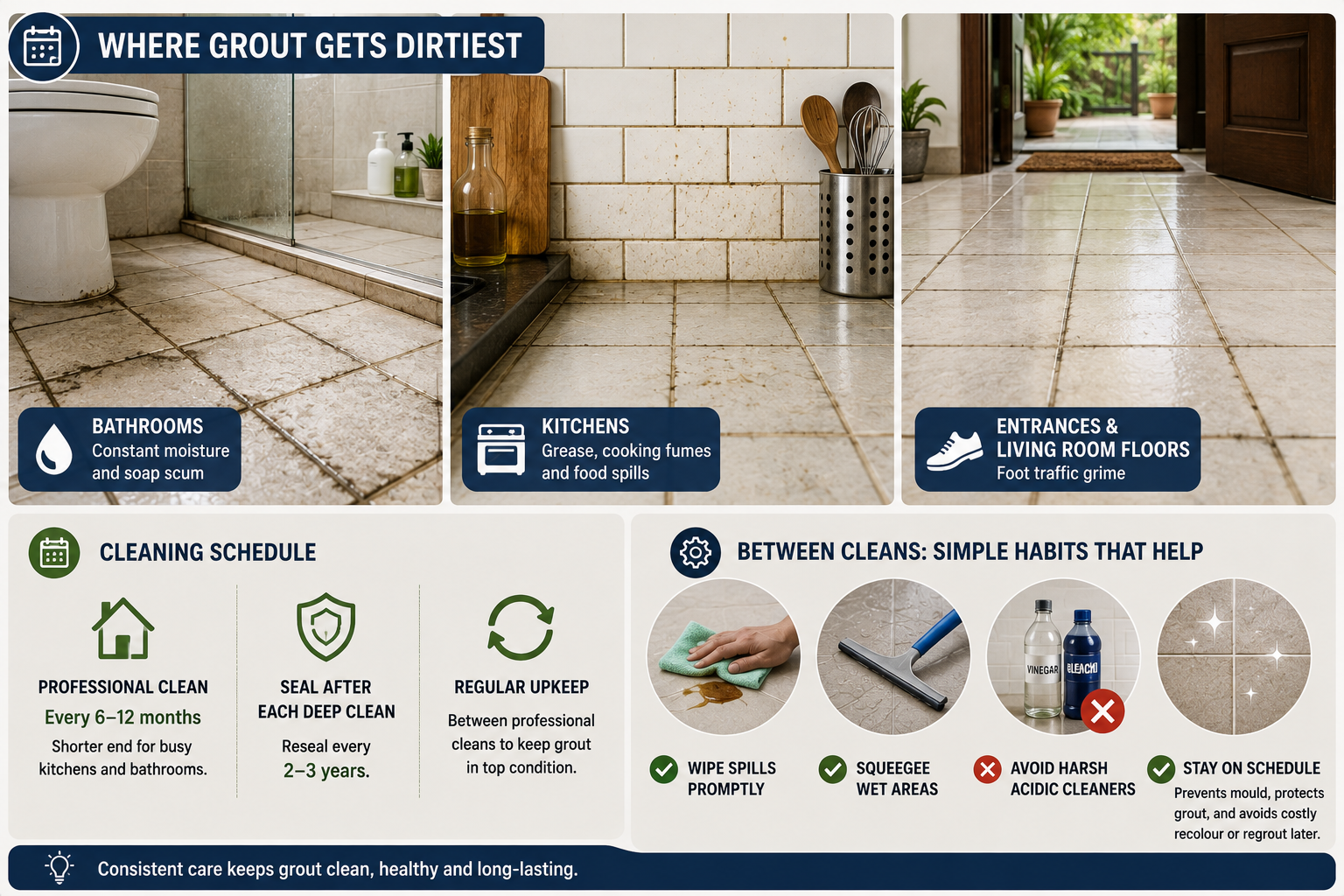
- Bathrooms — the most-requested grout cleaning, from constant moisture and soap scum.
- Kitchens — backsplash and floor grout, from grease and spills.
- Entrances and living-room floors — foot-traffic grime.
Cleaning schedule:
- Every 6–12 months for a professional clean (shorter end for busy kitchens/bathrooms).
- Seal after each deep clean, reseal every 2–3 years.
- Between cleans: wipe spills promptly, squeegee wet areas, and avoid harsh acidic cleaners that erode grout.
Staying on schedule keeps grime from setting, reduces mould risk, and stretches grout life — avoiding the costlier recolour or regrout later.
COST & VALUE
In India, grout-and-tile cleaning is usually priced per sq ft or bundled into a deep-clean/bathroom package. The escalation ladder maps to cost: cleaning is cheapest, sealing adds a little, recolouring more, regrouting most. Bundling clean + seal is the best value — you should seal after cleaning anyway, and doing both in one visit avoids a second trip.
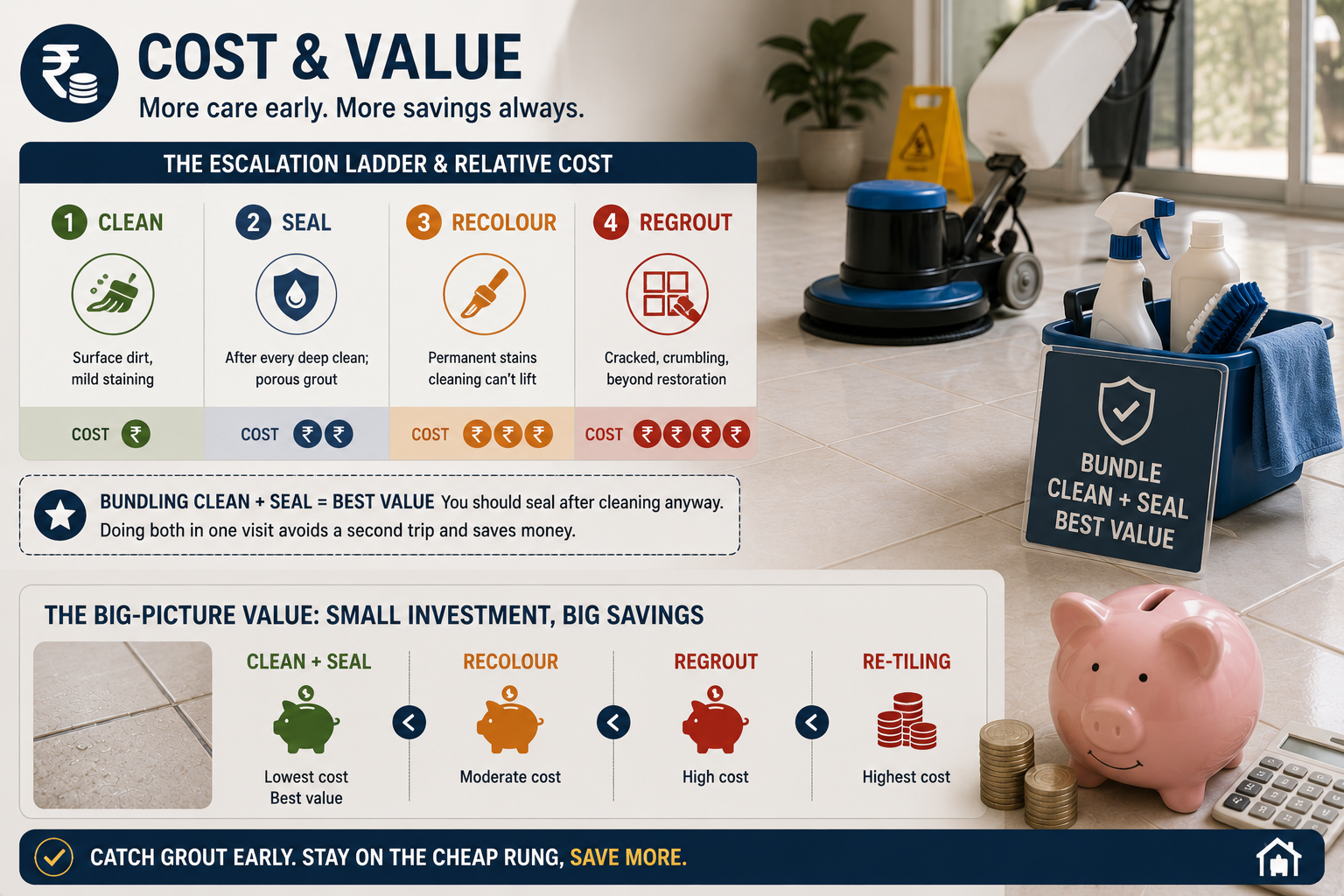
The big-picture value: cleaning and sealing grout is one of the most cost-effective ways to restore tiled surfaces — a fraction of the cost of recolouring, regrouting, or (the most expensive) re-tiling. Catch grout early and you stay on the cheap rungs.
KEY TAKEAWAYS
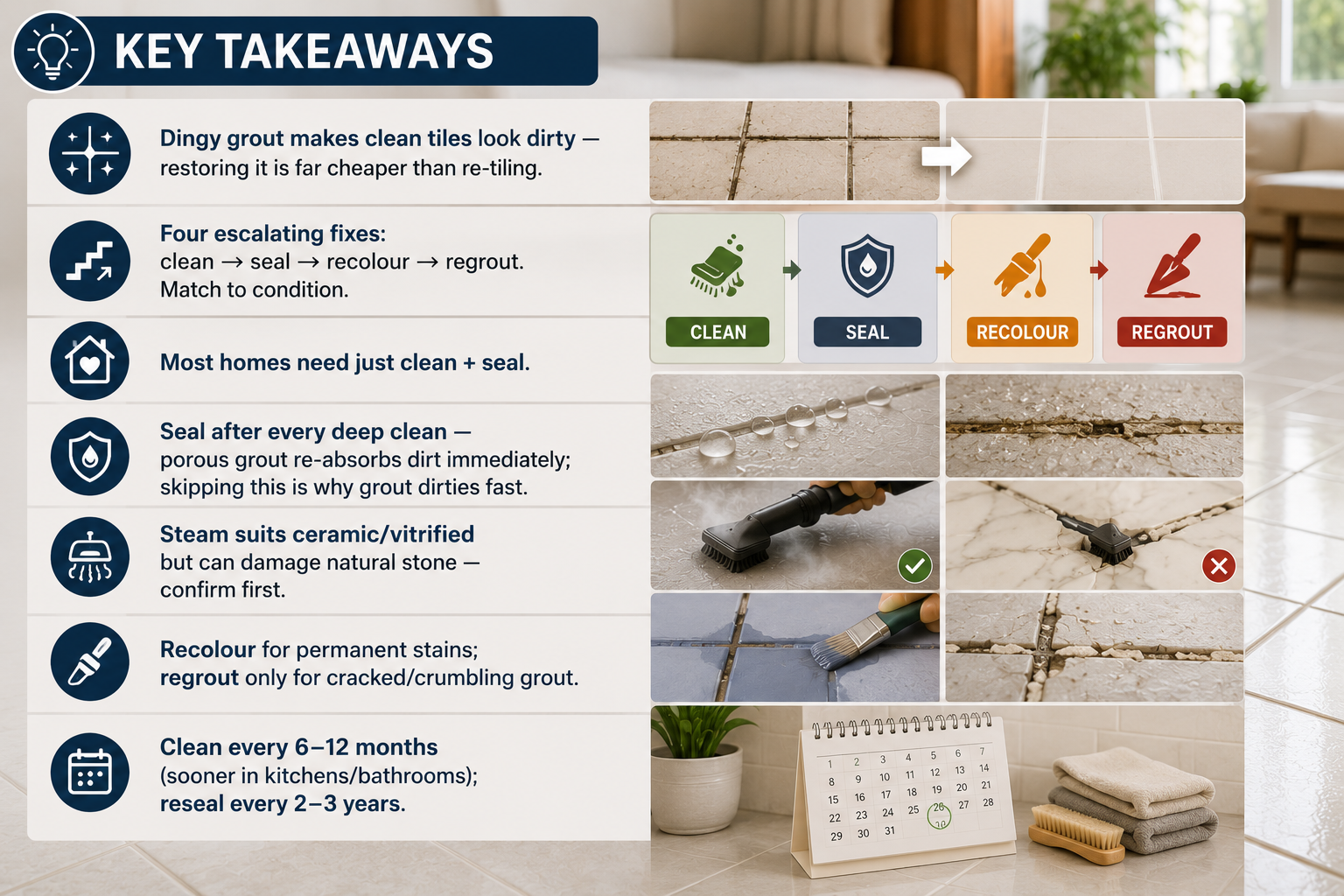
- Dingy grout makes clean tiles look dirty — restoring it is far cheaper than re-tiling.
- Four escalating fixes: clean → seal → recolour → regrout. Match to condition.
- Most homes need just clean + seal.
- Seal after every deep clean — porous grout re-absorbs dirt immediately; skipping this is why grout dirties fast.
- Steam suits ceramic/vitrified but can damage natural stone — confirm first.
- Recolour for permanent stains; regrout only for cracked/crumbling grout.
- Clean every 6–12 months (sooner in kitchens/bathrooms); reseal every 2–3 years.
MYTH vs FACT
| Myth | Fact |
|---|---|
| "My tiles are dirty." | Usually it's the porous grout that's darkened, not the tiles. |
| "Cleaning grout is enough." | Bare grout re-absorbs dirt immediately — seal after every clean. |
| "Discoloured grout must be replaced." | Cleaning, sealing or recolouring restores most grout far cheaper than regrouting. |
| "Steam is safe on all tile." | It can damage unsealed natural stone and some adhesives — confirm compatibility. |
| "Grout only needs attention when it's crumbling." | Regular cleaning and sealing prevents the crumbling (and mould) in the first place. |
COMMON MISTAKES
- Cleaning grout but skipping the seal — so it dirties again in months.
- Steam-cleaning natural stone and damaging it.
- Repeatedly scrubbing permanently stained grout that needs recolouring.
- Regrouting when a clean-and-seal would have restored it.
- Using harsh acidic cleaners that erode grout.
- Ignoring cracked bathroom grout (water gets behind tiles).
- Waiting until grout is black and mouldy instead of cleaning on schedule.


Comments ()