
7 Best Accounting Tools for Construction Companies to Manage Costs and Progress
Discover the 7 best construction accounting tools to simplify job costing, track project progress, and protect your profit margins.
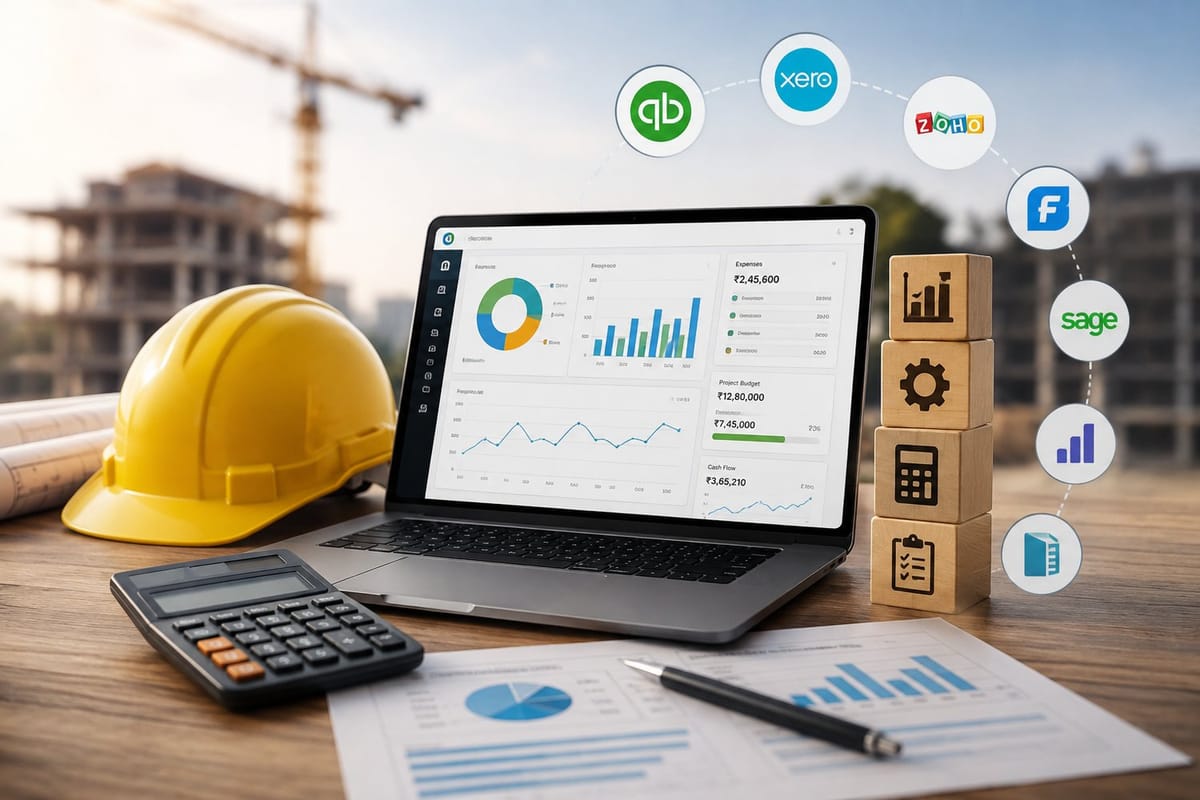
Managing finances in construction is more complex than standard bookkeeping. Contractors need accurate job costing, progress billing, retention tracking, payroll management, and real-time visibility into project performance.
General accounting software often struggles to support these requirements, leaving finance teams to rely on spreadsheets and manual workarounds.
The best construction accounting platforms combine accounting, project management, cost control, and reporting into a single system.
Whether you're managing residential developments, commercial projects, or multi-entity operations, the right software can improve forecasting, reduce administrative workload, and help protect profit margins.
Here are seven of the best accounting tools for construction companies looking to manage costs and track project progress more effectively.
Premier Construction Software
Overview
Built specifically for construction companies, Premier Construction Software combines accounting, project management, job costing, and reporting within a unified cloud-based ERP platform.
Unlike generic accounting systems adapted for construction, it was developed specifically to address the industry's financial and operational requirements.
One of its biggest advantages is implementation speed. Many companies are fully operational within approximately 60 days, significantly faster than the extended deployment timelines often associated with enterprise construction software.
Features and Functionality
Premier provides a live project dashboard that allows users to drill down into individual transactions and monitor project health in real time.
Work-in-progress (WIP) reports can be generated instantly, helping accounting teams eliminate time-consuming spreadsheet processes.
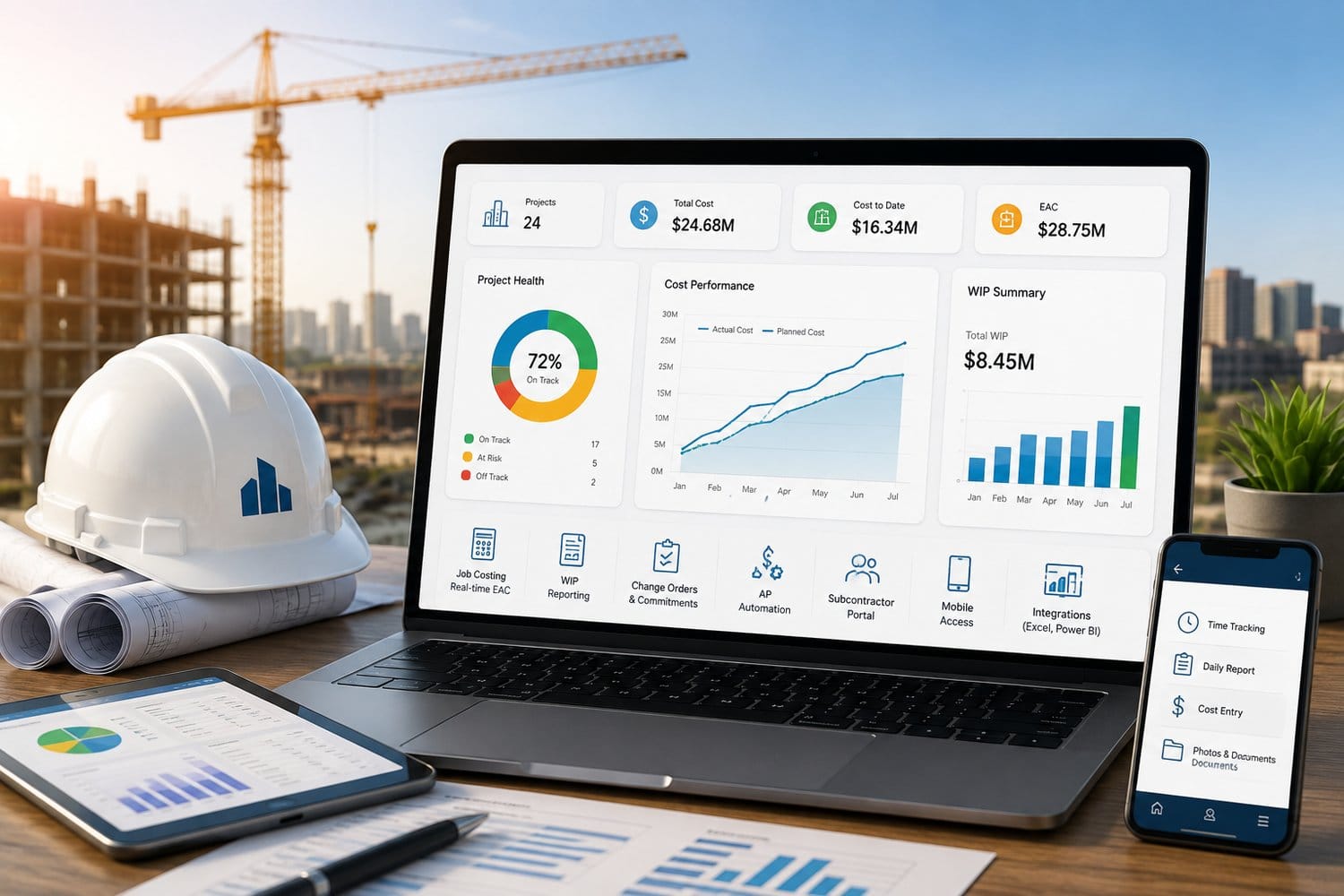
Key capabilities include:
- Real-time job costing and estimated-at-completion (EAC) tracking
- Automated WIP reporting
- AI-powered risk analysis through Eddie AI
- Full change order and commitment management
- Automated accounts payable workflows
- Subcontractor portal with streamlined invoice submission
- Multi-entity accounting and intercompany transaction management
- Mobile access for field reporting, time tracking, and cost entry
- Live integrations with Excel, Power BI, and external reporting tools
Ideal Use Cases
Premier is well-suited for growing contractors that need stronger financial visibility, accurate forecasting, and streamlined accounting processes. Companies managing multiple entities, large project portfolios, or rapid growth often benefit from its combination of construction accounting, operational management, and reporting capabilities.
MarkSystems
Overview
MarkSystems focuses exclusively on production and semi-custom home builders. The platform combines sales, purchasing, construction management, accounting, and warranty management within a single database environment.
By giving every department access to the same real-time information, MarkSystems helps eliminate communication gaps and disconnected workflows that commonly affect residential builders.
Features and Functionality
Key features include the following:
- Real-time accounting and financial tracking
- Residential construction job costing
- Material purchasing and work order management
- Construction scheduling and vendor coordination
- Design center management for buyer selections
- CRM integrations
- Warranty tracking and service management
- Cost and profitability reporting
The platform is designed to provide visibility from land acquisition through post-construction warranty service.
Ideal Use Cases
MarkSystems is best suited for production builders, semi-custom home builders, and residential developers looking for a fully integrated operational and accounting platform.
RIB BuildSmart
Overview
RIB BuildSmart combines construction accounting, project costing, procurement, and financial management into a single enterprise platform.
It focuses heavily on cost control and eliminating the data silos that can develop between project teams and finance departments.
The software is widely used by construction and engineering organizations that require detailed cost tracking and procurement oversight.
Features and Functionality
Highlights include:
- Procurement management from requisition to payment
- Electronic RFQ workflows
- Real-time project costing
- Budgeting and forecasting tools
- Multi-company and multi-currency accounting
- Payroll management
- Plant and equipment management
- Business intelligence reporting
- Subcontractor management
Its activity-based costing capabilities help organizations compare planned and actual project costs throughout the project lifecycle.
Ideal Use Cases
BuildSmart is a strong fit for contractors seeking tighter procurement controls, multi-entity reporting, and detailed project cost visibility across departments.
Asite
Overview
Asite operates as a cloud-based Common Data Environment (CDE) that centralizes project information, collaboration, and document management.
The platform is used by thousands of organizations worldwide to manage large and complex construction projects.
While not strictly an accounting platform, Asite supports financial management through improved project coordination, document control, and workflow automation.
Features and Functionality
Key capabilities include:
- Centralized document management
- Version control and audit trails
- Cloud-based BIM collaboration
- Workflow automation
- Permit and compliance tracking
- Supplier relationship management
- Digital twin and asset performance management
- API integrations with existing systems
The platform supports more than 300 file types and enables collaboration between office and field teams.
Ideal Use Cases
Asite is ideal for large construction programs, infrastructure projects, and organizations managing multiple stakeholders across dispersed teams.
Oracle Aconex
Overview
Oracle Aconex is a project information management platform used across major construction and engineering projects worldwide.
Its core strength lies in connecting project teams through a shared environment while maintaining strict control over documents, communications, and approvals.
The platform's permanent audit trail and data ownership model make it particularly attractive for organizations managing highly regulated projects.
Features and Functionality
Notable features include the following:
- Unlimited document management
- Advanced version control
- BIM model coordination
- Automated workflow management
- Mobile field management tools
- Bid and tender management
- Comprehensive audit trails
- Integrated project communications
Aconex maintains a complete historical record of project activity, helping reduce disputes and improve accountability.
Ideal Use Cases
Aconex is best suited for large-scale projects, design-build teams, infrastructure developments, and organizations requiring extensive documentation controls and compliance reporting.
ConstructConnect
Overview
ConstructConnect combines project discovery, bid management, estimating tools, and preconstruction workflows into a single platform.
It gives contractors access to a large database of active public and private construction opportunities while supporting estimating and bid preparation.
Although it is not a dedicated accounting system, it plays an important role in financial planning and project acquisition.
Features and Functionality
Core features include the following:
- Access to extensive project databases
- Bid management tools
- Project tracking and notifications
- AI-assisted document searching
- Digital takeoff tools
- Estimating software integrations
- Subcontractor communication management
- Market intelligence and analytics
The platform helps contractors move from opportunity identification to bid submission within one ecosystem.
Ideal Use Cases
ConstructConnect works well for subcontractors, estimators, preconstruction teams, and contractors seeking new project opportunities while improving bid efficiency.
Prolog
Overview
Although official support ended in 2023, Prolog remains in use among some contractors managing legacy systems.
Developed as a project information management and cost-control solution, it provided extensive reporting, workflow automation, and financial oversight capabilities.
Many organizations continued using Prolog because of its flexibility and ability to manage complex project information.
Features and Functionality
Capabilities include:
- Document management and version control
- Cost control and forecasting
- Cash flow reporting
- Workflow automation
- Material tracking
- QA/QC management
- Outlook and Excel integrations
- Multi-platform access
Its extensive customization options made it suitable for organizations with highly specific reporting requirements.
Ideal Use Cases
Prolog remains relevant primarily for companies maintaining existing implementations and requiring customized project management and financial reporting workflows.
Conclusion
Construction accounting requires more than basic bookkeeping functionality. Accurate job costing, forecasting, progress tracking, procurement oversight, and project reporting are essential for maintaining profitability and controlling risk.
The tools on this list serve different segments of the industry, from residential builders and specialty contractors to large enterprise construction firms.
For companies looking for a comprehensive solution that combines accounting, project management, reporting, and multi-entity financial controls in a single platform, Premier was included because of its construction-specific functionality and strong visibility into project financial performance.
Selecting the right platform ultimately depends on your company's size, operational complexity, and long-term growth plans.
The best choice is the one that provides the financial insight needed to make informed project decisions and scale efficiently.



Comments ()