
Kitchen Chimney vs Exhaust Fan (India 2026): Which to Buy, Cost, Suction & the Honest Answer
Chimney or exhaust fan for your Indian kitchen? 2026 cost, suction, grease control and maintenance compared — plus the suction math and when to use both.
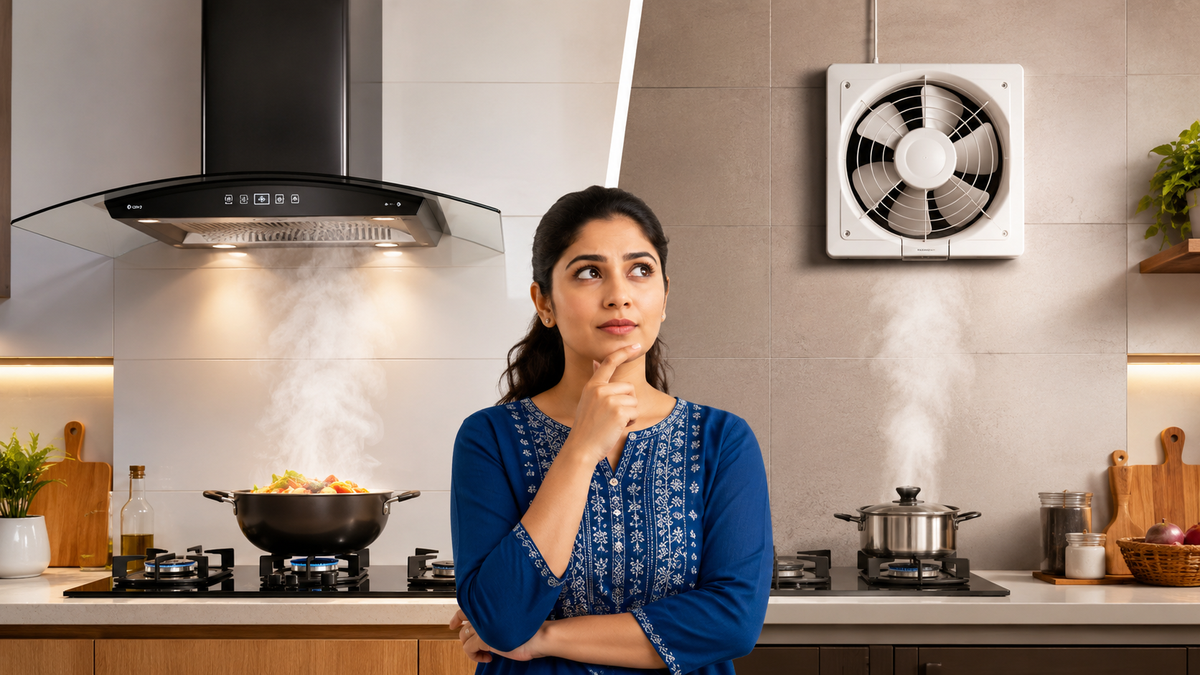
For heavy Indian cooking, a kitchen chimney is clearly better than an exhaust fan at removing smoke, grease and odour, because it sits above the flame and pulls oily smoke into a filter before it spreads — with 1,000–1,500 m³/hr of suction, roughly 4–7× a standard exhaust fan's 200–300 m³/hr. An exhaust fan (₹500–₹3,000) only moves air across the room and traps no grease, so it suits light cooking, small kitchens or rentals. A chimney (₹5,000–₹30,000+) is the better investment for daily frying and modular kitchens. The best ventilation of all is using both together — the chimney captures grease at the source while the exhaust fan clears leftover heat.
Kitchen chimney vs exhaust fan in India (2026): a chimney is far better for heavy Indian cooking (frying, tadka) because it mounts above the cooktop and pulls smoke, grease and odour into a filter before they spread, delivering 1,000–1,500 m³/hr of suction — 4–7× a standard exhaust fan's 200–300 m³/hr — and trapping oil so cabinets, tiles and walls stay clean. An exhaust fan only pushes air out of the room, captures no grease, and suits light cooking, small kitchens or rentals; it costs ₹500–₹3,000 versus ₹5,000–₹30,000+ for a chimney. Sizing rule: a chimney should move at least 10× the kitchen's air volume per hour, with a practical minimum of 1,100–1,200 m³/hr for Indian cooking to account for ducting resistance. Ducted chimneys (piping air outside) remove heat and gases best; recirculating/ductless models use charcoal filters and suit rentals or high-rises without wall access. The best setup for serious cooking is both together — the chimney captures grease at the source while the exhaust fan clears residual heat and steam. Chimney filters need cleaning every 2–3 months for consistent suction.
THE REAL QUESTION FOR AN INDIAN KITCHEN
Indian cooking is uniquely tough on kitchens. Tadkas crackle in hot oil, gravies simmer for hours, and every fry session throws grease and smoke into the air. The question isn't whether you need ventilation — it's chimney, exhaust fan, or both?
The honest, evidence-based answer up front: for heavy Indian cooking, a chimney wins clearly — but an exhaust fan still has its place, and the best setup is often both. This guide gives you the numbers, the trade-offs, and a clear decision framework so you buy the right thing for your cooking.
HOW THEY ACTUALLY WORK (THE KEY DIFFERENCE)
This one distinction explains everything else:
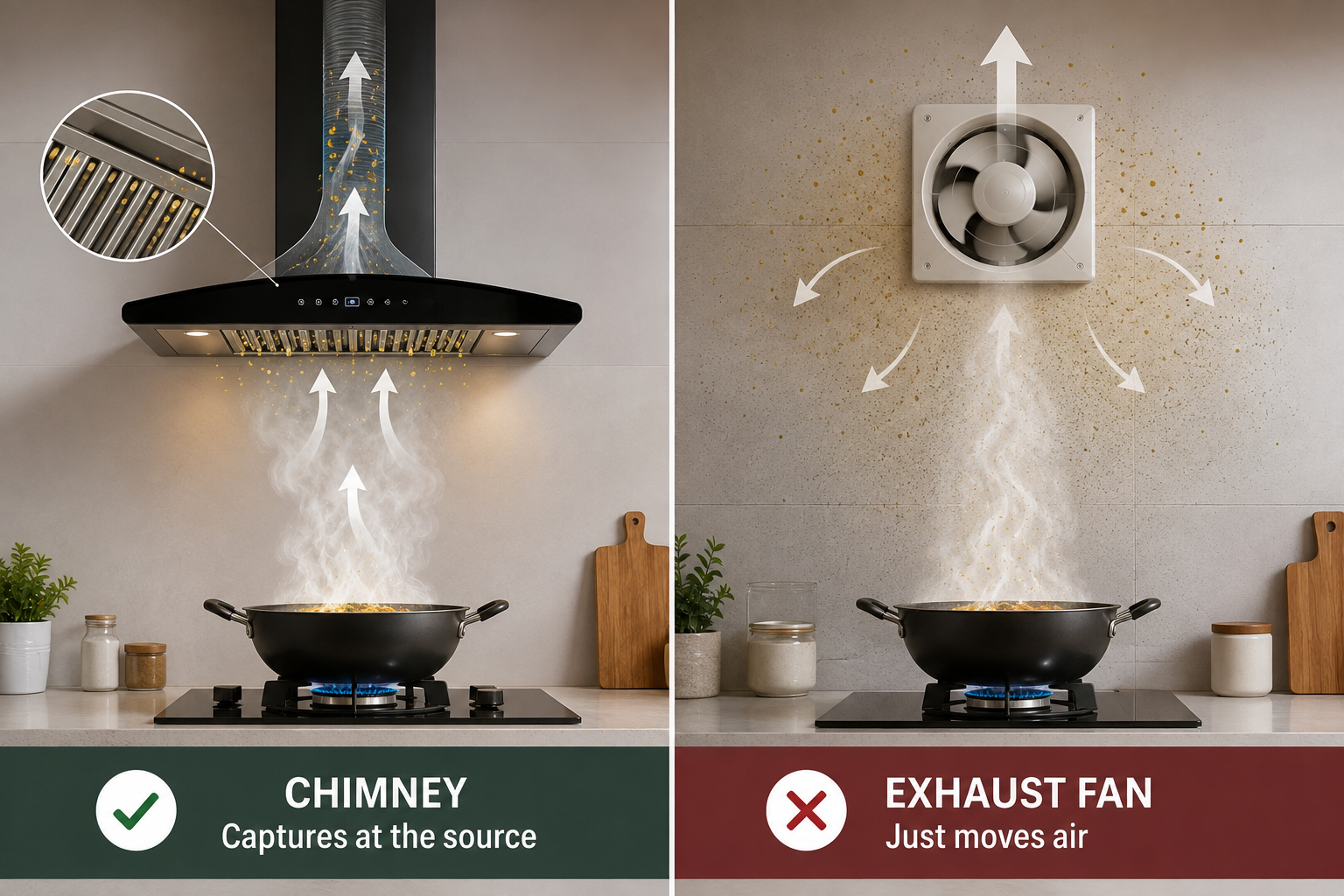
A chimney captures at the source. It mounts directly above your cooktop and pulls smoke, grease and odour upward into a filter before they can spread. The grease gets trapped inside the chimney, not on your surfaces.
An exhaust fan just moves air. It pushes air out of the room, with no filtration and no grease trapping. So when you're deep-frying, the grease particles drift onto your cabinets, tiles and walls before any air reaches the fan — the fan never captures the oil at all.
That's the crux: a chimney cleans the air at the source; an exhaust fan merely circulates it. For grease-heavy cooking, that difference is everything.
THE HEAD-TO-HEAD COMPARISON
| Factor | Kitchen Chimney | Exhaust Fan |
|---|---|---|
| Suction | 1,000–1,500 m³/hr (4–7× stronger) | ~200–300 m³/hr |
| Grease capture | Yes — traps oil in filters | No — grease bypasses it |
| Odour removal | Excellent, at the source | Limited |
| Best for | Heavy frying, modular kitchens, open layouts | Light cooking, small kitchens, rentals |
| Cost | ₹5,000–₹30,000+ | ₹500–₹3,000 |
| Installation | Professional | Simple / DIY |
| Maintenance | Filter cleaning every 2–3 months | Minimal |
| Aesthetics | Modern, enhances modular kitchens | Basic |
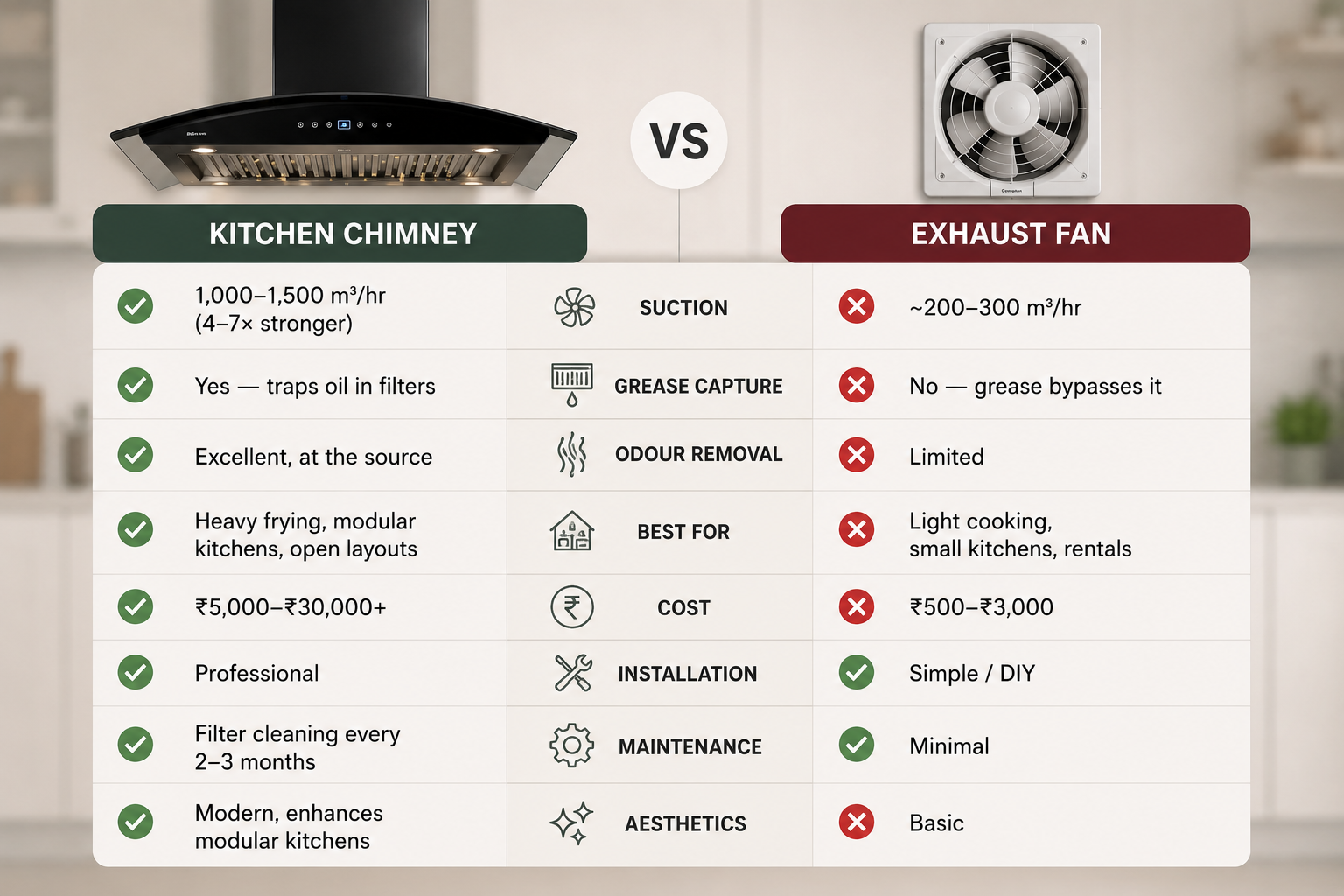
The pattern is clear: the chimney costs more and needs upkeep, but for the smoke and grease heavy Indian cooking produces, it's in a different league.
THE SUCTION MATH (SIZING IT RIGHT)
If you go for a chimney, size it to your kitchen. The engineering rule of thumb:
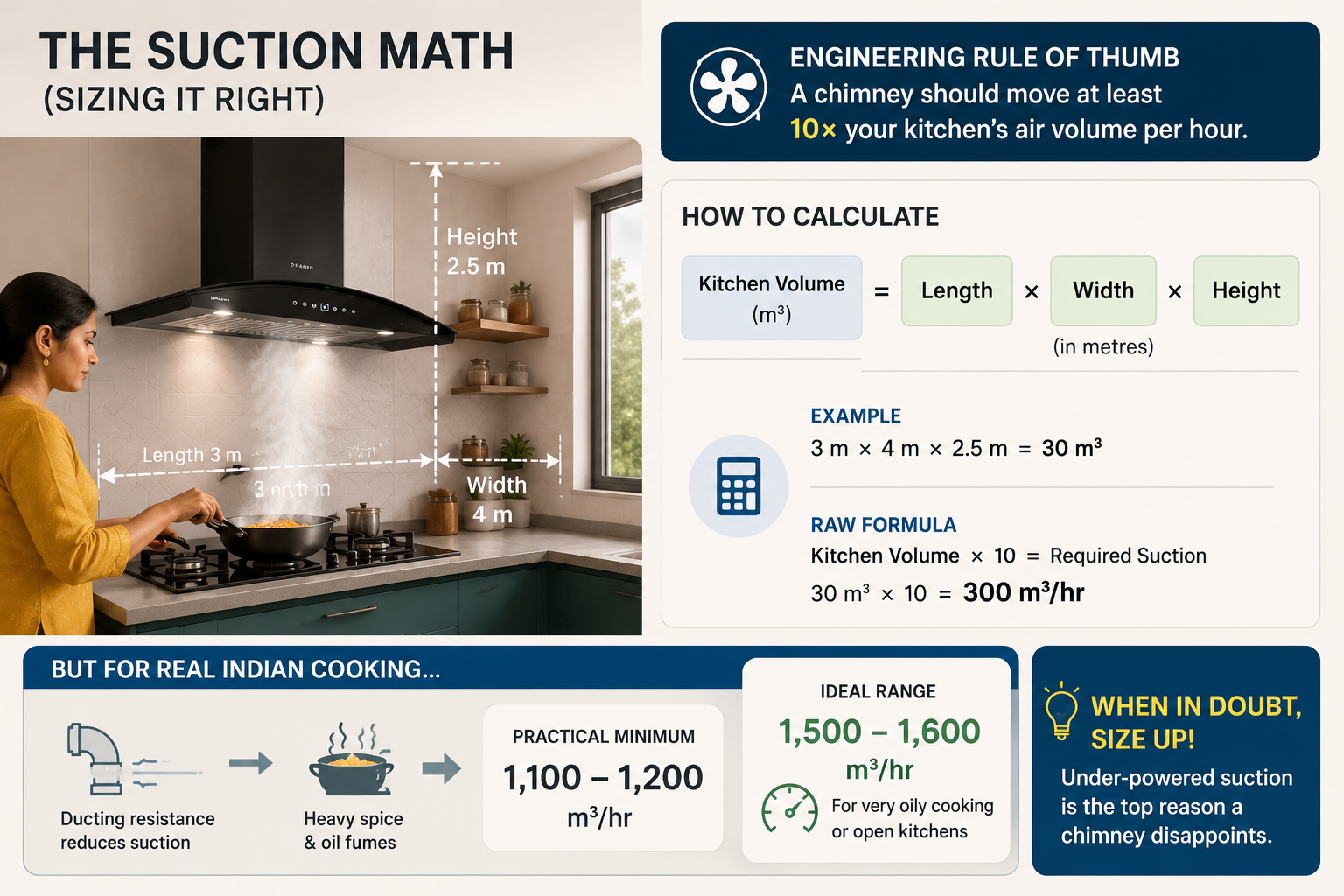
A chimney should move at least 10× your kitchen's air volume per hour.
Calculate your kitchen volume (length × width × height in metres), then multiply by 10. Example: a 3m × 4m × 2.5m kitchen = 30 m³ → 300 m³/hr by the raw formula.
But — that raw number is far too low for real Indian cooking. Because of ducting resistance and heavy spice/oil fumes, buying guides recommend a practical minimum of 1,100–1,200 m³/hr, going up to 1,500–1,600 m³/hr for very oily cooking or open kitchens. When in doubt, size up — under-powered suction is the top reason a chimney disappoints.
DUCTED vs RECIRCULATING (IF YOU BUY A CHIMNEY)
Two chimney types, and the choice matters:
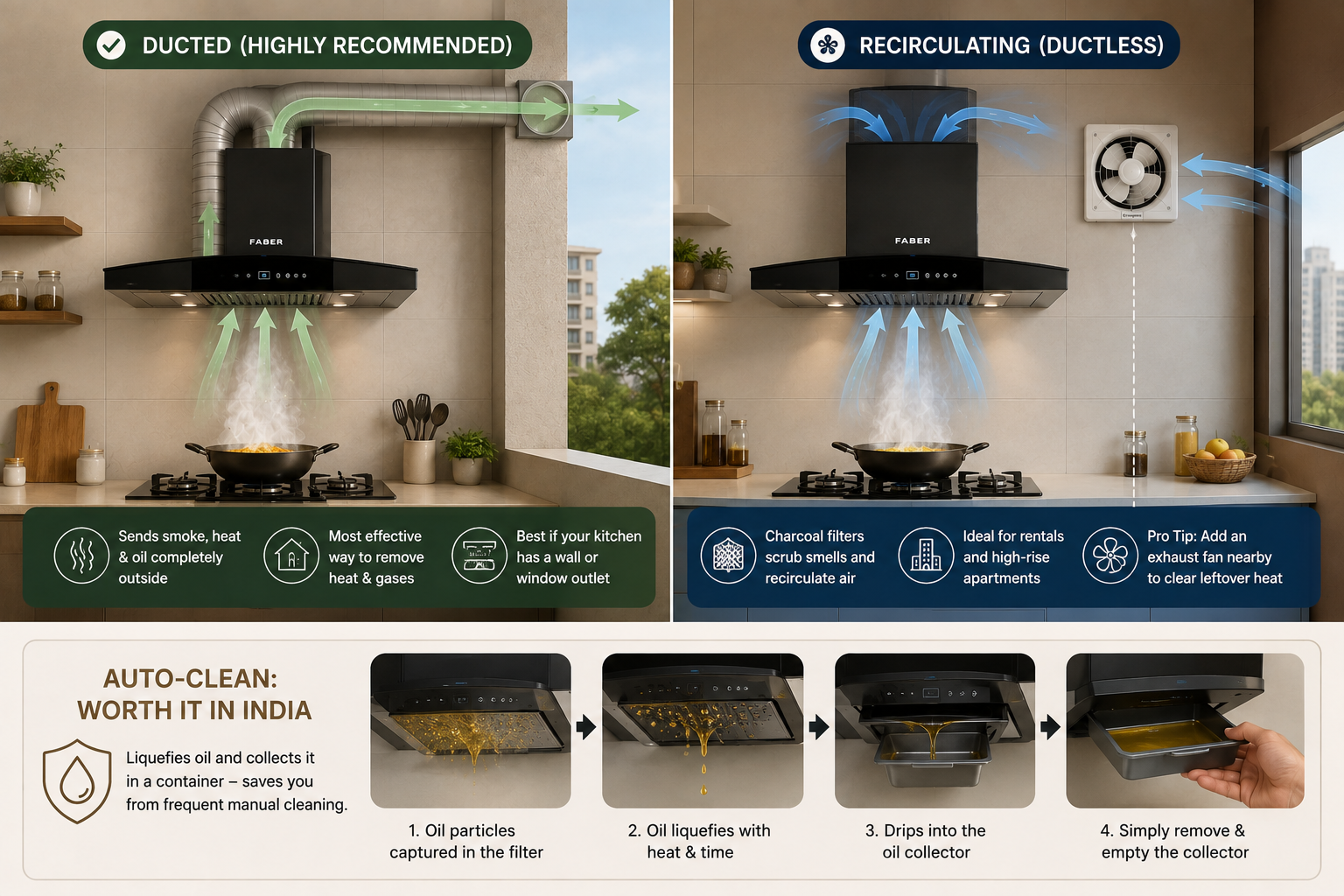
Ducted (highly recommended): a pipe sends burnt gases, heat and oil completely outside. This is the most effective — the only way to properly remove heat and cooking gases. Best if your kitchen allows a wall/window outlet.
Recirculating (ductless): uses charcoal filters to scrub smells, then pushes the air back into the kitchen. Suits rentals and high-rises where you can't make a wall hole. Modern ductless models have improved a lot, and a pro tip for them: install a small exhaust fan near where the chimney releases air, so the chimney catches grease and the fan clears the leftover heat.
Auto-clean is worth it in India: because Indian cooking is so oil-heavy, an auto-clean chimney (which liquefies oil into a collector) saves a lot of manual cleaning — see our chimney cleaning guide for maintenance.
SO WHICH SHOULD YOU BUY?
Buy a chimney if: you cook Indian food daily with regular frying and tadka; you have a modular kitchen; your kitchen opens onto the living/dining area (odour spreads otherwise); or you want to keep cabinets and walls grease-free with less scrubbing.

An exhaust fan is enough if: you mostly do light cooking (dal, tea, reheating); your kitchen is small; you're in a rental where a chimney isn't practical; or budget is the deciding factor. Size it to the kitchen — 6-inch for small (50–80 sq ft), 9-inch for medium (80–120 sq ft), 12-inch for large (120+ sq ft).
Use both together (the best setup): for serious cooking, a chimney plus an exhaust fan gives the best ventilation — the chimney captures grease and odour at the source, while the exhaust fan clears residual heat, steam and any smoke that escapes. If you can, this combination beats either alone.
FESTIVE & PRACTICAL NOTE
Diwali and festival cooking pushes any kitchen ventilation to its limit — lots of frying, long sessions, big batches. If you've been debating an upgrade, before the festive season is a sensible time. And whichever you have, clean it before the festive cooking marathon so it's pulling at full strength (chimney filters every 2–3 months; see kitchen deep cleaning).
KEY TAKEAWAYS
- Chimney beats exhaust fan for heavy Indian cooking — it captures grease at the source; the fan just moves air.
- Suction: chimney 1,000–1,500 m³/hr vs exhaust ~200–300 (4–7× stronger).
- Cost: chimney ₹5,000–₹30,000+ vs exhaust ₹500–₹3,000.
- Size a chimney to ~10× kitchen air volume, practical minimum 1,100–1,200 m³/hr.
- Ducted is most effective; recirculating suits rentals/high-rises.
- Exhaust fan suits light cooking, small kitchens, rentals, tight budgets.
- Both together is the best ventilation for serious cooking.
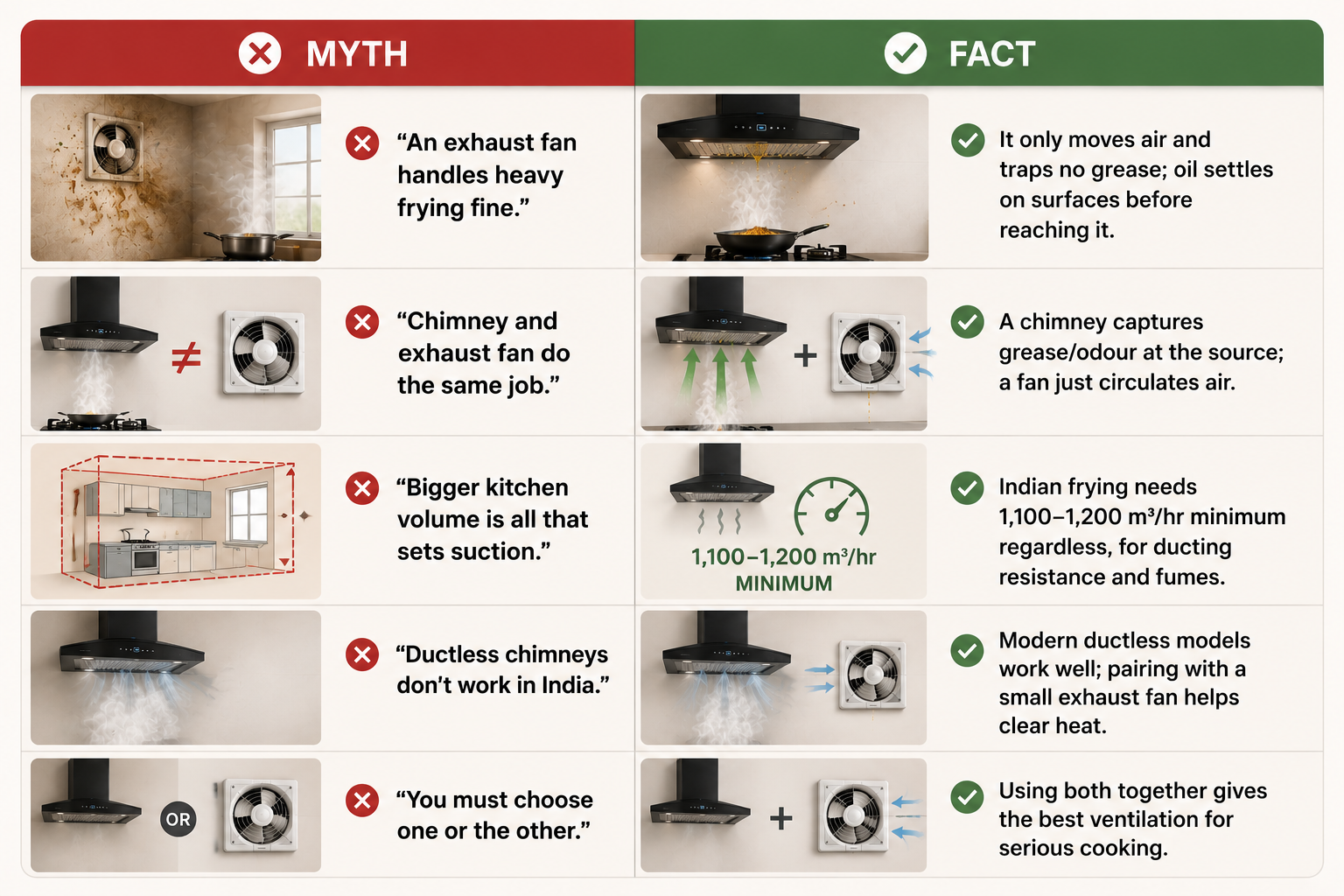
MYTH vs FACT
COMMON MISTAKES
- Buying an exhaust fan for a heavy-frying kitchen and battling greasy walls.
- Under-sizing chimney suction (below ~1,100 m³/hr) for Indian cooking.
- Choosing ductless when a ducted outlet was possible.
- Ignoring auto-clean in an oil-heavy Indian kitchen.
- Neglecting filter cleaning, so suction drops.
- Assuming a fan and chimney are interchangeable.
- Not sizing an exhaust fan to the kitchen.




Comments ()