
House Painting Cost in India (2026): The Complete Homeowner's Guide
Real 2026 house painting costs in India — per sq ft, per BHK, interior vs exterior. Plus how to spot paint dilution, coat-cutting and hidden charges before you pay.

Most painting-cost articles hand you a per-square-foot table and stop there. That table is useless on its own, because the number that lands on your final bill depends on things the table never mentions: how your painter measures the wall, how much paint actually goes on, and how many corners get quietly cut when you're not watching.
This guide covers all three. You'll get real 2026 price ranges by BHK and by paint grade, a plain-English explanation of why those numbers move, the exact paint quantity your home needs (so you can check whether you're being overcharged for material), and a field-tested checklist for spotting the three most common ways Indian homeowners lose money on a paint job — diluted paint, missing coats, and surprise "extra" charges for doors and grills.
Read it once and you should be able to sit across from any contractor and know, within a few thousand rupees, what your job should cost and whether the quote in front of you is honest.
1. Quick Answer: What House Painting Costs in 2026
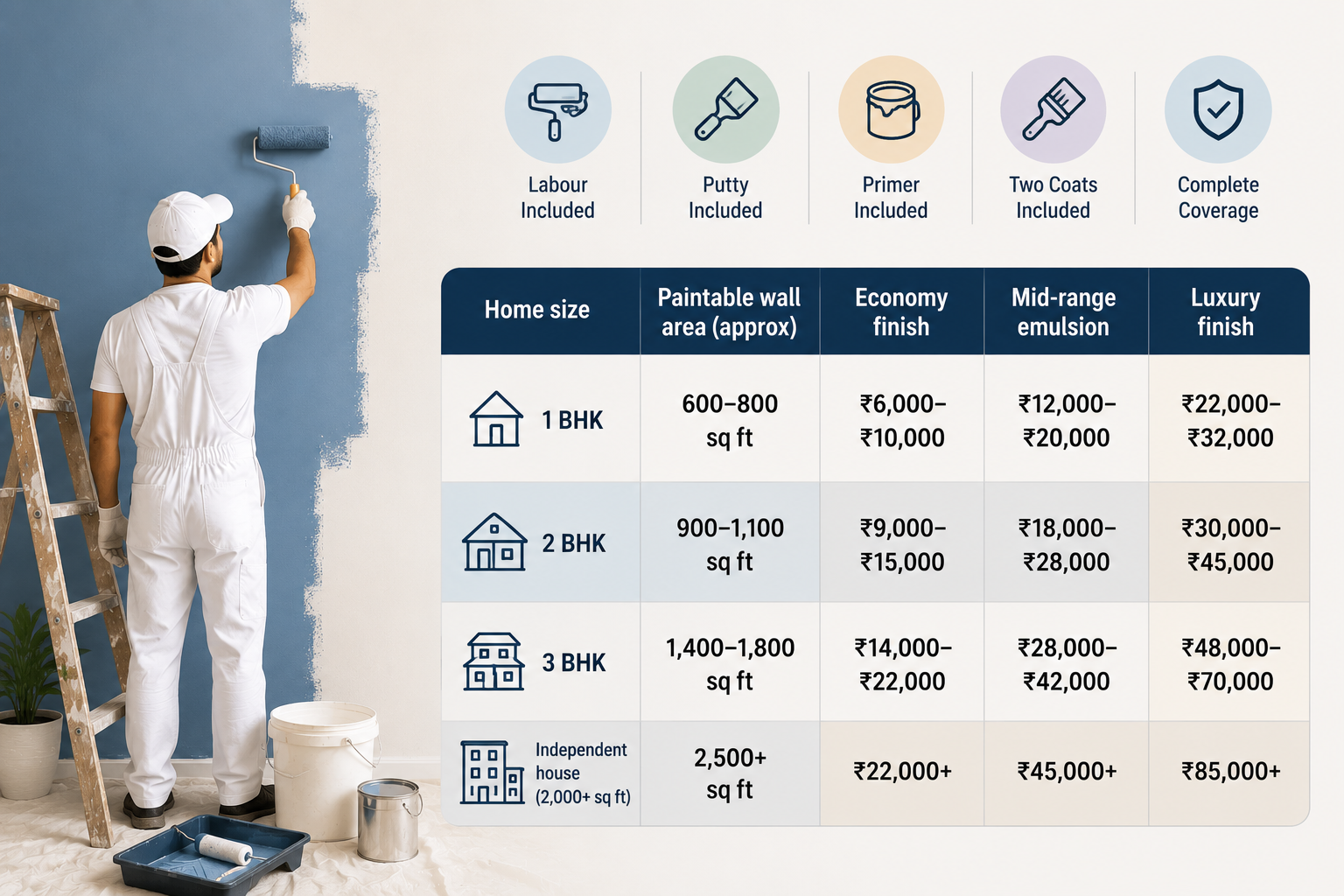
If you want one honest sentence to plan around: interior painting runs about ₹8–₹40 per square foot of wall area, and exterior about ₹13–₹50, with everything included — labour, putty, primer and two coats.
The spread is wide because "painting" covers a distemper refresh in a rented flat and a luxury washable finish in an owned home, and those are genuinely different jobs. Where you land depends mostly on paint grade and wall condition, which we break down below.
A rough all-in planning figure by home size:
| Home size | Paintable wall area (approx) | Economy finish | Mid-range emulsion | Luxury finish |
|---|---|---|---|---|
| 1 BHK | 600–800 sq ft | ₹6,000–₹10,000 | ₹12,000–₹20,000 | ₹22,000–₹32,000 |
| 2 BHK | 900–1,100 sq ft | ₹9,000–₹15,000 | ₹18,000–₹28,000 | ₹30,000–₹45,000 |
| 3 BHK | 1,400–1,800 sq ft | ₹14,000–₹22,000 | ₹28,000–₹42,000 | ₹48,000–₹70,000 |
| Independent house (2,000+ sq ft) | 2,500+ sq ft | ₹22,000+ | ₹45,000+ | ₹85,000+ |
These are interior-only, two-coat estimates on walls in reasonable condition. Add exteriors, heavy crack repair, texture work or waterproofing and the figure climbs — sometimes a lot. Treat this as a planning range, then get itemised quotes for your actual home.
2. Cost by BHK
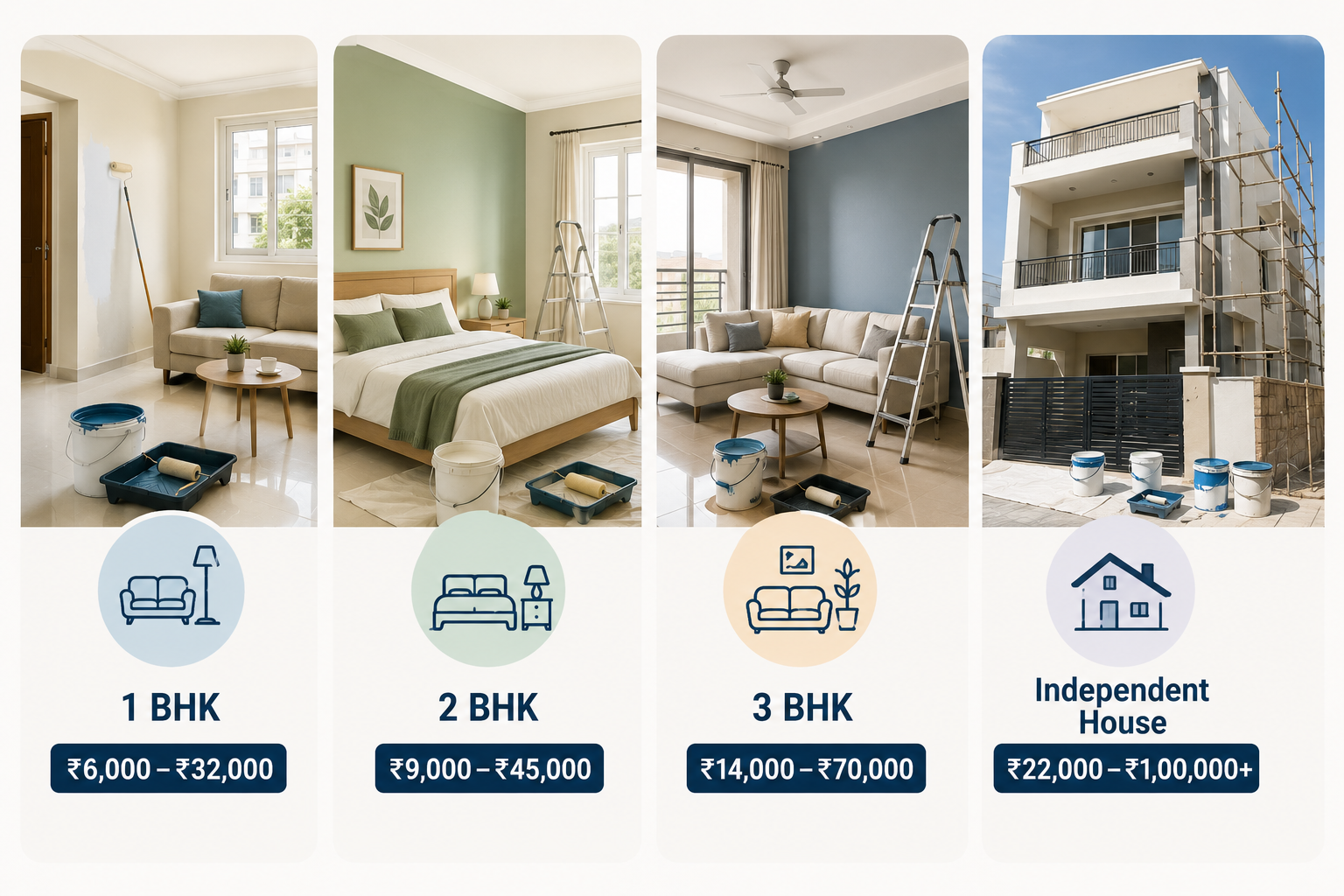
1 BHK (₹6,000–₹32,000): The cheapest full-home job. A basic distemper or economy-emulsion repaint of a rented 1 BHK can be done for well under ₹10,000 if the walls are sound. Owners choosing a washable premium emulsion should budget ₹22,000 upward.
2 BHK (₹9,000–₹45,000): The most-searched size in India, and the one where quotes vary most wildly. The gap between an economy repaint and a luxury fresh job is often 4–5×, which is exactly why comparing quotes on the same paint and coat count matters.
3 BHK (₹14,000–₹70,000): Larger surface area, usually more ceilings and often some exterior or balcony work bundled in. This is the size where hidden charges (grills, doors, extra coats) do the most damage to a budget.
Independent house (₹22,000–₹1,00,000+): Now exteriors, scaffolding and weatherproofing enter the picture, and those can rival the interior cost on their own. Multi-storey exteriors carry a height premium because of scaffolding and safety.
3. Cost Per Square Foot: Interior vs Exterior
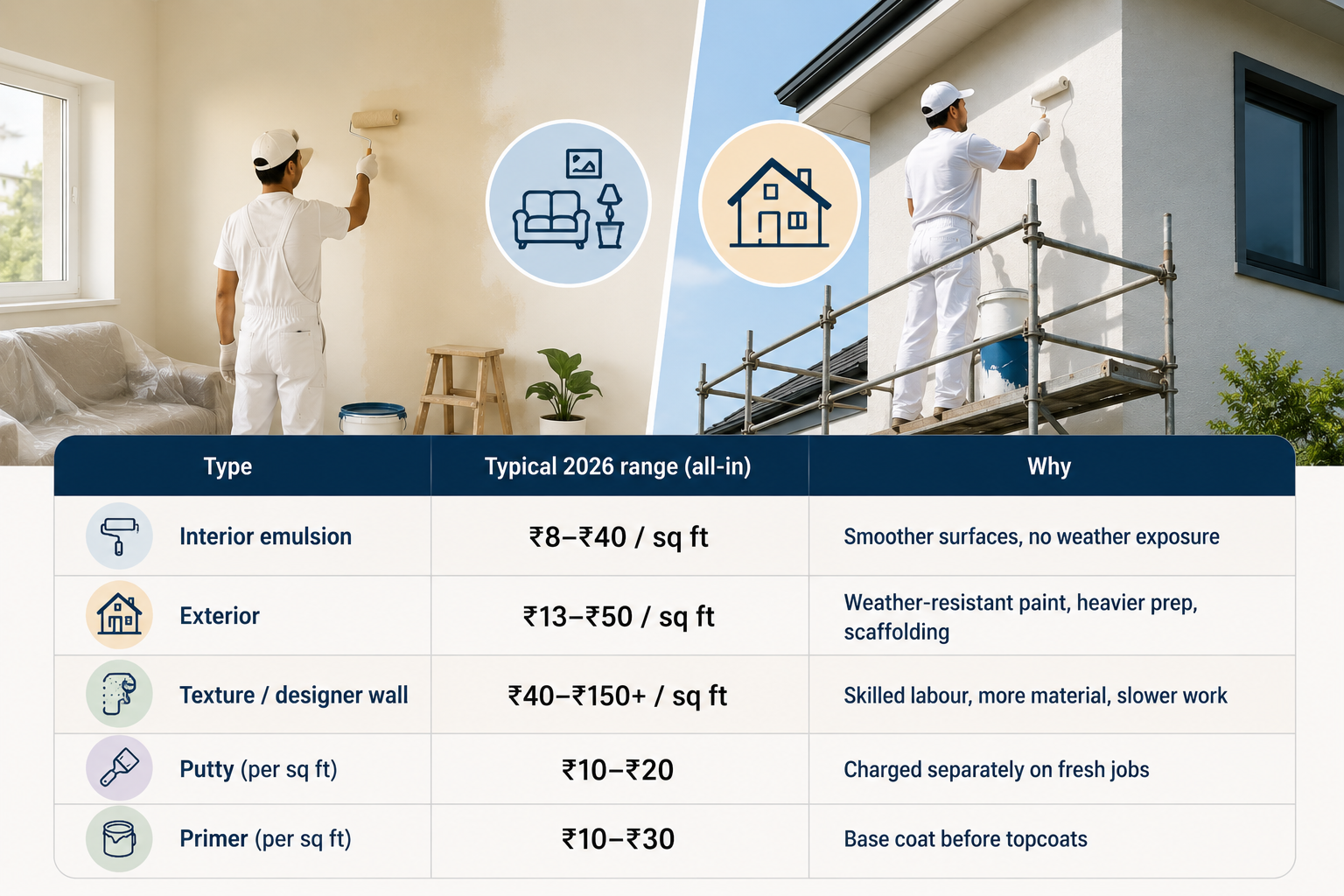
| Type | Typical 2026 range (all-in) | Why |
|---|---|---|
| Interior emulsion | ₹8–₹40 / sq ft | Smoother surfaces, no weather exposure |
| Exterior | ₹13–₹50 / sq ft | Weather-resistant paint, heavier prep, scaffolding |
| Texture / designer wall | ₹40–₹150+ / sq ft | Skilled labour, more material, slower work |
| Putty (per sq ft) | ₹10–₹20 | Charged separately on fresh jobs |
| Primer (per sq ft) | ₹10–₹30 | Base coat before topcoats |
Exterior always costs more than interior for the same home, because outdoor walls need weatherproof paint, more surface preparation, and often scaffolding — none of which interior walls require.
4. What Actually Drives the Price
Six factors explain almost every rupee of difference between two quotes:
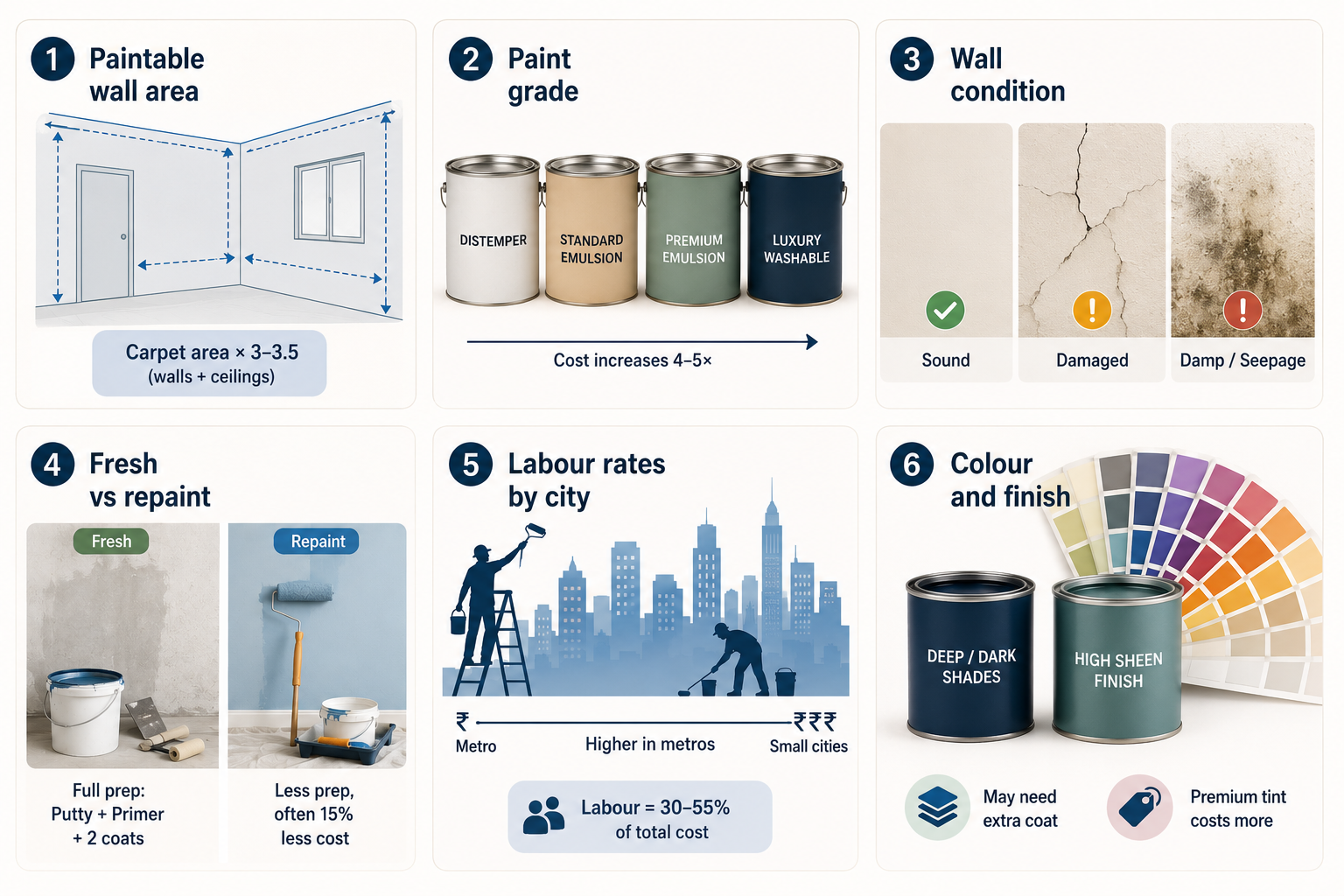
1. Paintable wall area — not floor area. This is the number one source of confusion. Your paintable area is roughly your carpet area multiplied by 3–3.5 (walls plus ceilings), because walls rise on all sides of every room. A "1,000 sq ft flat" can have 2,500+ sq ft of wall to paint.
2. Paint grade. The single biggest lever. Distemper, standard emulsion, premium emulsion and luxury washable paint can differ by 4–5× per square foot.
3. Wall condition. Sound walls need light sanding and paint. Damaged walls need crack-filling, full putty, extra primer — sometimes doubling prep cost. Damp or seepage-affected walls need waterproofing first, or the new paint fails within a year.
4. Fresh vs repaint. New plaster needs the full stack: putty, primer, two coats. A repaint on a sound wall can often skip full putty, so it costs roughly 15% less.
5. Labour rates by city. Skilled painter day-rates in metros run higher than in smaller cities. Labour is usually 30–55% of the all-in per-sq-ft rate.
6. Colour and finish. Deep or dark shades and high-sheen finishes can need an extra coat, and premium tint bases cost more.
5. How to Measure Paintable Area Yourself
You don't need the contractor's word for this. For each room:
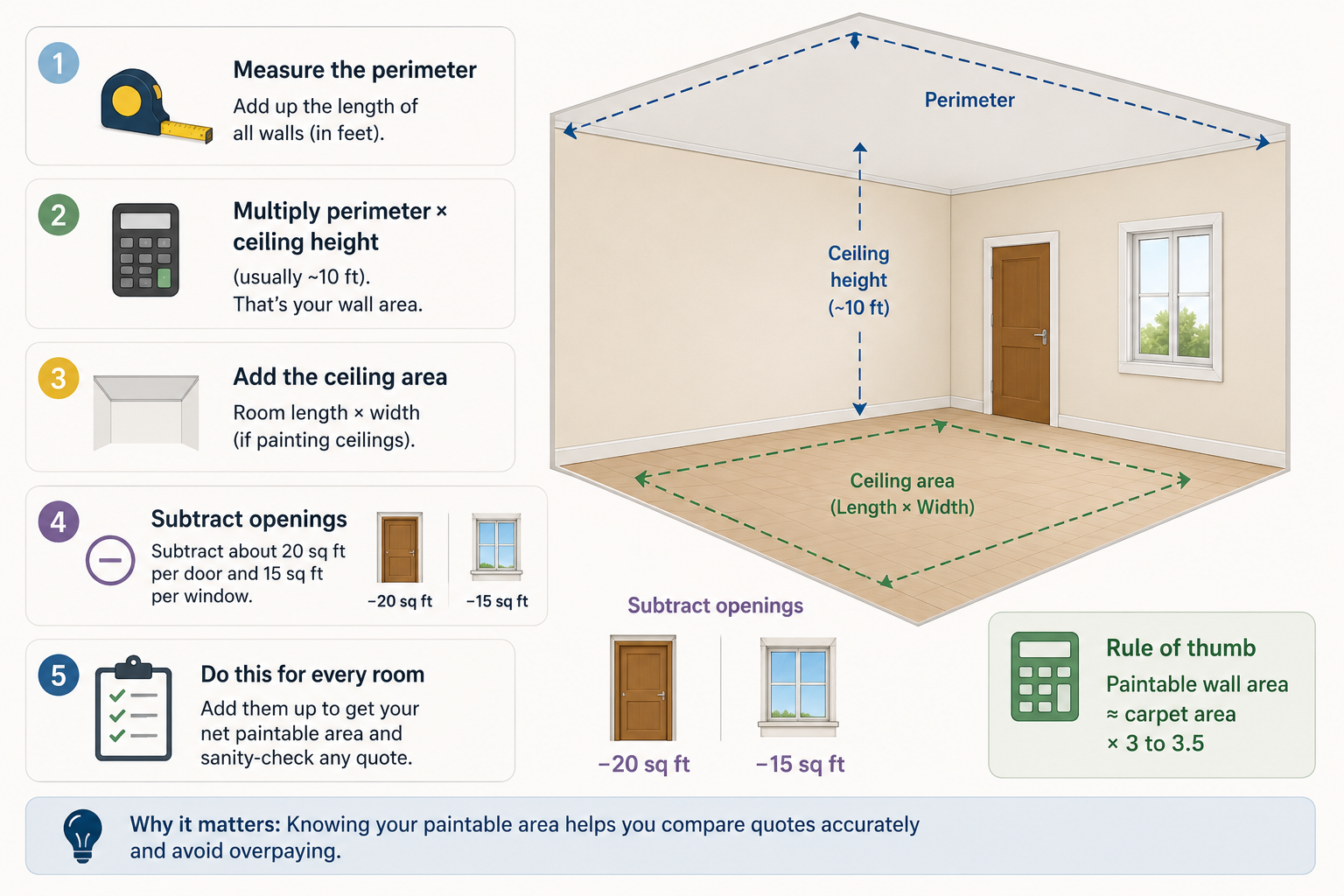
- Measure the perimeter — add up the length of all walls (in feet).
- Multiply perimeter × ceiling height (usually ~10 ft). That's your wall area.
- Add the ceiling area (room length × width) if you're painting ceilings.
- Subtract about 20 sq ft per standard door and 15 sq ft per window.
Do this for every room, add them up, and you have your net paintable area. Now you can sanity-check any quote: if a contractor's area is wildly higher than yours, ask why — a common trick is measuring gross area and ignoring door/window deductions.
Rule of thumb: paintable wall area ≈ carpet area × 3 to 3.5.
6. How Much Paint Your Home Actually Needs
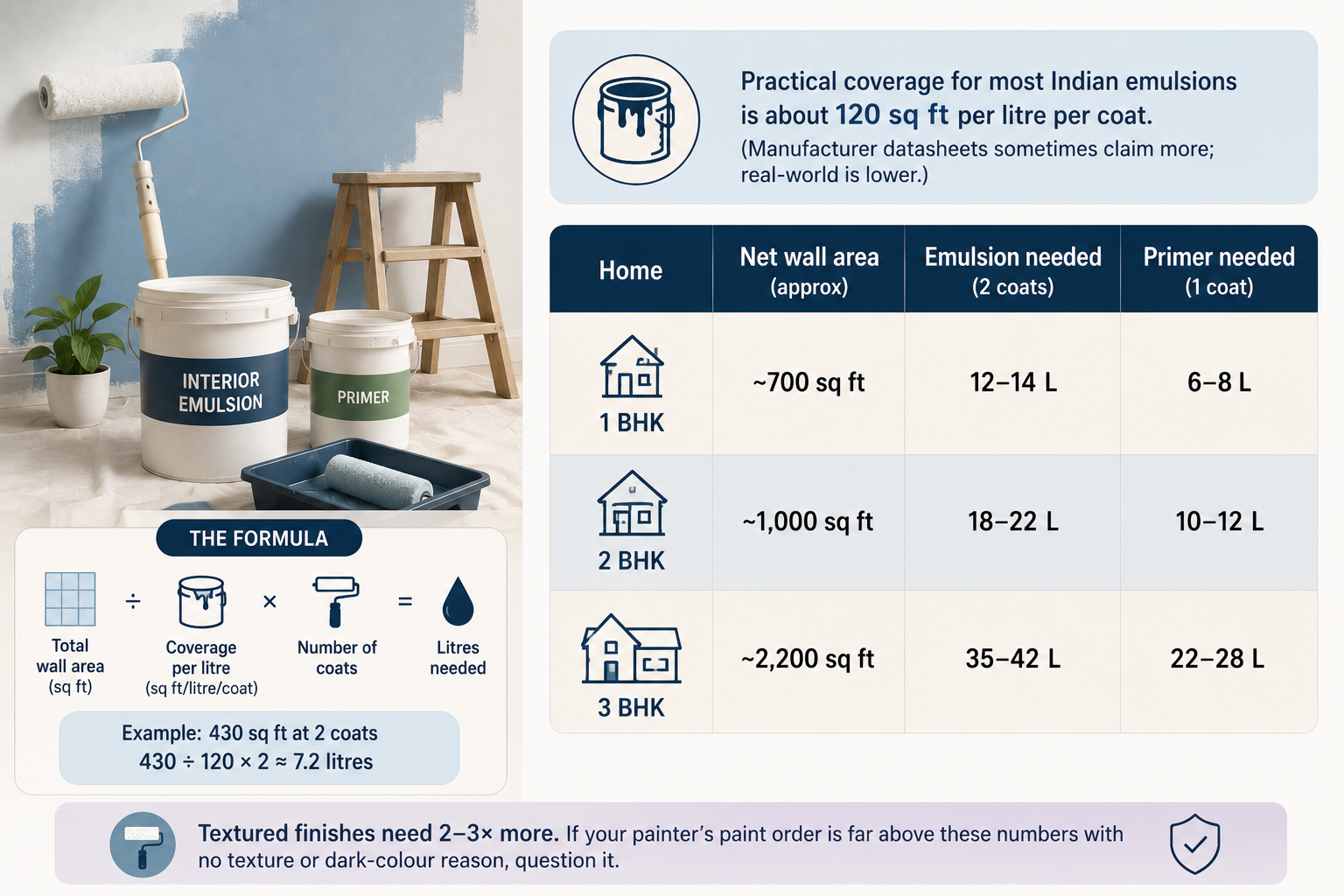
Knowing the quantity protects you from being billed for material you'll never see. The formula:
Litres needed = Total wall area ÷ coverage per litre × number of coats
Practical coverage for most Indian emulsions is about 120 sq ft per litre per coat (manufacturer datasheets sometimes claim more; real-world is lower). So a room with 430 sq ft of net wall area at two coats needs roughly 430 ÷ 120 × 2 ≈ 7.2 litres.
Ballpark whole-home quantities (two coats, interior emulsion):
| Home | Net wall area | Emulsion needed | Primer (1 coat) |
|---|---|---|---|
| 1 BHK | ~700 sq ft | 12–14 L | 6–8 L |
| 2 BHK | ~1,000 sq ft | 18–22 L | 10–12 L |
| 3 BHK | ~2,200 sq ft | 35–42 L | 22–28 L |
Textured finishes need 2–3× more. If your painter's paint order is far above these numbers with no texture or dark-colour reason, question it.
7. Paint Grades Explained
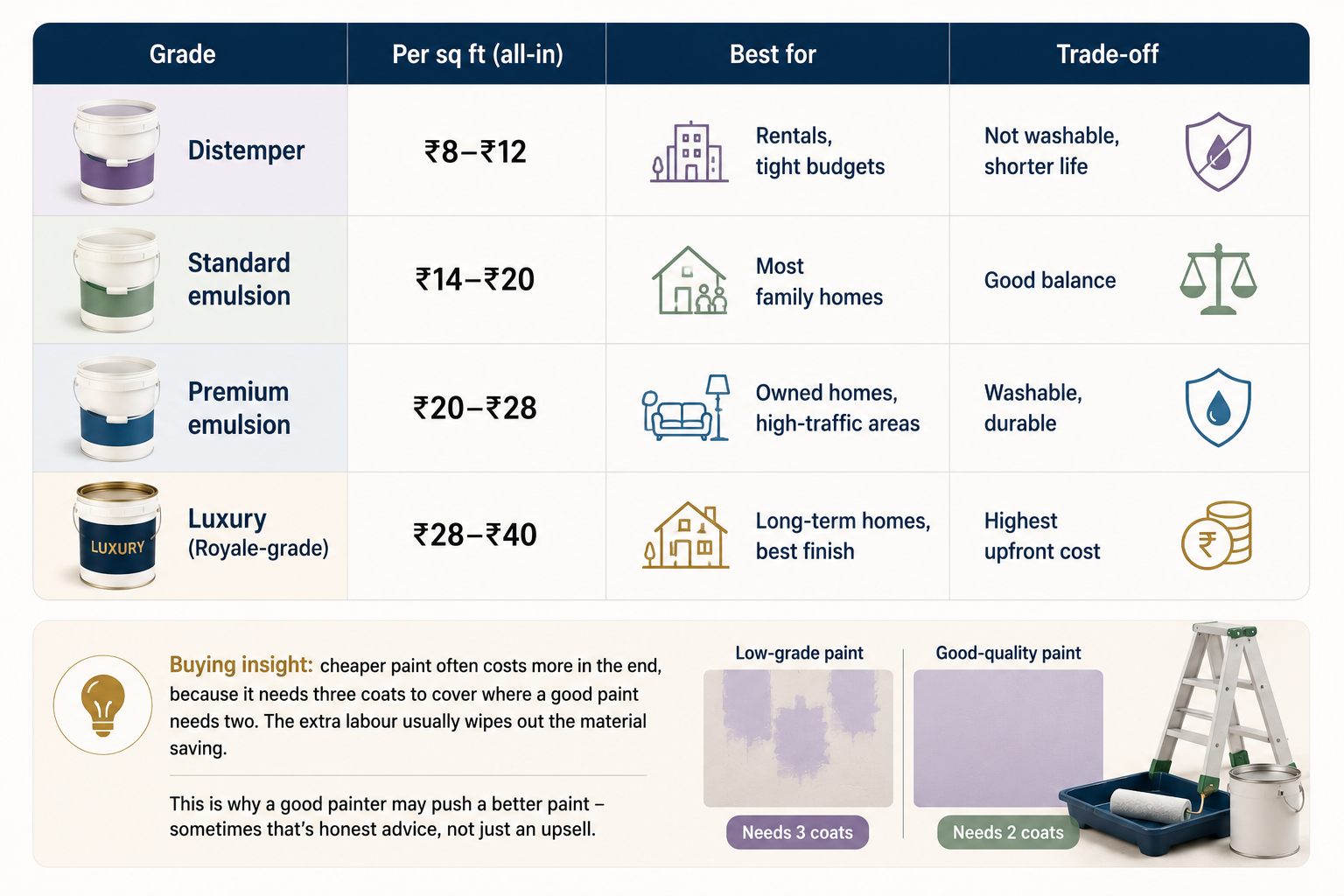
| Grade | Per sq ft (all-in) | Best for | Trade-off |
|---|---|---|---|
| Distemper | ₹8–₹12 | Rentals, tight budgets | Not washable, shorter life |
| Standard emulsion | ₹14–₹20 | Most family homes | Good balance |
| Premium emulsion | ₹20–₹28 | Owned homes, high-traffic areas | Washable, durable |
| Luxury (Royale-grade) | ₹28–₹40 | Long-term homes, best finish | Highest upfront cost |
Buying insight: cheaper paint often costs more in the end, because it needs three coats to cover where a good paint needs two. The extra labour usually wipes out the material saving. This is why a good painter may push a better paint — sometimes that's honest advice, not just an upsell.
8. Fresh Painting vs Repainting
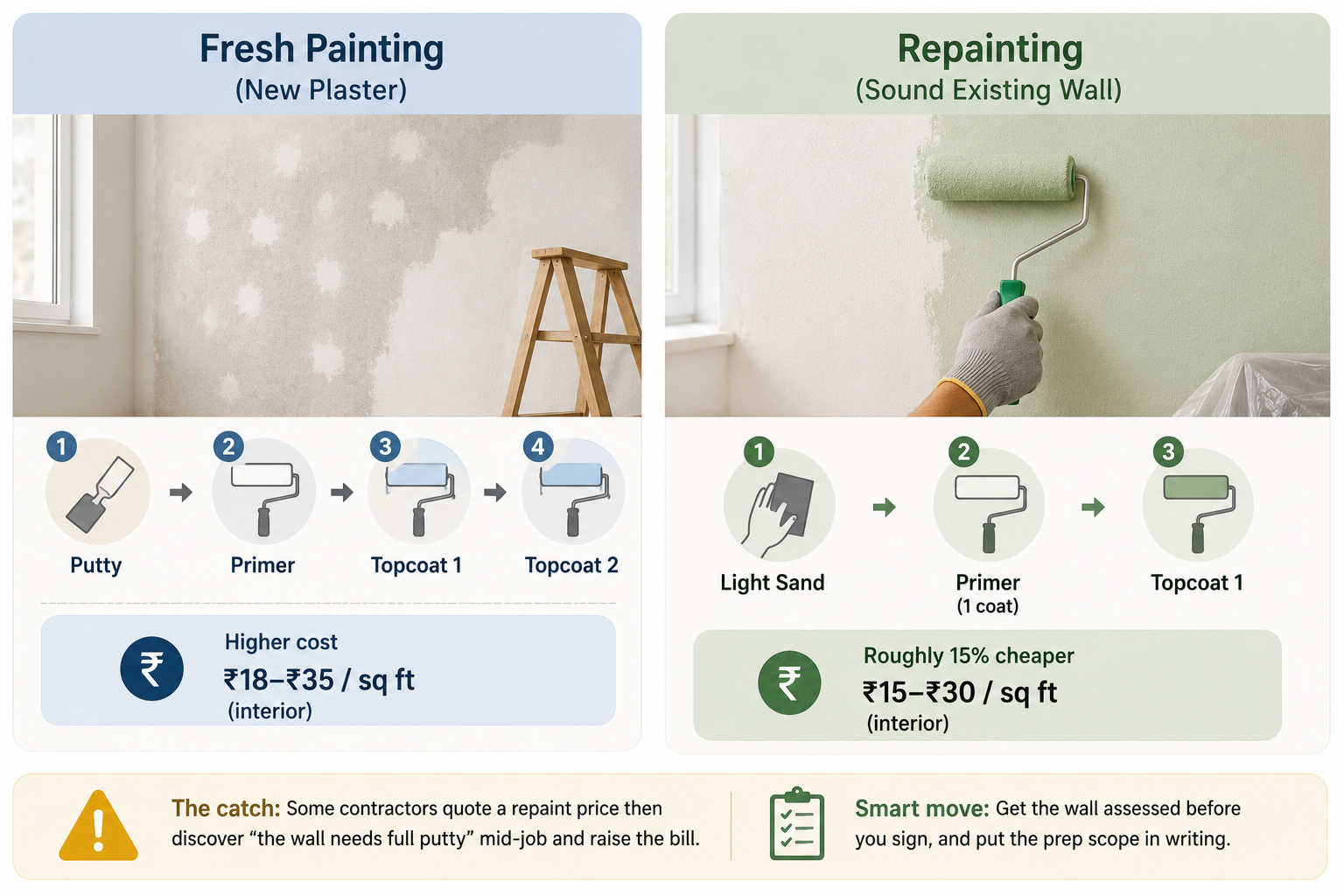
Fresh painting (new plaster): needs the full sequence — putty + primer + two topcoats. Higher cost, ₹18–₹35/sq ft interior.
Repainting (sound existing wall): can often skip full putty; a light sand plus one primer coat is enough. Roughly 15% cheaper.
The catch: some contractors quote a repaint price then discover "the wall needs full putty" mid-job and raise the bill. Get the wall assessed before you sign, and put the prep scope in writing.
9. Labour Charges
Labour is typically ₹4–₹12 per sq ft, or 30–55% of the all-in rate. In 2026, skilled painter day-rates commonly run ₹600–₹900 and a helper ₹400–₹550, though this varies by city.
Two ways painters price labour:
- Per sq ft — cleaner, easier to compare, better for you.
- Per day — riskier, because a slow crew costs you more. Only use day-rate for small, well-defined jobs.
Prefer a per-sq-ft labour quote for a full-home job.
10. Hidden Costs Nobody Quotes Upfront
These are the line items that turn a ₹25,000 quote into a ₹35,000 bill:
- Doors, window frames and grills — often excluded from the wall quote, then billed as enamel work.
- Full putty on walls quoted as a simple repaint.
- Waterproofing for damp walls — necessary, but should be flagged before, not sprung mid-job.
- Scaffolding for exterior or high ceilings.
- Furniture moving and masking — sometimes charged extra.
- Ceiling paint — occasionally quoted separately.
- Extra coats for dark colours.
- Post-painting cleanup — ask whether it's included.
Ask "what is not included in this price?" before signing. It's the most useful question you can ask.
11. How Painters Overcharge — and How to Catch It
Three tactics account for most painting losses in India:
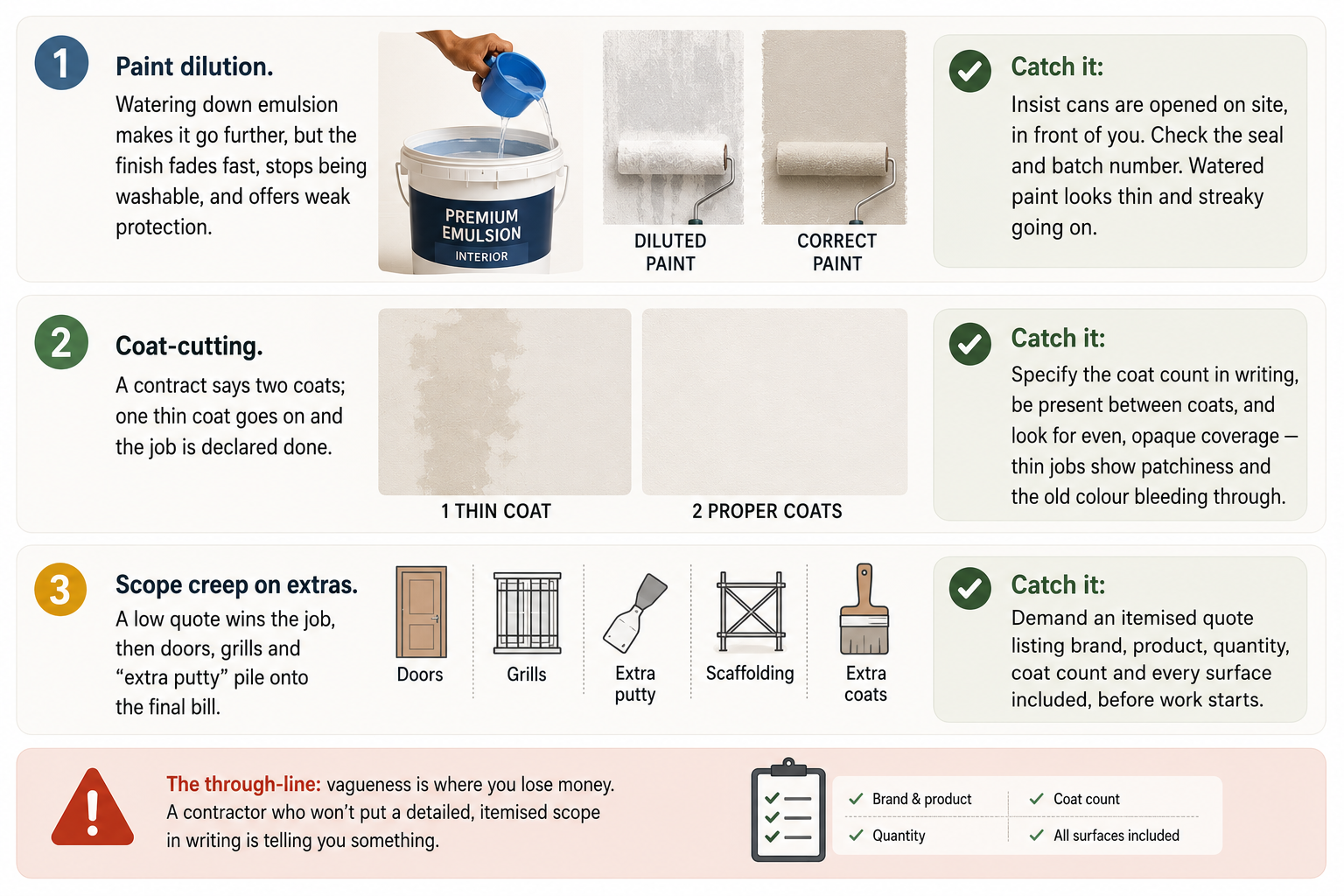
Paint dilution. Watering down emulsion makes it go further, but the finish fades fast, stops being washable, and offers weak protection. Catch it: insist cans are opened on site, in front of you. Check the seal and batch number. Watered paint looks thin and streaky going on.
Coat-cutting. A contract says two coats; one thin coat goes on and the job is declared done. Catch it: specify the coat count in writing, be present between coats, and look for even, opaque coverage — thin jobs show patchiness and the old colour bleeding through.
Scope creep on extras. A low quote wins the job, then doors, grills and "extra putty" pile onto the final bill. Catch it: demand an itemised quote listing brand, product, quantity, coat count and every surface included, before work starts.
The through-line: vagueness is where you lose money. A contractor who won't put a detailed, itemised scope in writing is telling you something.
12. How to Read and Compare Quotes
A legitimate quote is never a single lump-sum number. It should break down:
- Labour charges (per sq ft or total)
- Paint brand, exact product name and grade
- Quantity of paint and primer in litres
- Putty and surface-prep scope
- Number of coats (standard is 1 putty + 1 primer + 2 topcoats)
- Every surface included (walls, ceilings, doors, grills)
- Timeline and warranty
How to compare fairly: get at least three itemised quotes and compare them line by line on the same paint and coat count — not just on the bottom-line total. A cheaper total often just means less paint, fewer coats, or excluded surfaces.
13. When to DIY and When to Hire a Pro
Reasonable DIY: a single small room, a touch-up, an accent wall, or a rental you want freshened cheaply. Paint plus roller and tray is a modest outlay if your walls are sound.
Hire a pro when: the whole home needs doing, walls have cracks/damp/seepage, you want a washable premium finish, ceilings or exteriors are involved, or you simply can't afford the days off and the mess. Prep is where amateurs lose — skipped prep is the top reason DIY paint jobs fail, and fixing a bad job costs more than doing it right once.
Honest rule: DIY the small and simple; hire out the large, the damaged and the high.
14. Seasonal Timing and Monsoon Warnings
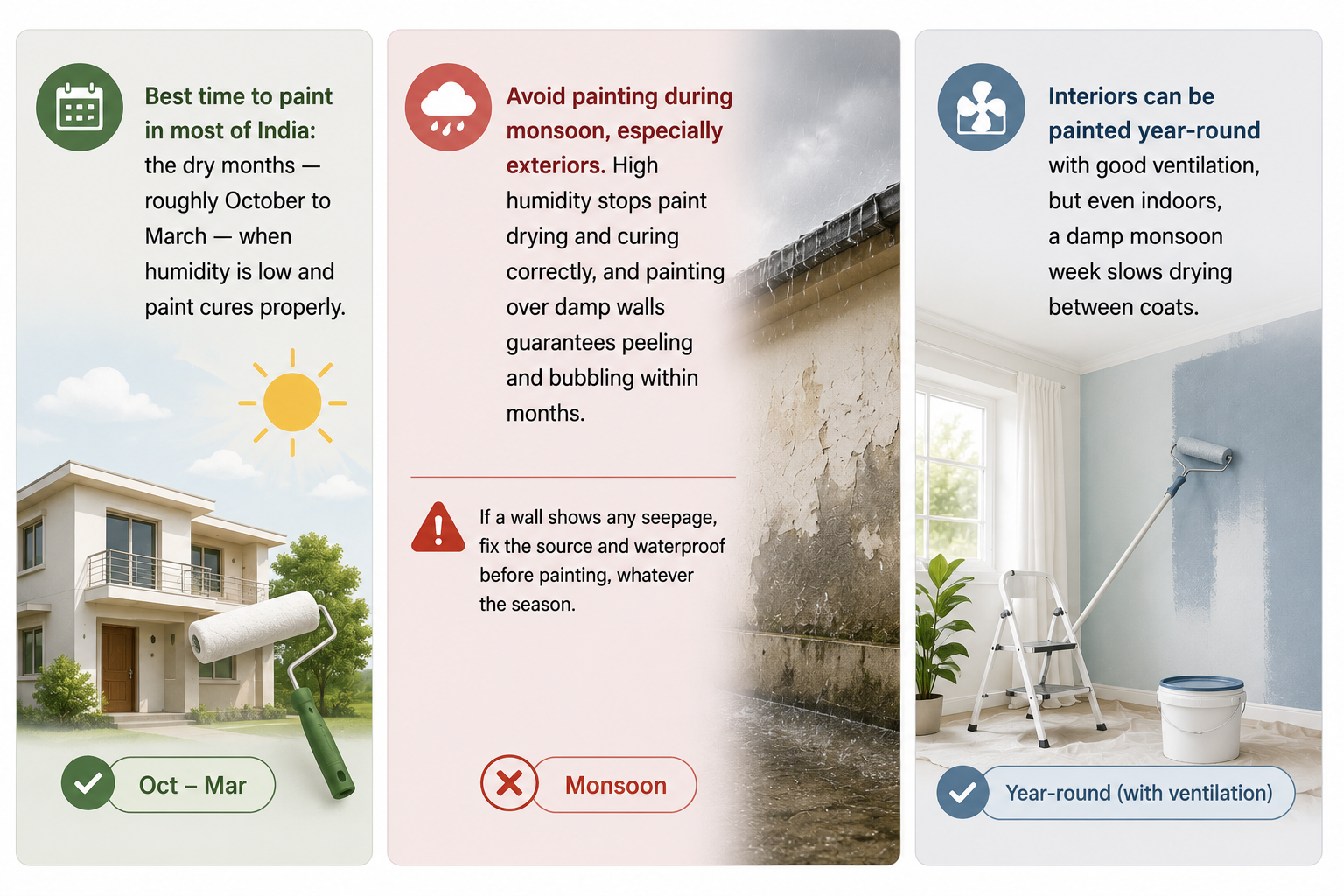
Best time to paint in most of India: the dry months — roughly October to March — when humidity is low and paint cures properly.
Avoid painting during monsoon, especially exteriors. High humidity stops paint drying and curing correctly, and painting over damp walls guarantees peeling and bubbling within months. If a wall shows any seepage, fix the source and waterproof before painting, whatever the season.
Interiors can be painted year-round with good ventilation, but even indoors, a damp monsoon week slows drying between coats.
15. How Long a Paint Job Should Last
- Interior emulsion: 4–7 years for a good premium paint, applied well.
- Exterior: most homes need repainting every 5–8 years depending on climate and paint quality.
- Distemper: shorter — a couple of years, and it can't be washed.
If a fresh premium job is failing within a year, the usual culprits are diluted paint, skipped primer, painting over damp, or too few coats — all avoidable with the checks above.
16. Getting It Done Through HomeTriangle
When the job is bigger than a weekend — a full home, damaged walls, or a finish you want to last — a vetted professional is worth it. HomeTriangle connects you with verified painters, shows upfront package pricing, and carries genuine customer reviews so you can compare before you commit. The value for a cost-anxious homeowner is exactly the protection this guide is about: a clear scope and a known price instead of a vague lump sum.
If your walls need repair before paint, HomeTriangle's handyman and carpentry services can handle prep, and house cleaning covers the post-paint clean-up that quotes usually leave out. Planning a bigger refresh? Pair painting with interior design to plan colour and finish together.
KEY TAKEAWAYS
- Budget ₹8–₹40/sq ft interior, ₹13–₹50/sq ft exterior, all-in, for 2026.
- A mid-range 2 BHK typically runs ₹18,000–₹28,000.
- You pay by paintable wall area (carpet area × ~3–3.5), not floor area.
- Paint grade and wall condition drive most of the price difference.
- The three big money-losers are diluted paint, missing coats, and extras (doors/grills/putty).
- Itemised written quotes naming brand, quantity and coats are your best protection.
- Get three quotes and compare line by line, not on total price.
- Paint in the dry season; never over damp walls or during monsoon.
MYTH vs FACT
| Myth | Fact |
|---|---|
| "Cost is based on the flat's square footage." | You pay by paintable wall area, which is roughly 3–3.5× the carpet area. |
| "Cheaper paint saves money." | Cheap paint often needs a third coat, and the extra labour erases the saving. |
| "A single lump-sum quote is fine." | A quote with no breakdown is where most overcharging hides. Demand line items. |
| "More coats always means a better job." | Two coats of good paint is standard. A push for three can be a genuine need — or padding. |
| "Painting fixes damp walls." | Paint over damp peels within months. Waterproof first, always. |
| "Any season is fine to paint." | Monsoon humidity ruins curing, especially outdoors. Dry months are best. |
COMMON MISTAKES
- Comparing quotes on total price alone instead of the same paint and coat count.
- Not deducting doors and windows when checking the contractor's area math.
- Paying a large advance — cap it at ~30% and tie the rest to milestones.
- Not being present when cans are opened or between coats.
- Skipping the "what's excluded?" question and getting surprised by grill/door charges.
- Painting over seepage and blaming the paint when it fails.
- Choosing a dark accent wall on impulse — a top regret; test a sample patch first.
- No written warranty on workmanship.
EXPERT TIPS
- Get a 1–2 year workmanship warranty in writing before work begins.
- Verify the paint on delivery — brand, batch number, sealed tins, opened on site.
- Use a manufacturer paint calculator (Asian Paints, Berger, Dulux) to independently check quantity.
- Buy in 20-litre packs for whole-home jobs — cheaper per litre than small cans.
- Skip premium paint on ceilings — standard ceiling white is fine and saves money.
- Sample before you commit — one colour looks different in different rooms and lighting.
- Photograph walls before work so any new damage is clearly the crew's.
PRE-PAINTING CHECKLIST
- [ ] Measured my own paintable wall area
- [ ] Decided paint grade (distemper / standard / premium / luxury)
- [ ] Checked walls for cracks, damp, seepage
- [ ] Got 3 itemised, written quotes
- [ ] Compared quotes line by line on same paint + coats
- [ ] Confirmed what's included (doors, grills, ceilings, cleanup)
- [ ] Agreed coat count and prep scope in writing
- [ ] Capped advance at ~30%, rest on milestones
- [ ] Warranty in writing
- [ ] Scheduled for the dry season
- [ ] Plan to be present when cans open and between coats

Comments ()