
Diwali Electrical & Lighting Safety (India 2026): The Complete Guide to a Fire-Free Festival
Prevent festive electrical fires this Diwali 2026. Wiring checks, load management, fairy-light safety, MCB vs RCCB, and when to call an electrician — the complete guide.
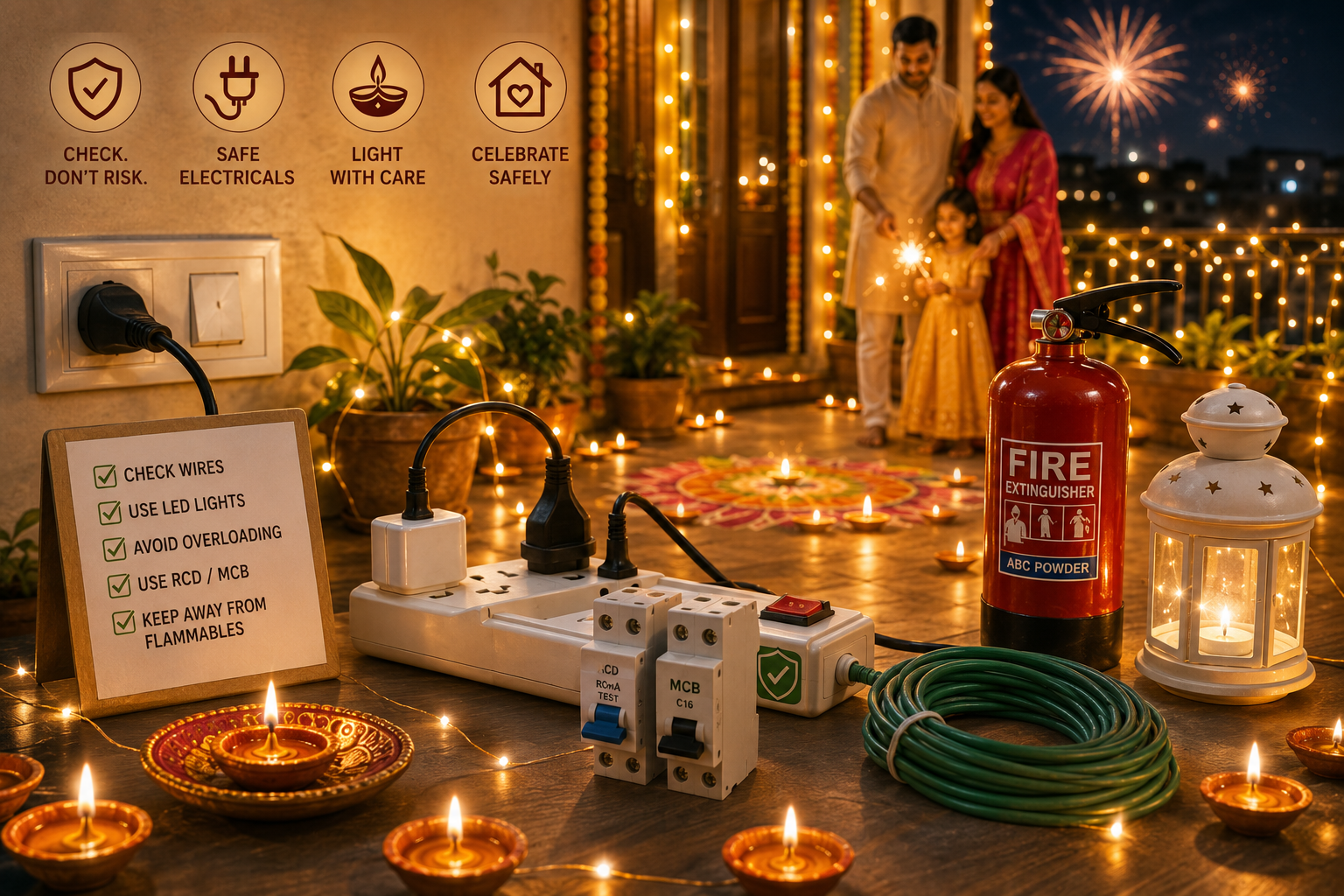
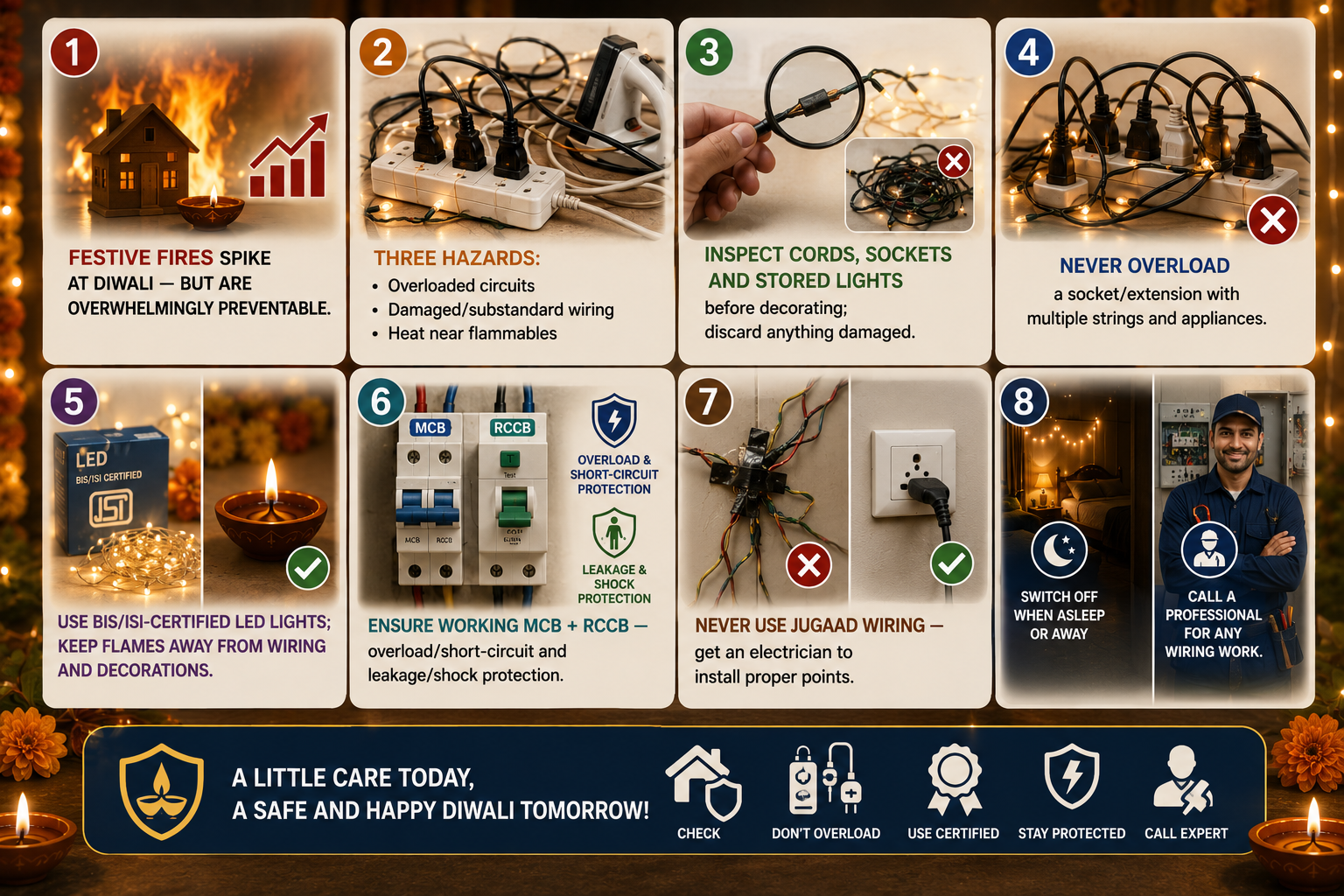
To stay safe with Diwali lighting: use only BIS/ISI-certified lights; never overload a single socket or extension board with multiple light strings and appliances; check all wiring and cords for fraying or damage before use; keep diyas and candles away from electrical fittings and flammable decorations; prefer LED lights (cooler and lower-wattage than incandescent); never leave decorative lights on when asleep or away; and ensure your home has a working MCB and RCCB. Fire incidents spike during Diwali — in Delhi, fire-service calls on Diwali night 2024 were the highest in 13 years — and most are preventable with these steps. For old or overloaded wiring, get a licensed electrician to inspect before the festival.
Diwali electrical safety in India centres on three risks: overloaded circuits, damaged or substandard wiring, and heat from lights near flammable decorations. Fire incidents surge during the festival — Delhi Fire Services logged 318 calls on Diwali night 2024, the highest in 13 years and up over 53% year-on-year, and Tamil Nadu reported 150 fire accidents during Deepavali 2024. Prevention: use only BIS/ISI-certified lights and products; avoid plugging multiple light strings and appliances into one socket or extension board; inspect all cords and wiring for fraying, cracks or loose connections before use; prefer LED lights, which run cooler and draw less power than incandescent; keep diyas and candles away from wiring and paper decorations; secure and weatherproof outdoor wiring; never leave decorative lights on unattended or overnight; and ensure the home has working protection — an MCB (cuts overload and short circuits) plus an RCCB (cuts leakage current in milliseconds to protect against shock). Homes older than 10–15 years, or before adding high-load fixtures, should get a licensed electrician's inspection. Avoid 'jugaad' temporary wiring — a thin unsanctioned connection behind a curtain is a common fire cause.
Summary
Diwali is the festival of lights — and, every year across India, a spike in preventable house fires. The lights, the extra appliances, the temporary connections, the diyas near decorations: festive homes carry far more electrical load and fire risk than usual, often on wiring that was never checked.
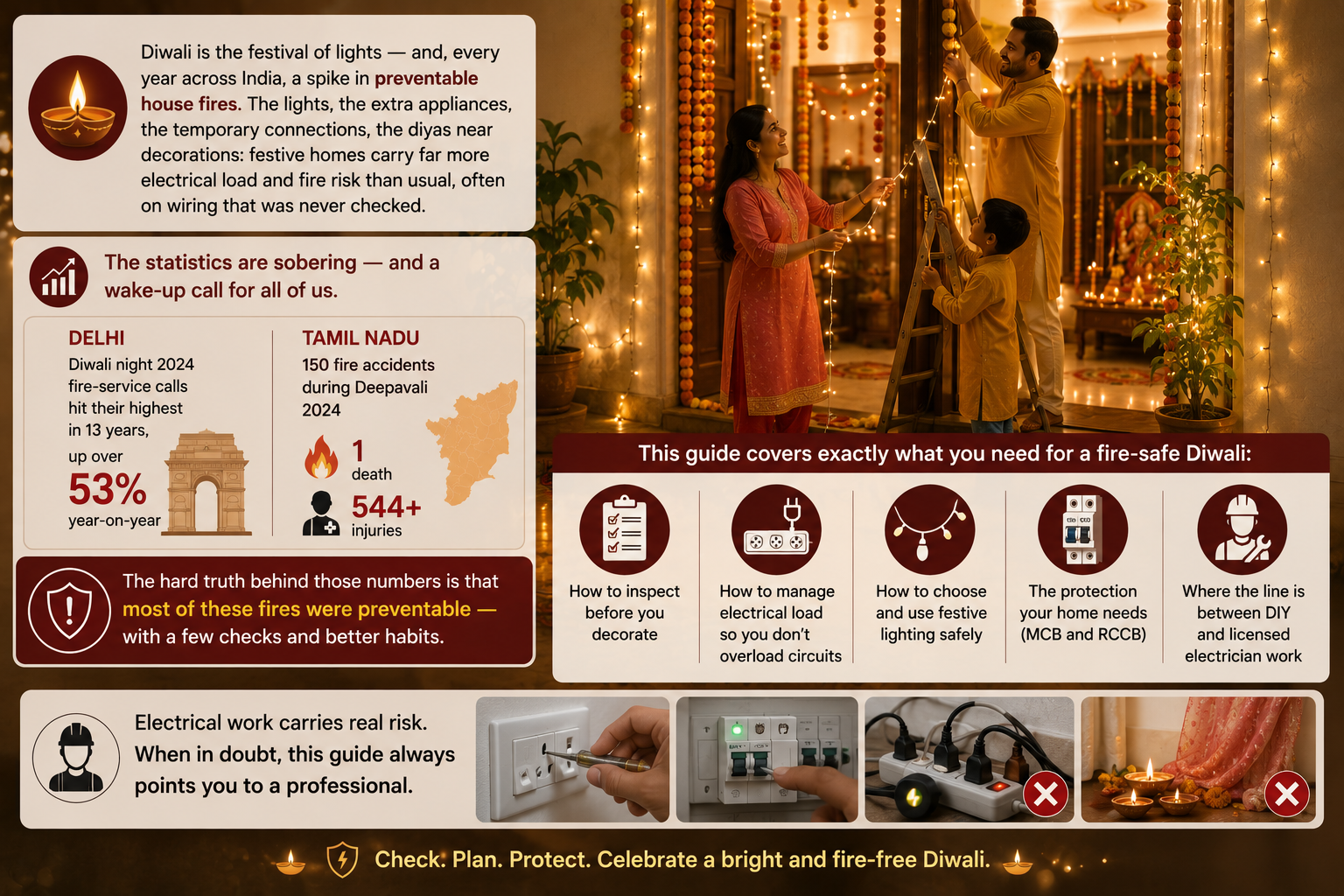
The statistics are sobering and worth stating plainly, because they're the reason this guide exists: in Delhi, fire-service calls on Diwali night 2024 hit their highest in 13 years, up over 53% year-on-year; Tamil Nadu recorded 150 fire accidents during Deepavali 2024 with one death and over 544 injuries. The hard truth behind those numbers is that most of these fires were preventable — with a few checks and better habits.
This guide covers exactly those: how to inspect before you decorate, how to manage electrical load so you don't overload circuits, how to choose and use festive lighting safely, the protection your home needs (MCB and RCCB), and — importantly — where the line is between what you can safely do yourself and what needs a licensed electrician. Electrical work carries real risk; when in doubt, this guide always points you to a professional.
1. Why Diwali Is High-Risk (The Numbers)
Diwali concentrates several fire risks into a few days: more decorative lighting, more appliances running at once, temporary wiring set up in a hurry, and open flames (diyas, candles) near paper and fabric decorations. Add wiring that hasn't been inspected in years, and the risk climbs.
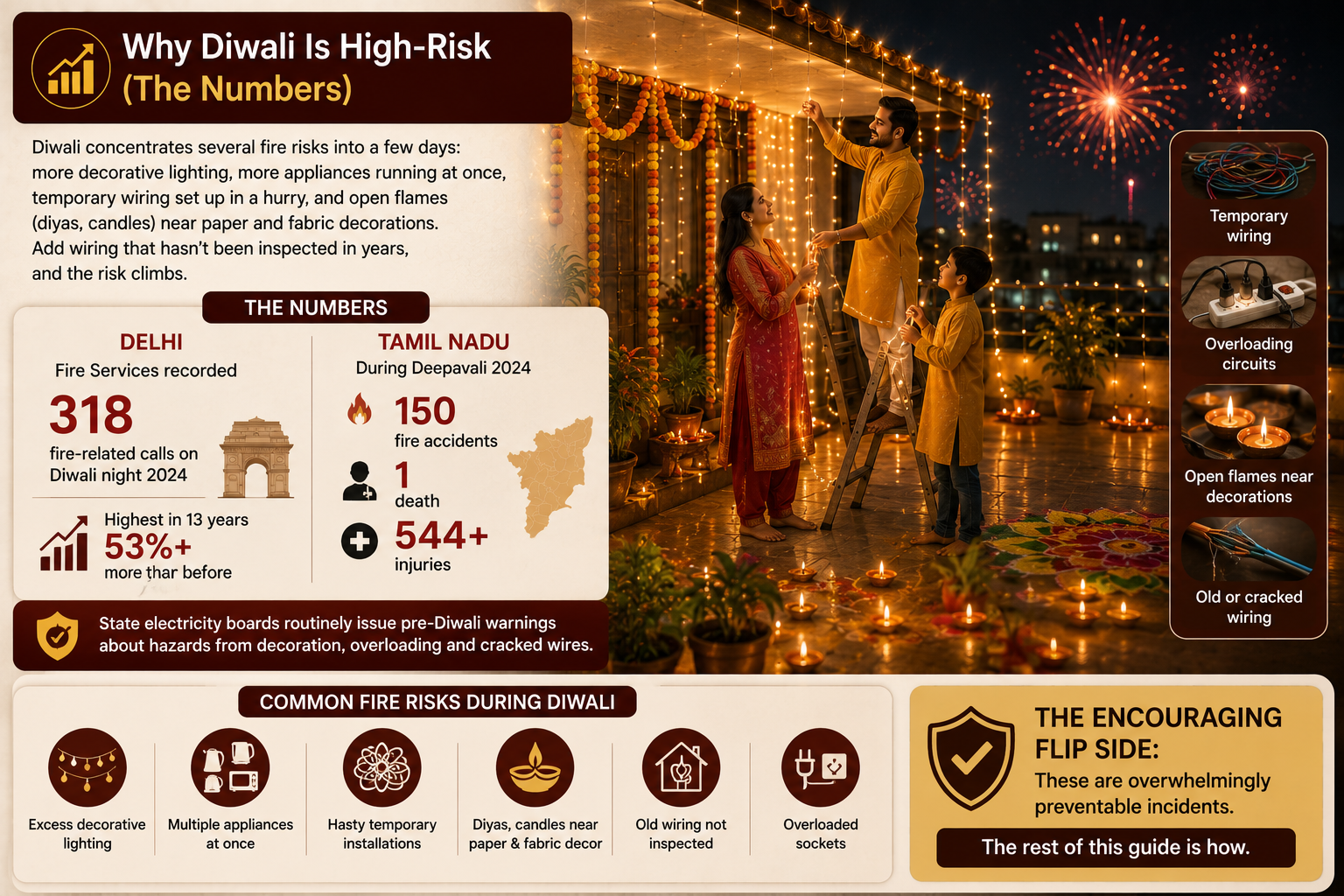
The data makes it concrete. In Delhi, the Fire Services recorded 318 fire-related calls on Diwali night 2024 — the highest in 13 years, and over 53% more than the year before. In Tamil Nadu in 2024, 150 fire accidents were reported during Deepavali, resulting in one death and over 544 injuries. State electricity boards routinely issue pre-Diwali warnings about hazards from decoration, overloading and cracked wires.
The encouraging flip side: these are overwhelmingly preventable incidents. The rest of this guide is how.
2. The Three Main Hazards
Almost every festive electrical fire traces to one of these:
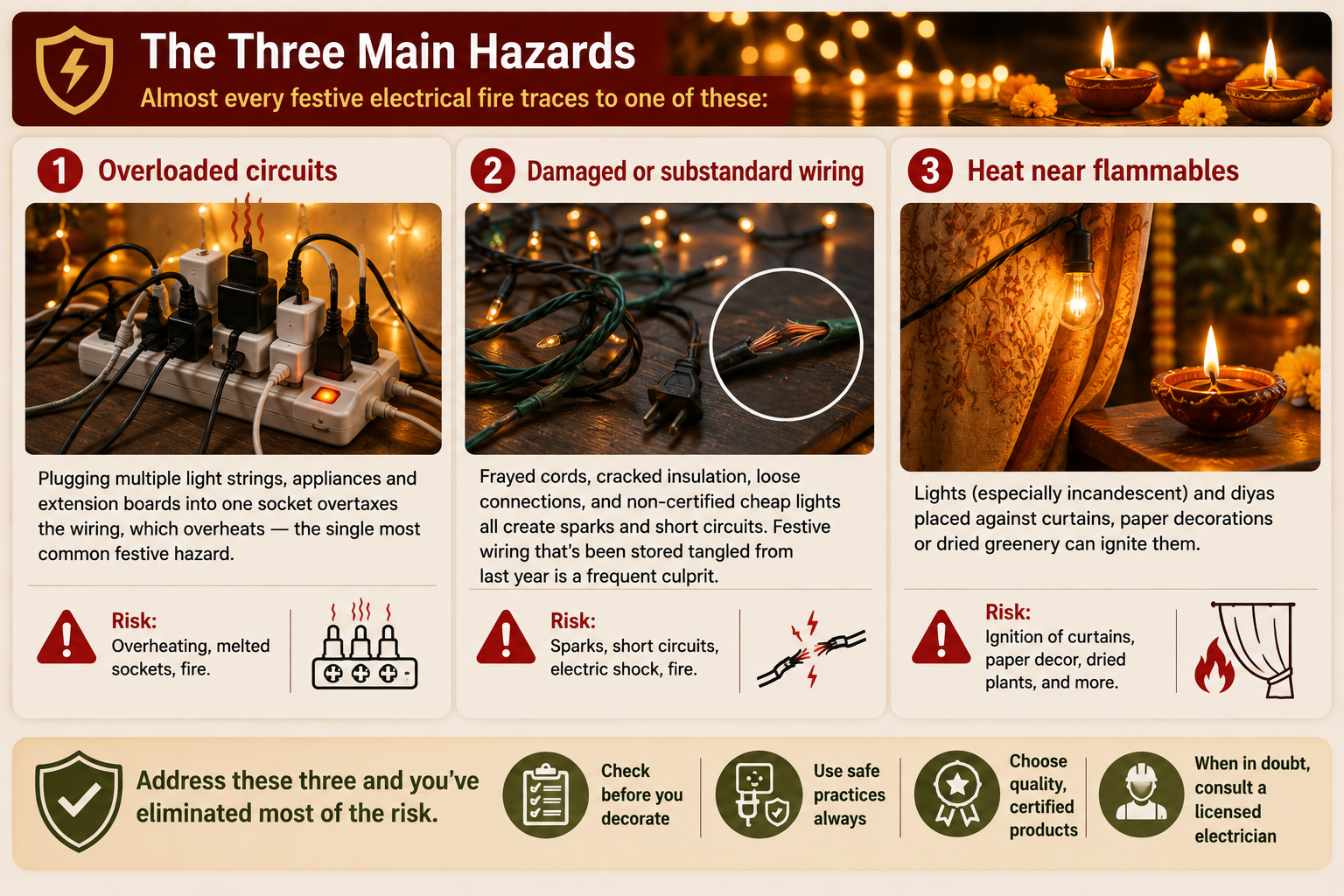
1. Overloaded circuits. Plugging multiple light strings, appliances and extension boards into one socket overtaxes the wiring, which overheats — the single most common festive hazard.
2. Damaged or substandard wiring. Frayed cords, cracked insulation, loose connections, and non-certified cheap lights all create sparks and short circuits. Festive wiring that's been stored tangled from last year is a frequent culprit.
3. Heat near flammables. Lights (especially incandescent) and diyas placed against curtains, paper decorations or dried greenery can ignite them.
Address these three and you've eliminated most of the risk.
3. Before You Decorate: The Inspection
Before plugging in a single light, walk your home and check:
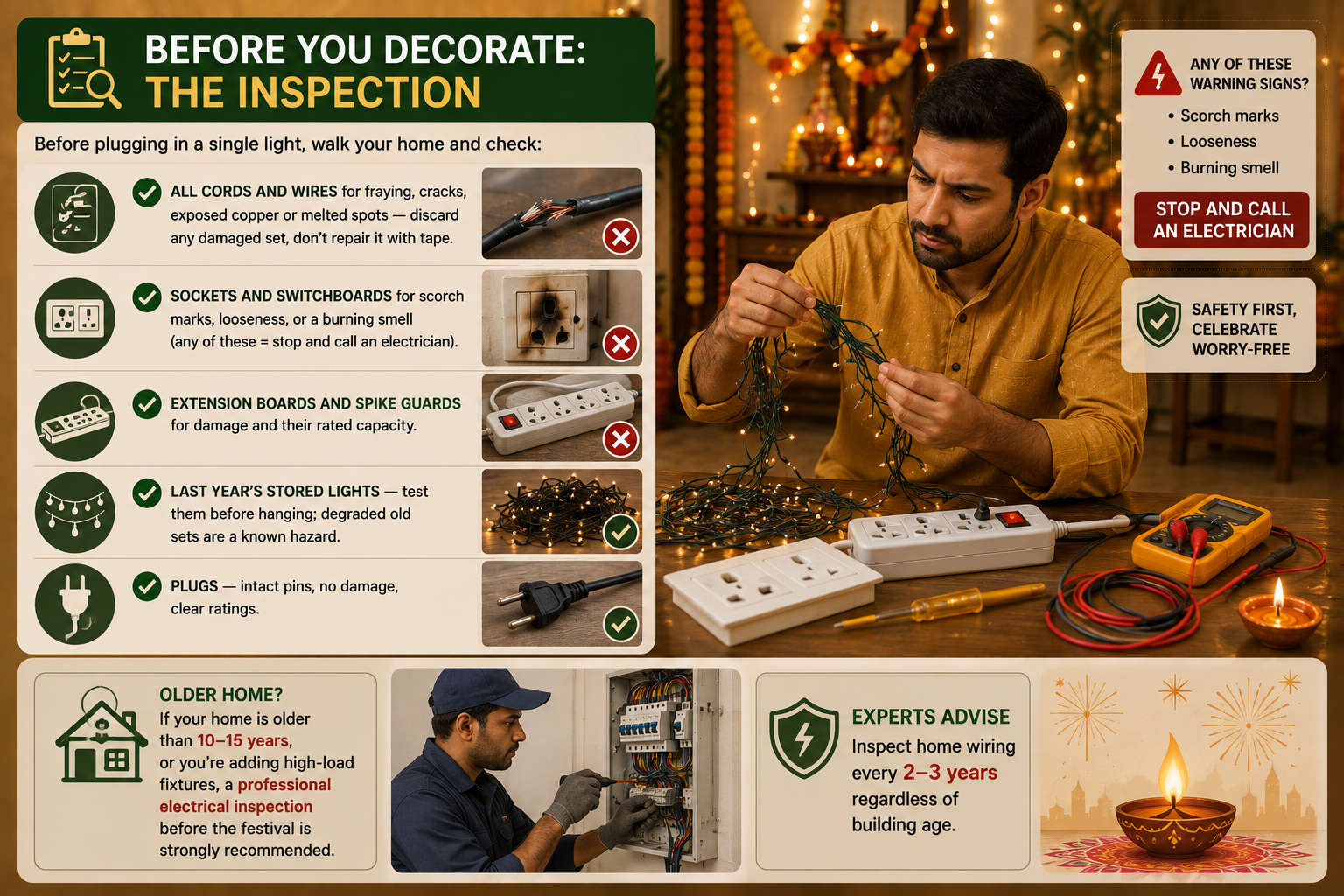
- All cords and wires for fraying, cracks, exposed copper or melted spots — discard any damaged set, don't repair it with tape.
- Sockets and switchboards for scorch marks, looseness, or a burning smell (any of these = stop and call an electrician).
- Extension boards and spike guards for damage and their rated capacity.
- Last year's stored lights — test them before hanging; degraded old sets are a known hazard.
- Plugs — intact pins, no damage, clear ratings.
If your home is older than 10–15 years, or you're adding high-load fixtures, a professional electrical inspection before the festival is strongly recommended — this is the highest-value safety step you can take. Experts advise inspecting home wiring every 2–3 years regardless of building age.
4. Managing Electrical Load (Avoiding Overload)
Overloading is the top festive hazard, so manage it deliberately:
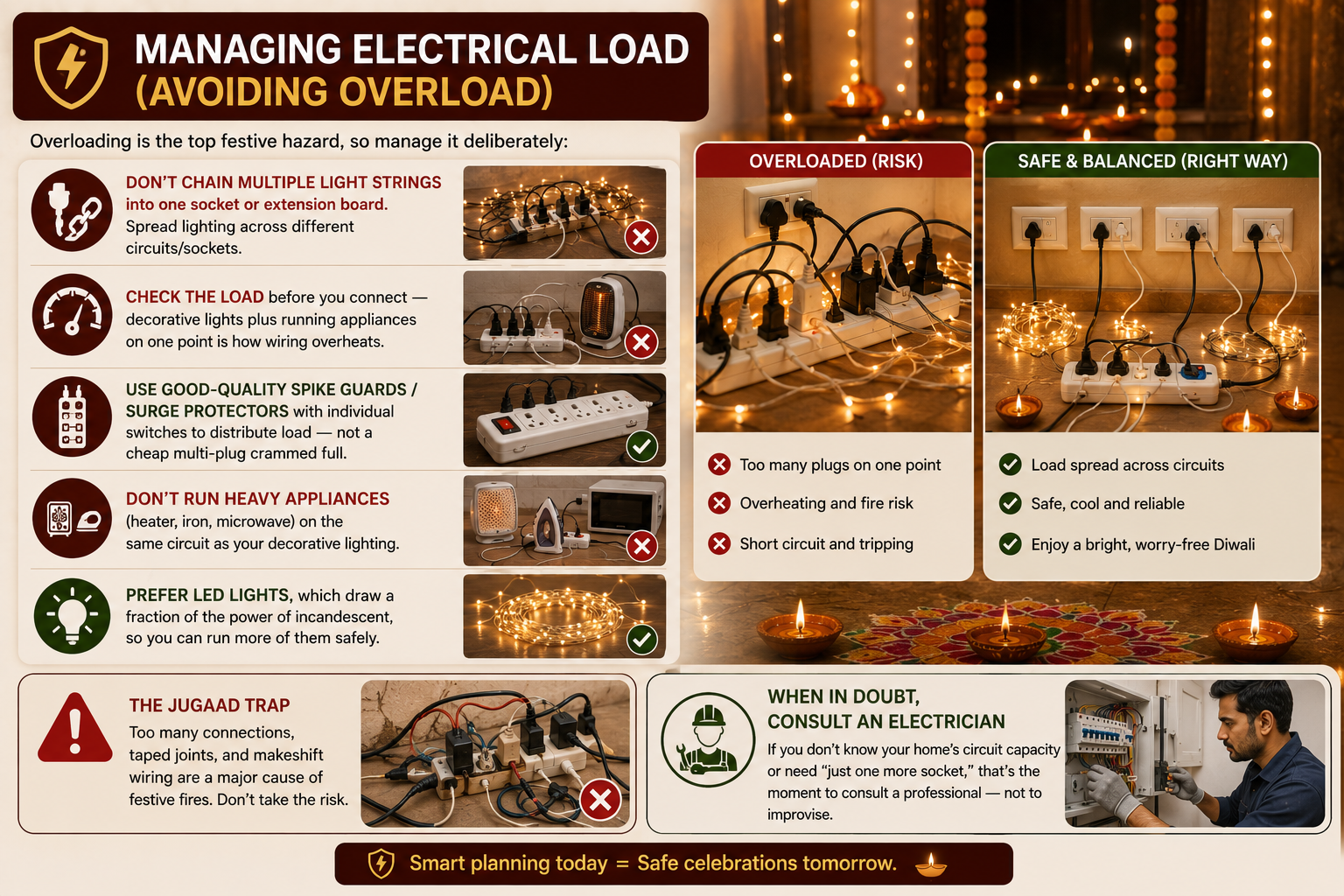
- Don't chain multiple light strings into one socket or extension board. Spread lighting across different circuits/sockets.
- Check the load before you connect — decorative lights plus running appliances on one point is how wiring overheats.
- Use good-quality spike guards / surge protectors with individual switches to distribute load — not a cheap multi-plug crammed full.
- Don't run heavy appliances (heater, iron, microwave) on the same circuit as your decorative lighting.
- Prefer LED lights, which draw a fraction of the power of incandescent, so you can run more of them safely.
If you don't know your home's circuit capacity or find yourself needing "just one more socket," that's the moment to consult an electrician — not to improvise (see the jugaad trap below).
5. Choosing Safe Festive Lights
What you buy matters as much as how you use it:
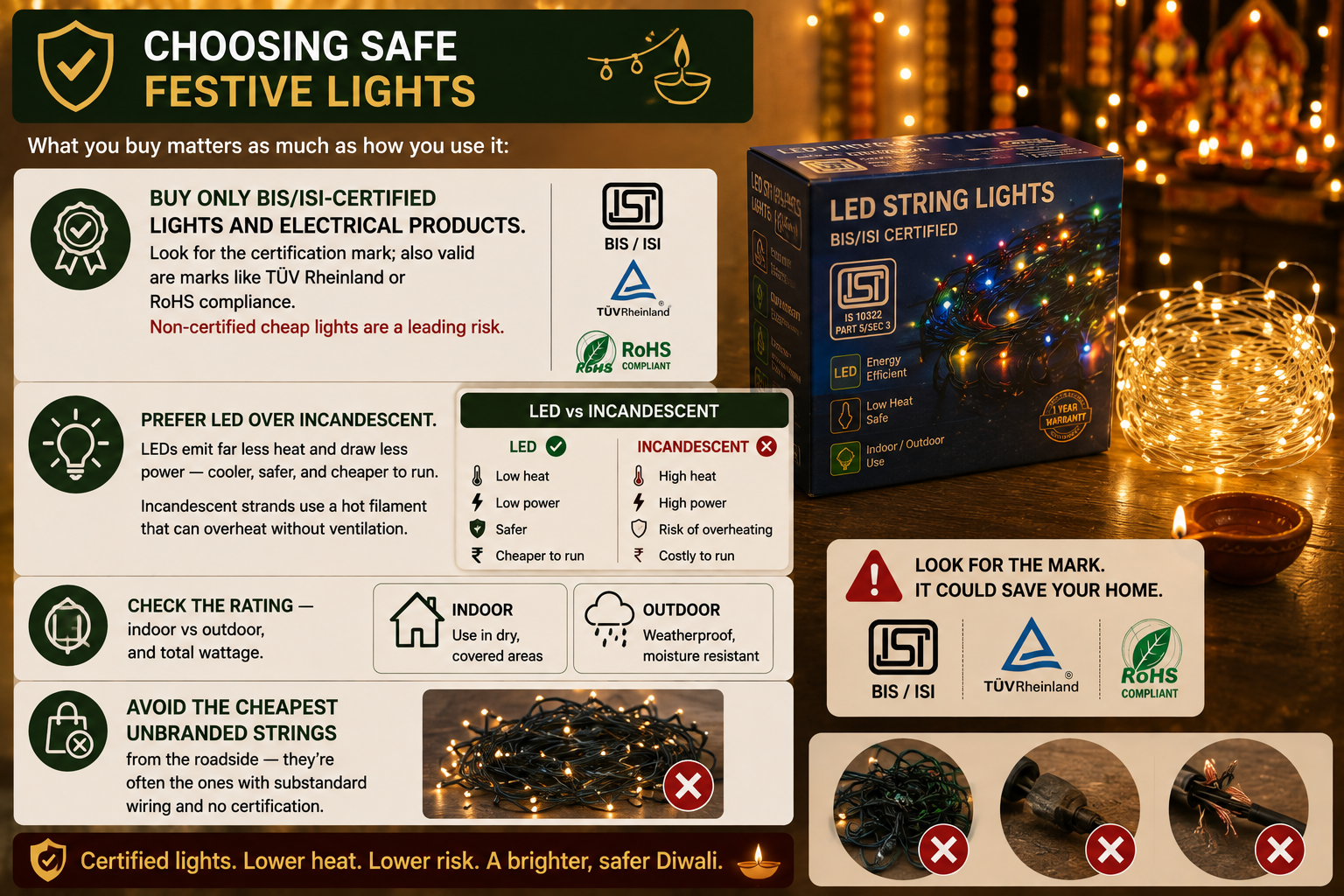
- Buy only BIS/ISI-certified lights and electrical products. Look for the certification mark; also valid are marks like TÜV Rheinland or RoHS compliance. Non-certified cheap lights are a leading risk.
- Prefer LED over incandescent. LEDs emit far less heat and draw less power — cooler, safer, and cheaper to run. Incandescent strands use a hot filament that can overheat without ventilation.
- Check the rating — indoor vs outdoor, and total wattage.
- Avoid the cheapest unbranded strings from the roadside — they're often the ones with substandard wiring and no certification.
6. Fairy Lights & String Lights: Safe Use
The most-used festive lighting, and a common fire source when misused:
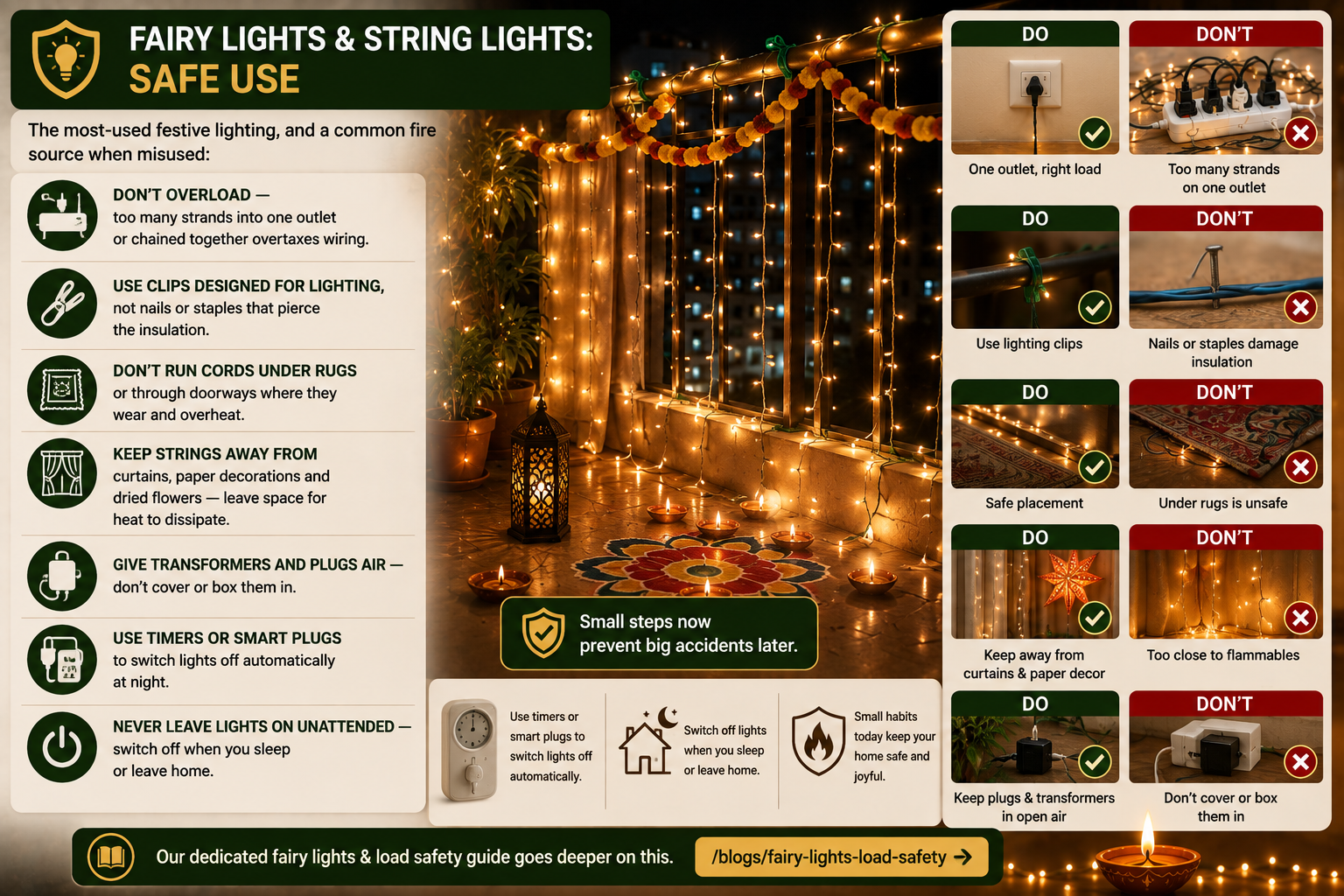
- Don't overload — too many strands into one outlet or chained together overtaxes wiring.
- Use clips designed for lighting, not nails or staples that pierce the insulation.
- Don't run cords under rugs or through doorways where they wear and overheat.
- Keep strings away from curtains, paper decorations and dried flowers — leave space for heat to dissipate.
- Give transformers and plugs air — don't cover or box them in.
- Use timers or smart plugs to switch lights off automatically at night.
- Never leave lights on unattended — switch off when you sleep or leave home.
Our dedicated fairy lights & load safety guide goes deeper on this.
7. Diyas, Candles & Electrical Fittings
The festival's open flames need their own care:
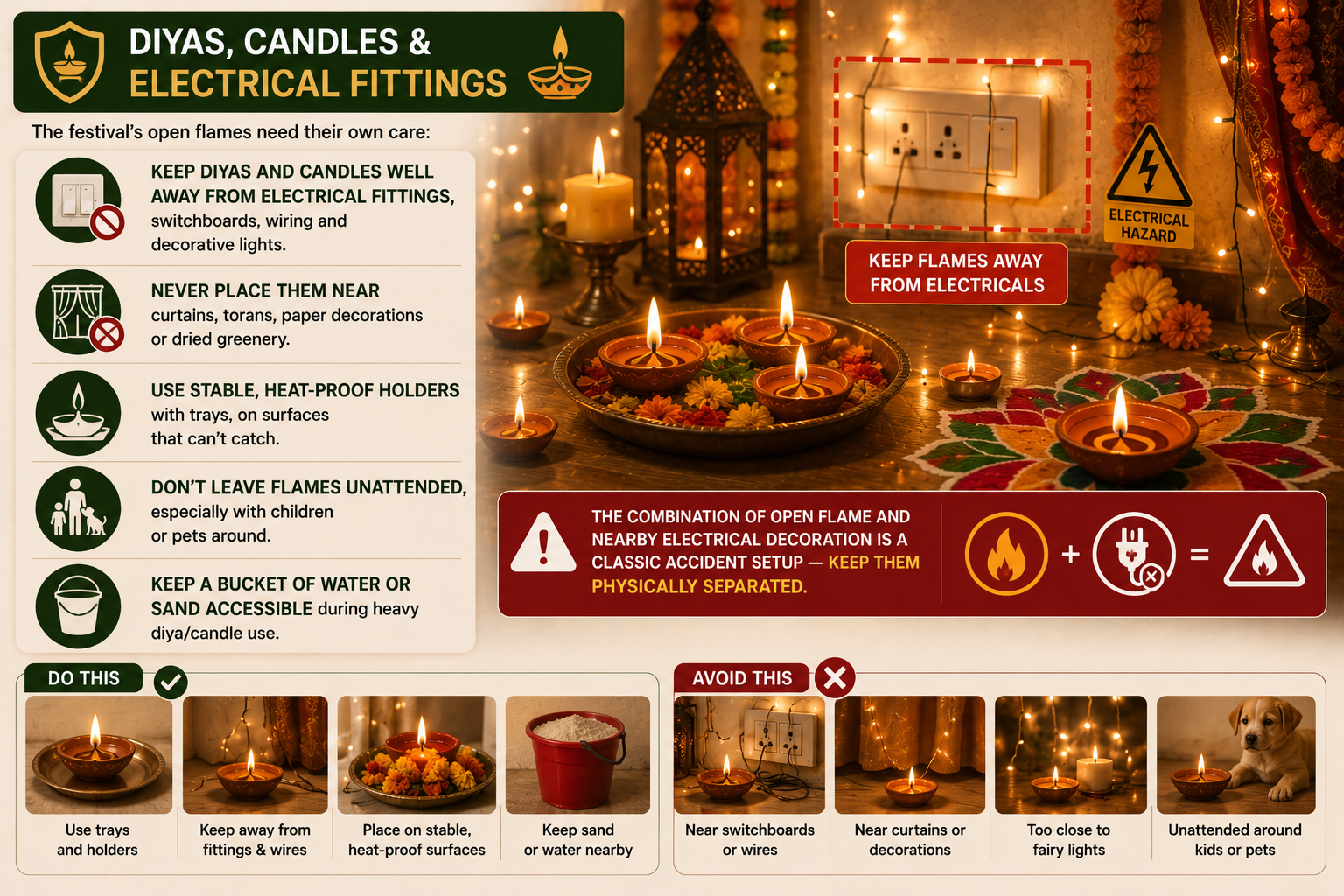
- Keep diyas and candles well away from electrical fittings, switchboards, wiring and decorative lights.
- Never place them near curtains, torans, paper decorations or dried greenery.
- Use stable, heat-proof holders with trays, on surfaces that can't catch.
- Don't leave flames unattended, especially with children or pets around.
- Keep a bucket of water or sand accessible during heavy diya/candle use.
The combination of open flame and nearby electrical decoration is a classic accident setup — keep them physically separated.
8. Outdoor Lighting Safety
Balcony, terrace and entrance lighting face weather:
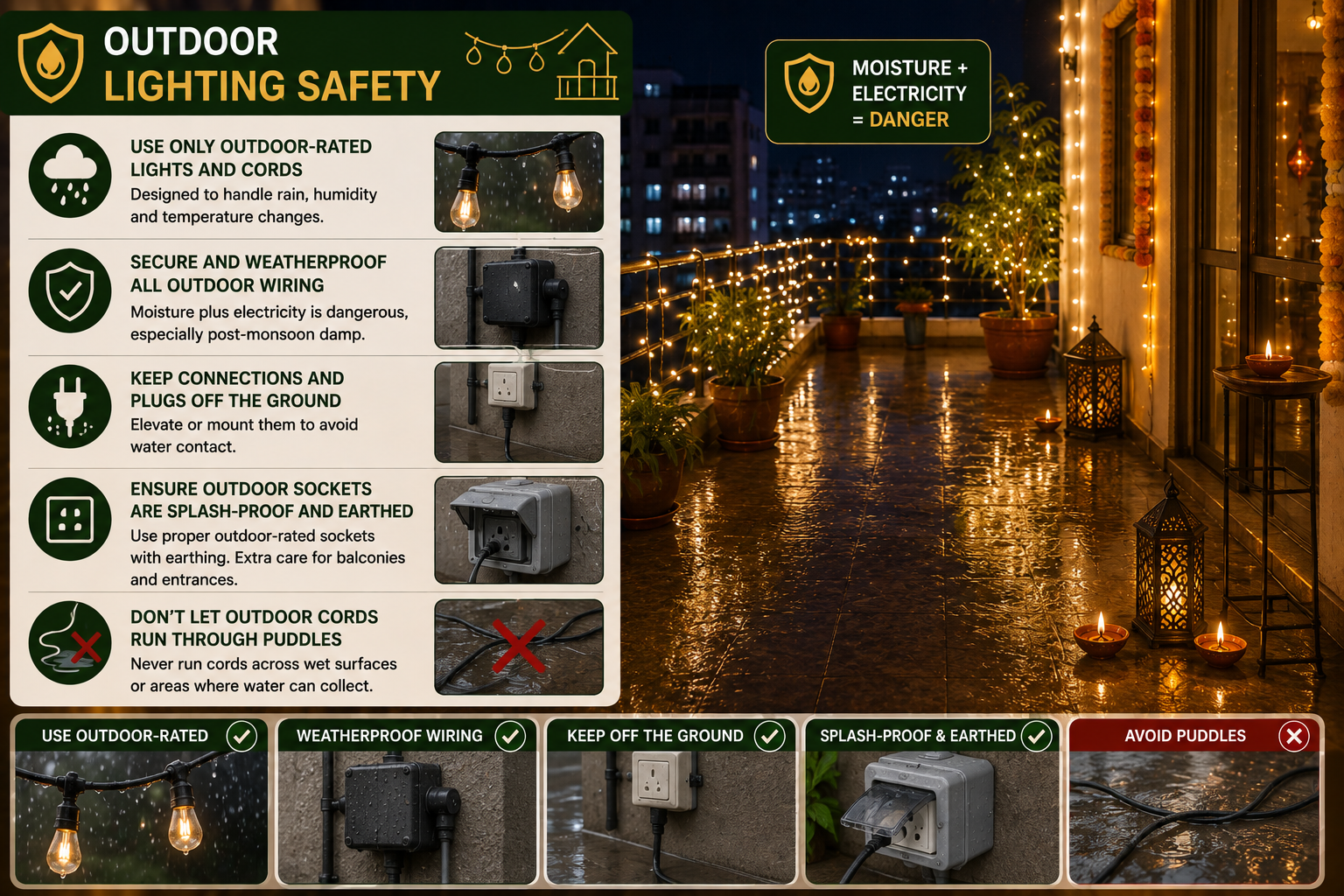
- Use only outdoor-rated lights and cords for outdoor spaces.
- Secure and weatherproof all outdoor wiring — moisture plus electricity is dangerous, especially given lingering post-monsoon damp.
- Keep connections and plugs off the ground and protected from water.
- Ensure outdoor sockets are splash-proof and earthed; balconies and entrances need extra care.
- Don't let outdoor cords run through puddles or across wet surfaces.
9. Your Home's Protection: MCB & RCCB
This is the safety backbone, and the two devices do different jobs — you need both:
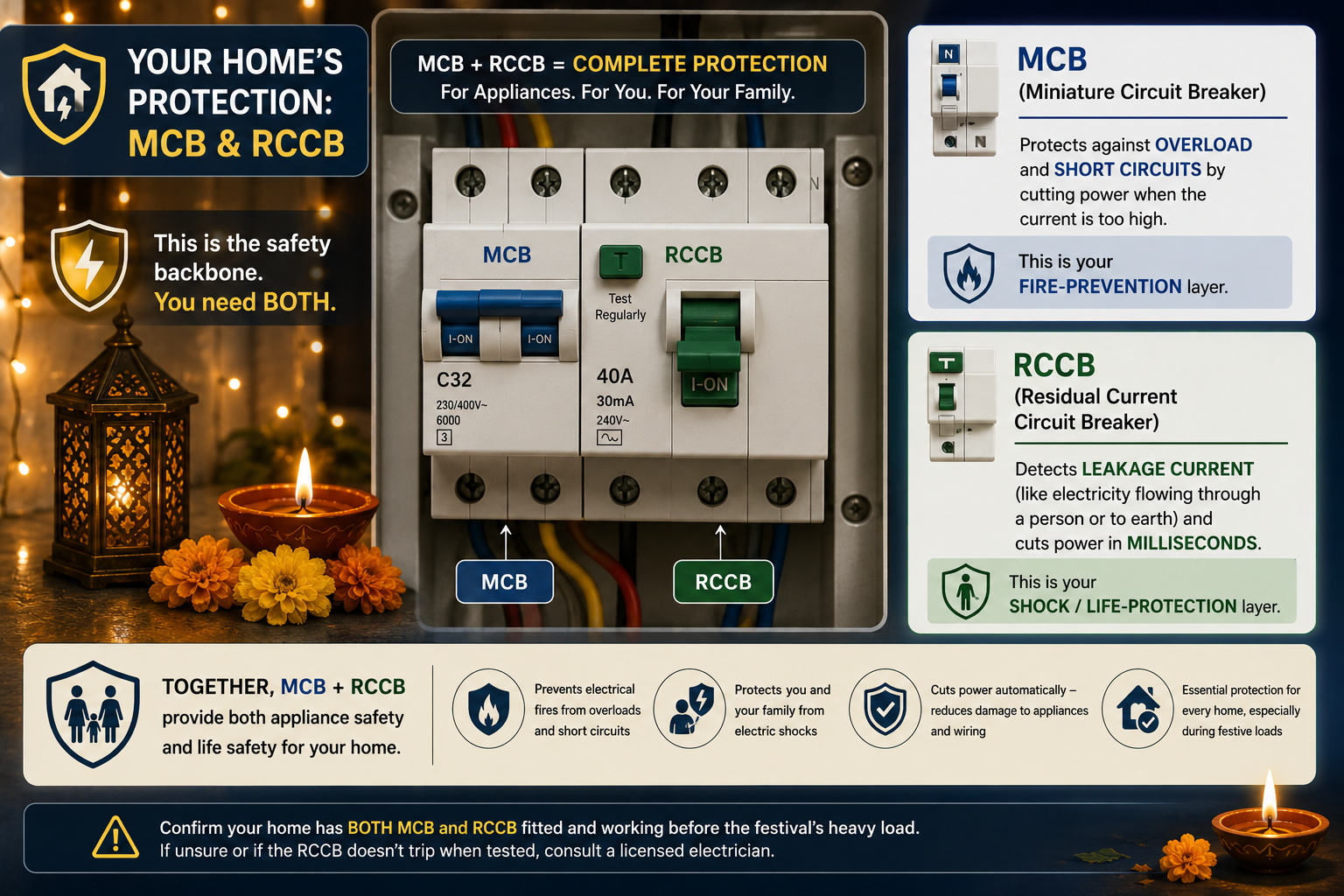
- MCB (Miniature Circuit Breaker) — protects against overload and short circuits by cutting power when the current is too high. This is your fire-prevention layer.
- RCCB (Residual Current Circuit Breaker) — detects leakage current (like electricity flowing through a person or to earth) and cuts power in milliseconds. This is your shock/life-protection layer.
Together, MCB + RCCB provide both appliance safety and life safety. Confirm your home has both fitted and working before the festival's heavy load. If you're unsure whether you have an RCCB or whether it works, ask a licensed electrician — it's one of the most important protections in the home and not something to guess about.
10. The "Jugaad" Wiring Trap
One specific, very common Indian festive hazard deserves calling out: the temporary "jugaad" connection. You need an extra socket for lights, so a quick thin-wire connection gets rigged behind a curtain or taped to a wall. It seems harmless — until the wire overheats, the insulation melts, and a spark becomes a flame.
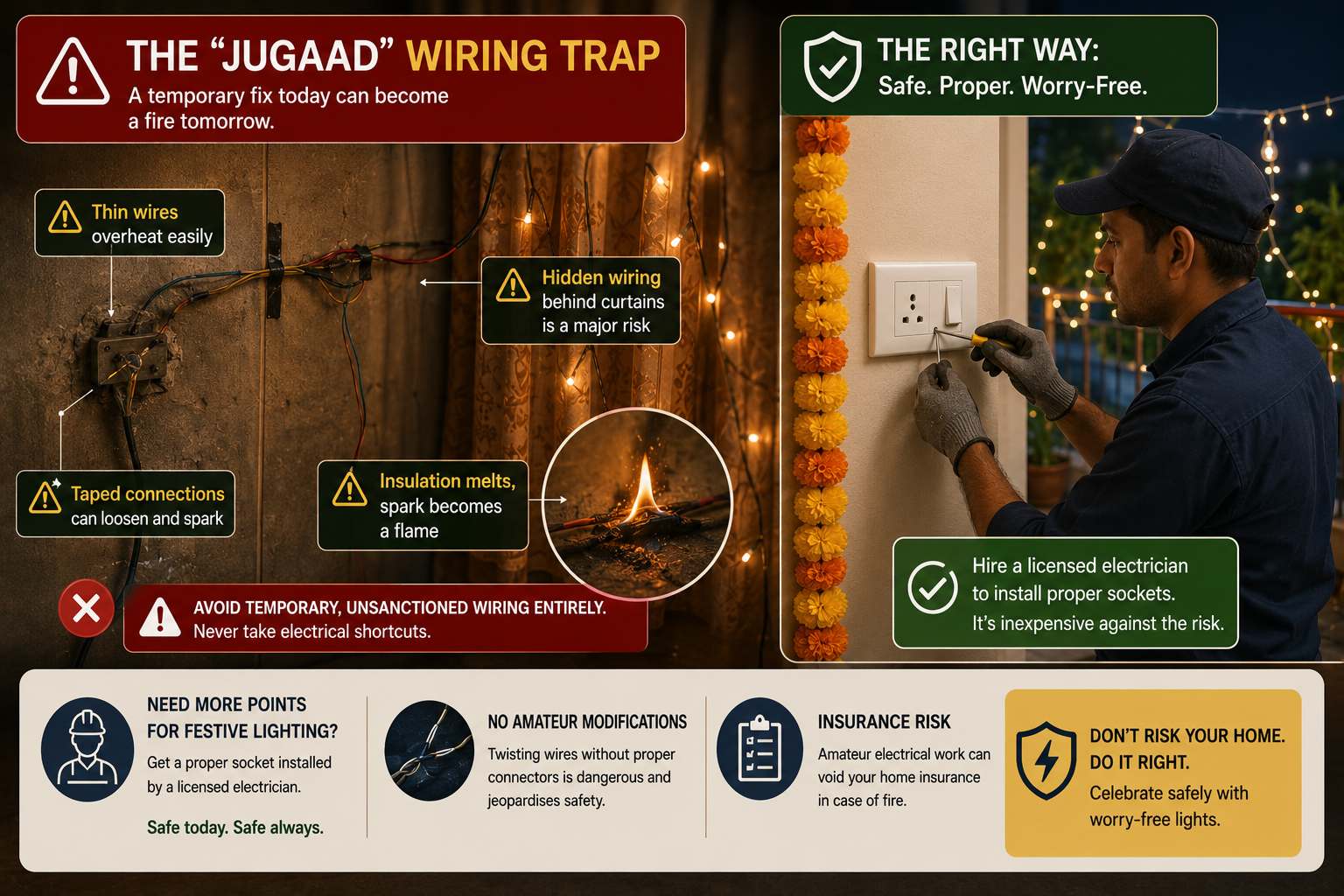
Avoid temporary, unsanctioned wiring entirely. If you genuinely need more points for festive lighting, have a licensed electrician install a proper socket — it's inexpensive against the risk. Amateur modifications like twisting wires without proper connectors also jeopardise safety and can void your home insurance.
11. What You Can DIY vs What Needs an Electrician
Being honest about this line is itself a safety measure.
Safe to do yourself:
- Visual inspection of cords, plugs and lights
- Discarding damaged light sets
- Managing load sensibly (not overloading sockets)
- Using certified lights, timers and quality spike guards
- Keeping flames away from electricals
Always call a licensed electrician for:
- Any wiring repair, new socket, or circuit work
- Scorched sockets, burning smells, or a tripping breaker
- Installing or checking MCB/RCCB
- Inspecting homes older than 10–15 years
- Anything involving opening a switchboard or the mains.
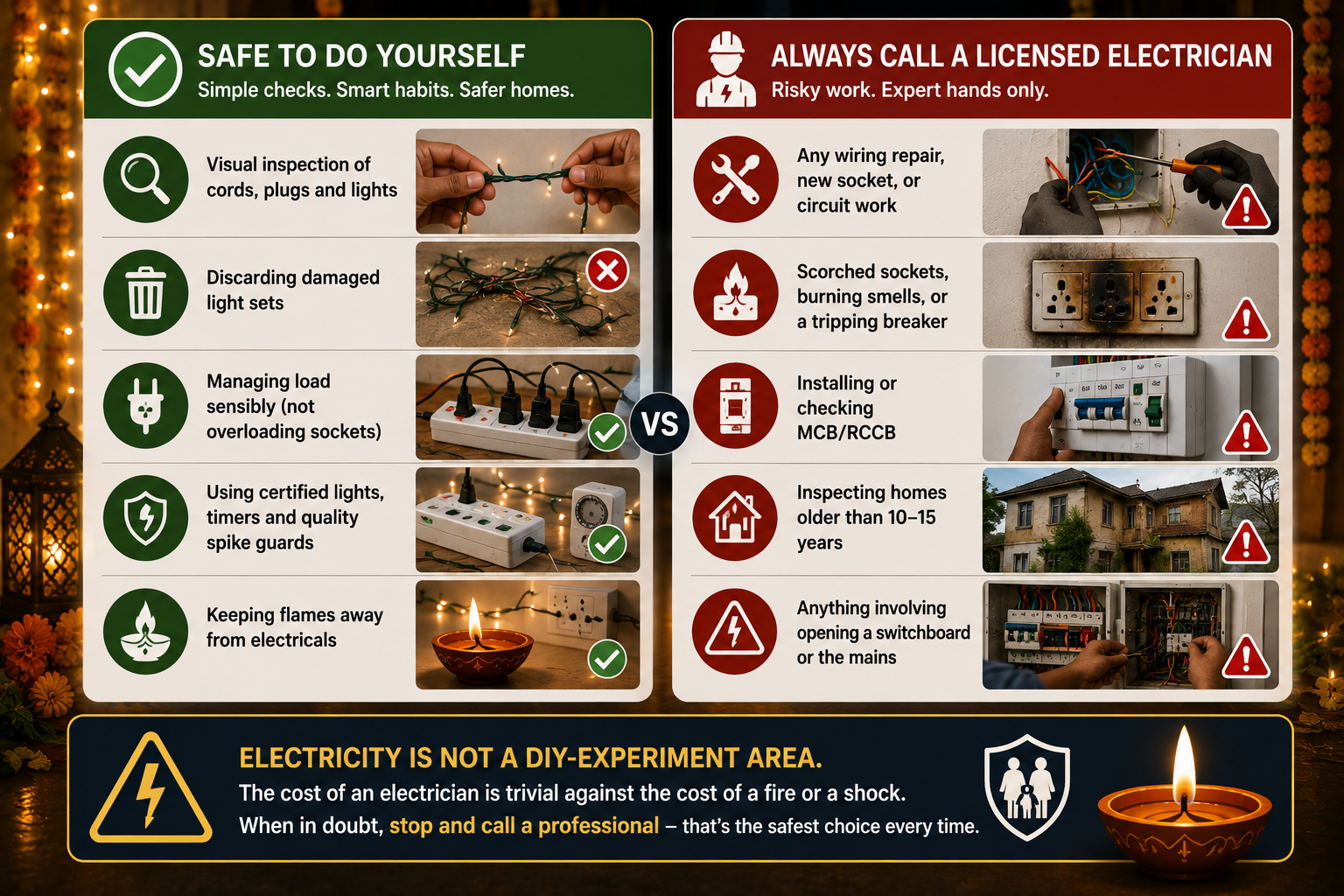
Electricity is not a DIY-experiment area. The cost of an electrician is trivial against the cost of a fire or a shock. When any doubt exists, stop and call a professional — that's the safest choice every time.
12. During the Festival: Safe Habits
- Switch off all decorative lights when sleeping or leaving home.
- Don't overload as you add more decorations through the days.
- Keep checking for warm plugs, flickering, or a burning smell — and stop immediately if you notice any.
- Avoid using appliances with wet hands or in damp festive-cleaned areas.
- Supervise children and pets around lights, diyas and cords.
- Keep water/sand handy near open flames.
13. Getting Help Through HomeTriangle
For anything beyond a visual check — a pre-Diwali wiring inspection, a properly installed socket, or confirming your MCB/RCCB protection — a licensed electrician is the safe choice, and worth booking before the festive rush. HomeTriangle connects you with verified electricians who can inspect your home's wiring, install safe festive points, and confirm your protection is working — cheap insurance against a preventable disaster.
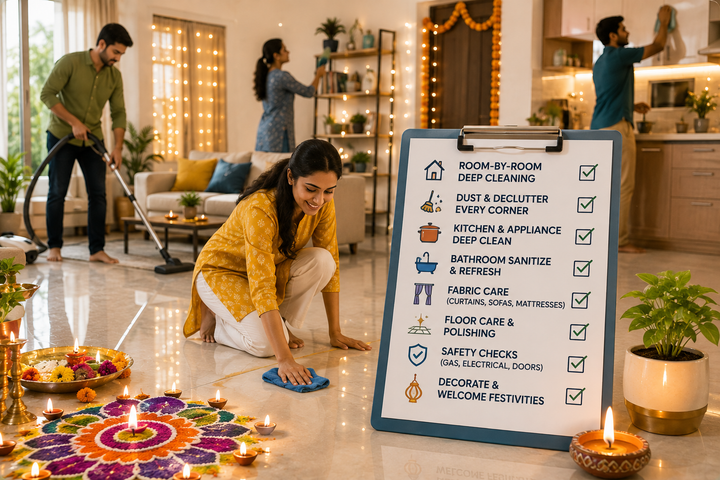
Fold this into your wider festive prep: see the Diwali deep cleaning checklist for the full home-readiness plan, of which a wiring check is one smart step.
Key Takeaways
Myth Vs Fact
| Myth | Fact |
|---|---|
| "Festive fires are rare and unlucky." | They spike measurably at Diwali — and are overwhelmingly preventable. |
| "One socket can handle all my lights." | Overloading one socket/extension is the top festive fire cause. |
| "Cheap unbranded lights are fine." | Non-certified lights are a leading risk; buy only BIS/ISI-certified. |
| "An MCB covers everything." | MCB handles overload/short circuit; you also need an RCCB for shock protection. |
| "A quick jugaad socket is harmless." | Temporary thin wiring overheats and is a common fire cause — install proper points. |
| "LEDs and incandescent are equally safe." | LEDs run far cooler and draw less power — safer for festive use. |
Common Mistakes
- Overloading one socket or extension board with lights and appliances.
- Reusing damaged or degraded old light sets.
- Buying cheap non-certified roadside lights.
- Rigging temporary jugaad wiring for extra sockets.
- Placing diyas/candles near curtains, torans or wiring.
- Leaving decorative lights on overnight or when away.
- Ignoring a burning smell, warm plug or tripping breaker.
- Skipping a wiring inspection in an older home.
Expert Tips
- Book a pre-Diwali wiring inspection if your home is 10–15+ years old.
- Switch to LED festive lights — cooler, cheaper, safer.
- Use quality spike guards with individual switches to spread load.
- Set timers/smart plugs to auto-off lights at night.
- Buy certified (BIS/ISI) lights only, not roadside unbranded.
- Never DIY wiring — a licensed electrician for any socket/circuit work.
- Separate flames and electricals by clear distance.
- Confirm your RCCB works before the festival load.
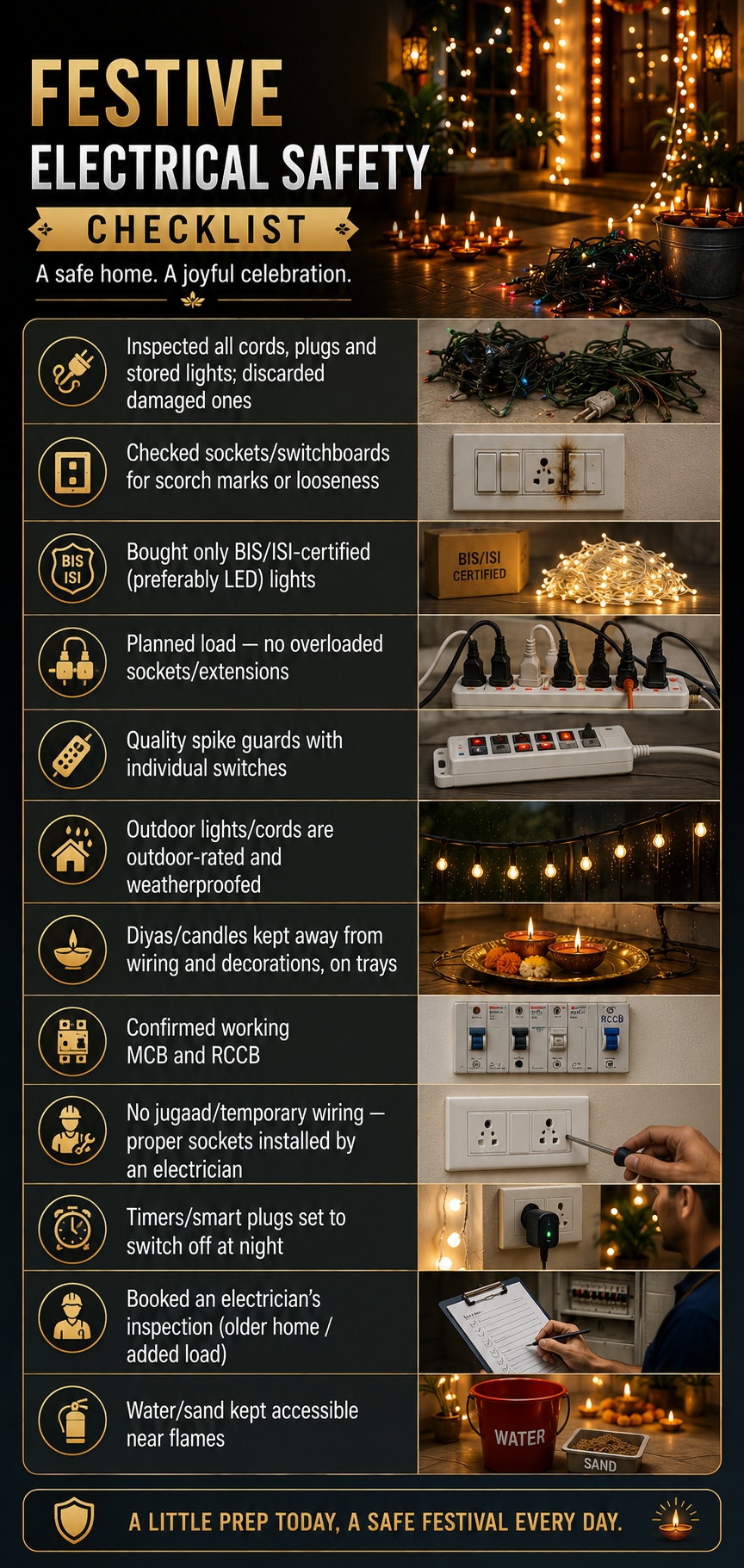
Festive Electrical Safety Checklist

Comments ()